By: S. Holy Dharshni
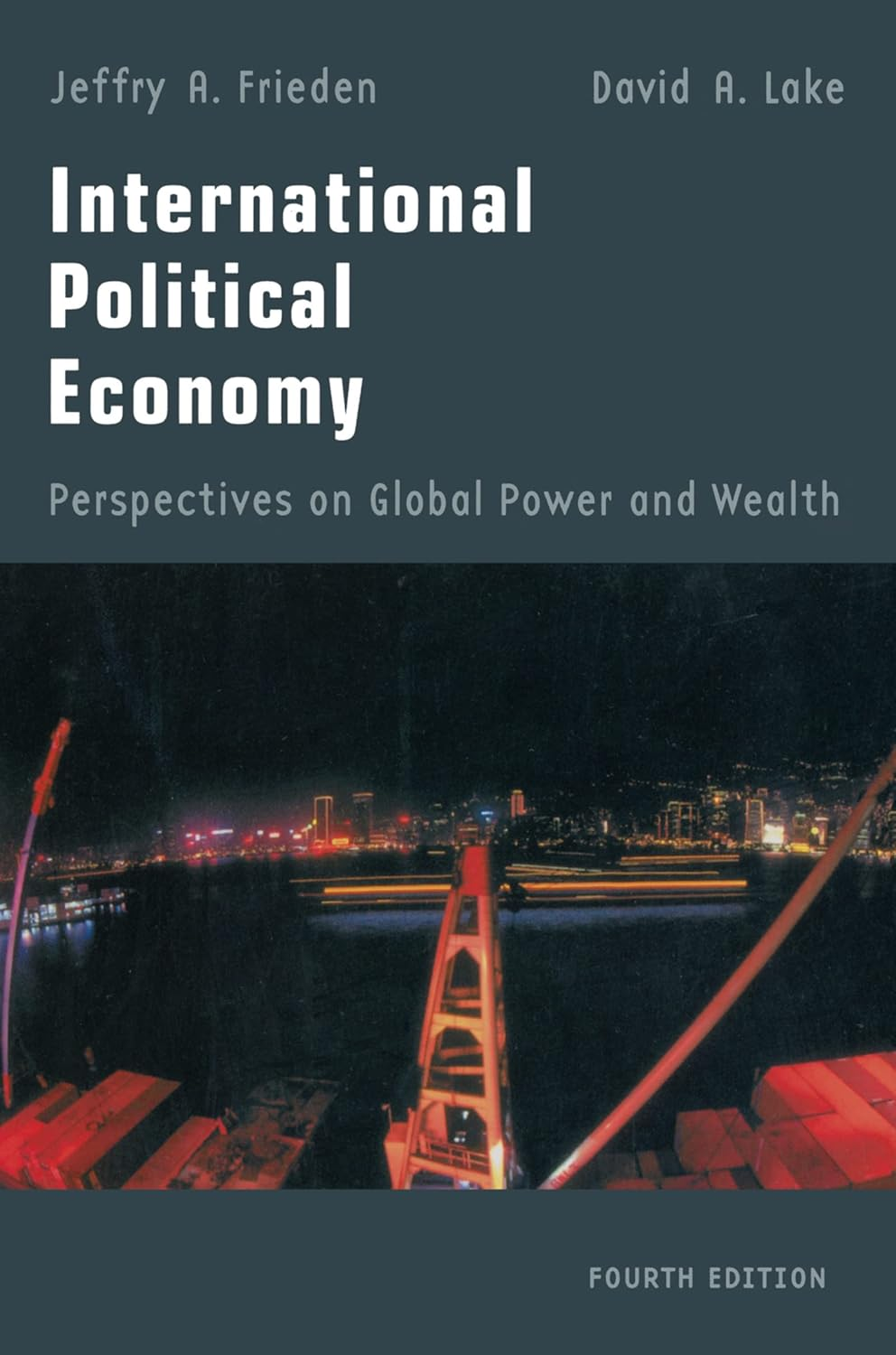
| Title of the book | International Political Economy: Perspectives on global Power, Fourth Edition |
| Name of the author | Jeffry A. Frieden and David A. Lake |
| Name of the publisher | Routledge |
| Year of publication | 29 September 2015 |
International Political Economy: Perspectives on global Power, Fourth Edition, by Jeffry A. Frieden and David A. Lake, is informative and thorough collection that incite the readers interest to study about the IPE with a specified focus on global power dynamics and wealth distribution. This book helps to provide more structured information about political science, international relations and international economics, well proportioned combination of theoretical perspectives, historical analysis and contemporary issues.
The first of the book’s seven parts presents different viewpoints on International Political Economy (IPE), offering alternatives to the established theories of realism, Marxism, and liberalism. The text details how foundational institutions such as the Marshall Plan, Bretton Woods, and the European Union created the modern global economic order. A key theme is the academic debate concerning the main force behind economic shifts and trade policies, with some scholars emphasizing the role of state decisions, others the institutional framework, and still others the interests of powerful socioeconomic groups. The comparison of British and American supremacy illuminates the comparison between economic, political structure and the implications for the rules – based international order.
The author strongly addressing the contemporary issues related to development, engaging in deep conversation on the subject matter such as international development, inequality, inflation and economic stabilization. It showcasing the conceptual view points on the neoclassical and critical schools’ vision. The author concedes the market-based solutions can play a role in promoting sustainable development, they are not sufficient on their own. The consideration for long-lasting progress also depends on topics that markets cannot produce, such as powerful governance, the government’s capacity to implement policies, and leadership. By acknowledging that no single theoretical framework is sufficient to explain the complexities of IPE, the analysis provides a balanced assessment. The book is mainly to appreciate how issues are being shaped by their specific context by the evolving relationship between national and international influences, and the interactions of theoretical and practical concepts.
The four important dimensional framework (international/ domestic and society/ state) defines by differentiating the elucidation of economic events such as trade liberalization, where it comprises free trade and markets are supported by government, Marxism portraits class conflicts and inequality through core – periphery ill treatment and finally Realism engages on state sovereignty, power dynamics and hegemonic stability in framing the economic openness. The book’s interdisciplinary approach and critical engagement with contemporary issues make it an indispensable resource for understanding the interplay of politics and economics on the world stage.
The book creates links for these theoretical schools to real-world problems, including the post-WWII U.S.-led liberal order, the evolution of international institutions, the sub linked decline of American dominance, and the emergence of a multipolar leadership shared by the U.S., Europe, and Japan autonomy. In conclusion, this book stands out as a comprehensive, authoritative that understand and critically engage with the multifaceted realities of international political economy, explaining clear frameworks and historical insight while emphasizing the ongoing debates and evolving nature of this field.
###
S. Holy Dharshni is a passionate reader, student and emerging writer who enjoys exploring literature through thoughtful reviews. With a keen interest in political and cultural perspectives, she writes to inspire and connect with fellow readers. Her work reflects curiosity, clarity, and a love for learning across diverse genres.


No responses yet