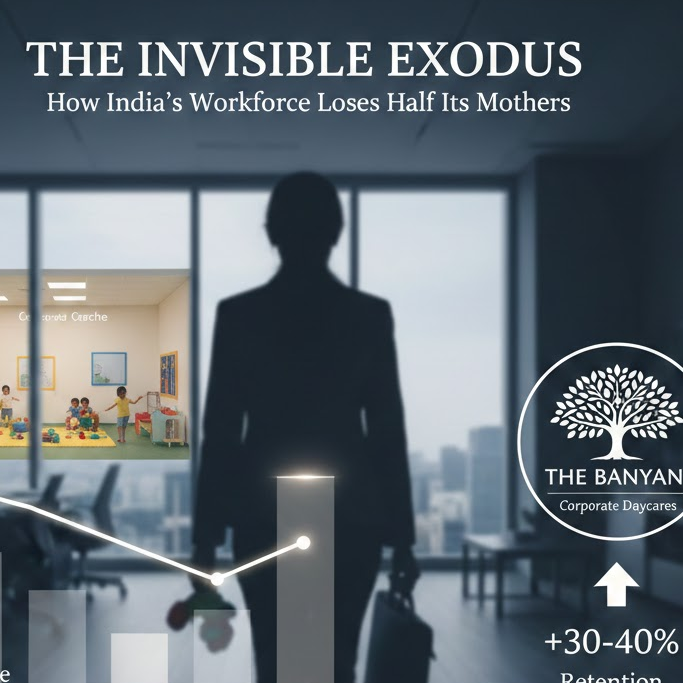
For the modern Indian professional woman, the climb up the corporate ladder often ends not at a glass ceiling, but at a nursery door.
New data reveals a staggering leak in India’s talent pipeline: 48% of women employees drop out of the workforce within just four months of returning from maternity leave. This “Invisible Exodus” represents more than a social shift; it is an economic drain on a nation striving to become a global powerhouse. With over 89 million urban women remaining outside the labor market in the 2023-24 period, India is grappling with the systemic failure to reintegrate its most valuable asset: experienced female talent.
The Motherhood Penalty
The transition from maternity leave back to the office is increasingly described by professionals as a “war zone.” The challenges are three-fold:
- Inflexible Structures: Rigid “clock-in” cultures and grueling commutes in Tier-1 cities often make childcare logistically impossible.
- The Benefits Gap: While the law is robust, its reach is narrow. Only 6.5% of working women are eligible for formal maternity benefits, leaving the 94% in the informal sector entirely unprotected.
- Professional Stagnation: Returning mothers frequently face the “motherhood penalty”—a combination of wage stagnation, passed-over promotions, and the subtle bias that a mother’s ambition has been permanently dampened by her new role.
The Compliance Mandate
The legal framework to address this has existed since the Maternity Benefit Act of 1961, which mandates that any organization with 50 or more employees must provide a creche facility. However, for many firms, this has remained a “check-the-box” compliance exercise rather than a strategic priority.
Forward-thinking giants like Infosys and TCS have pioneered on-site childcare, treating it not as a regulatory burden but as a talent magnet. The results are quantifiable: companies with on-site creches report 30% to 40% higher retention rates among female staff. Proximity to their children reduces maternal stress and boosts focus, directly impacting the bottom line.
A Strategic Investment
As the demand for specialized childcare grows, a new sector of corporate partners is rising to bridge the gap between policy and practice.
It is important for organizations to simultaneously invest in creches that can help working mothers continue their work. While we have seen many start-ups emerge on the scene with solutions like that. For example, the Banyan, an Indian childcare provider launched in 2003, has spent two decades positioning childcare as a critical infrastructure for the modern economy. With 22 years of experience and a footprint across Delhi NCR, Maharashtra, and Karnataka, the firm facilitates childcare for sectors ranging from Aviation to Power.
“Corporate daycares aren’t a perk; they’re a strategic investment,” says Swati Jain, Director of The Banyan. “Maternity shouldn’t be a career pause, but a chapter in a thriving journey.”
The Banyan’s model caters to children from six months to 12 years old, aiming to ensure that the “return to work” isn’t a countdown to a resignation. With plans to expand to 200+ centers and partnerships over the next five years, the firm is betting on a future where childcare is as standard as a corporate health plan.
The Economic Bottom Line
The stakes for India’s GDP are high. Economists argue that for India to reach its growth targets, it must address the domestic hurdles that keep women at home. When nearly half of returning mothers quit within 120 days, the cost to companies in recruitment and retraining is immense.
For India’s C-suite, the message is becoming clear: The secret to retaining the next generation of leadership may not be found in the boardroom, but in the quality of the company creche.


No responses yet