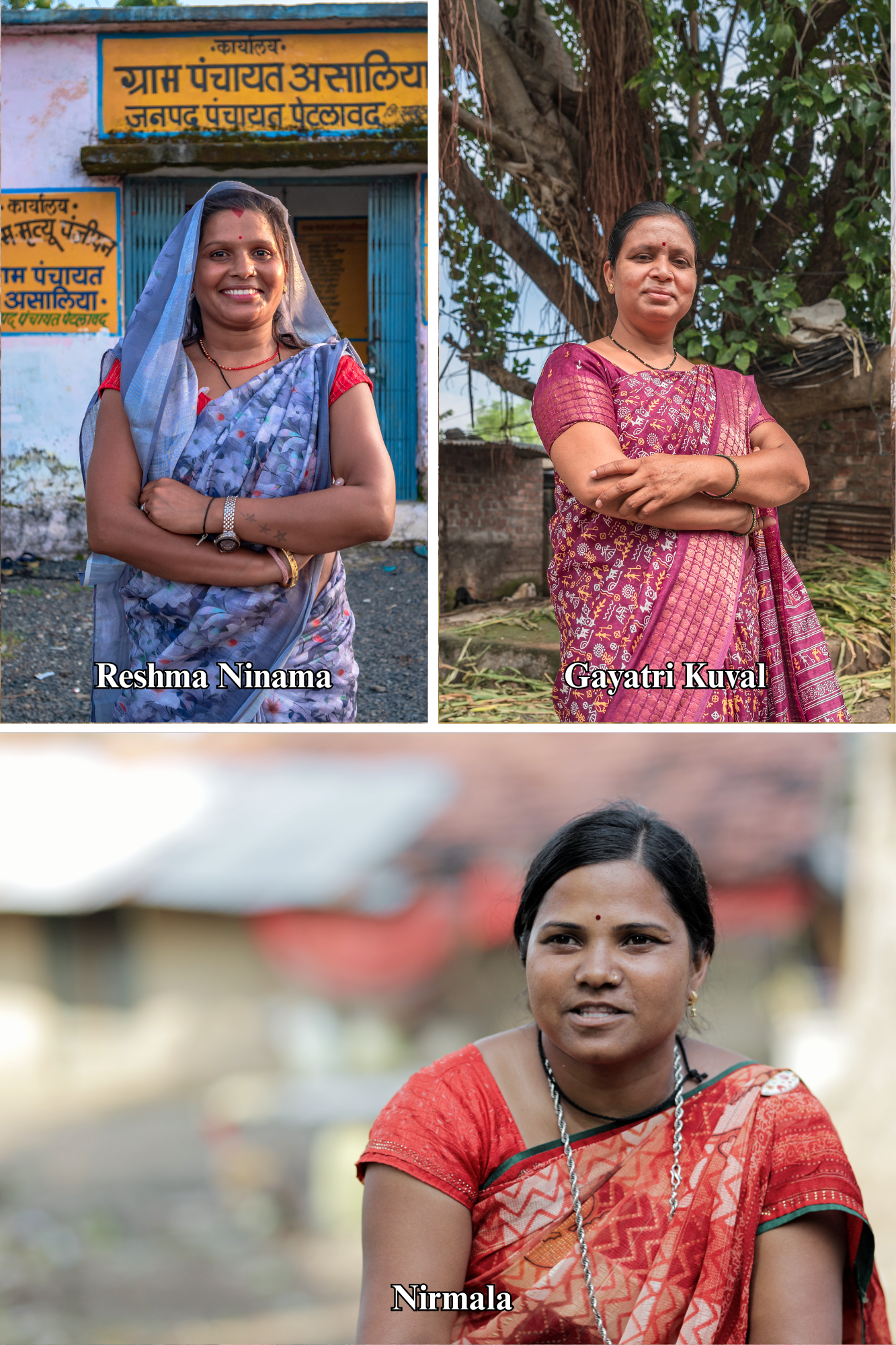
As 16 Days of Activism (Nov 25th – Dec 10th) Against Gender-Based-Violence conclude, the stories of three survivors of acute discrimination and inequality spark the hope that far-reaching change is possible. The individual trajectories of Gayatri Kuval, Nirmala, and Reshma Ninama show that gender training, leadership opportunities, and mentorship can not only turn survivors into powerful advocates for women’s rights and equality — but also uplift entire communities.
Gayatri Kuval
The cycle of abuse often perpetuates itself unless broken. Gayatri Kuval from Sirsi village in Jhabua, Madhya Pradesh grew up watching the excesses of her alcoholic father. Born into an impoverished Scheduled Caste family, she too was married off after Class 8 into another abusive household where her alcoholic husband and her in-laws mistreated her. After years of abuse, she joined a Self-Help Group in 2020 and through the SHG, was introduced to Transform Rural India’s (TRI) Nari Adhikar Kendra. TRI is a development design organisation, working on transforming India’s bottom 1,00,000 villages into flourishing localities. Their focus is also on grassroots attitudinal change and Gayatri exemplifies the success of this approach. Her very first gender training made her question the violence she had endured and realising that change begins at home, she began to teach her son and daughter to share responsibilities. She even insisted that her husband share the workload at home. Eventually, things changed for the better at home but her conservative community began to target her for ” ruining cultural values”. Undeterred, she completed Class 12 in 2023, and is now in the final year of her Bachelor of Social Work degree. In 2023, she joined the Nari Adhikar Kendra as a Community Resource Person and later as a Coordinator with TRI, trained nearly 3,000 women across villages to recognise and report abuse. Together with her husband, she also launched awareness campaigns against dowry and domestic violence. She has helped form a Social Welfare Committee which works with 800 families from six villages, and is focused on education for every child. She herself can now drive a scooter, use a laptop, read and write in Hindi and English and is no longer a passive victim, but a triumphant survivor.
Nirmala
In Madhya Pradesh’s Bardiya village, the reassuringly calm voice of Nirmala has changed the narrative around women’s rights. However, the work she does as a member of the Jai Ambe Self-Help Group and the Coordinator of the Lok Adhikar Kendra (a centre under the aegis of National Rural Livelihood Mission), to help women is rooted in her own story of resilience and courage. Nirmala was married off as a teenager in 2009 to an alcoholic abuser who subjected her to relentless domestic violence even after she became a mother of two daughters and a son. In 2018, her husband abandoned her to marry again. Nirmala worked as a maid and also as a support staff at the government hospital to support her family. An encounter with a Self-Help Group network in 2020, led her to connect with the local TRI team. A gender training session followed and the journey of self-belief and empowerment began. With TRI’s support, she became the Gender Point Person in her SHG, and at Nari Adhikar Kendra, trained to respond to gender-based violence, to counsel distressed women, and help them to access government schemes and entitlements. At the Ajeevika Mission, she accessed financial literacy, and leadership opportunities. A loan through her SHG, helped her complete her education and she became a bookkeeper in her Cluster Level Federation. Another SHG loan helped her to build her own home and today her children are getting the education that she did not have access to as a young girl. In 2021, she joined the Lok Adhikar Kendra as a Gender Community Resource Person. Educating SHG and Village Organisation members with sensitising gender modules led to a bigger leadership role as the coordinator for the entire Petlawad block. As the key figure of TRI’s gender work in Jhabua, Nirmala Didi, as she is known today, supports domestic violence survivors, prevents child marriages and campaigns against alcohol abuse and dowry. She continues to actively contribute to a future where women and girls can succeed and thrive with dignity and without fear.
Reshma Ninama
In the tribal village of Asaliya in Madhya Pradesh’s Jhabua district, Reshma Ninama has sparked a movement reclaiming health, dignity, and women’s rights. Reshma didi, as she is now known, has displayed exemplary grit, leadership and grace in her journey from being a Health Change Vector to her village’s Sarpanch. In 2021 she participated in TRI’s visioning exercises, where a blueprint for Asaliya’s development was envisioned. This was the beginning of her transformative journey. She subsequently became a Health Change Vector and as a trained volunteer, began working to improve health and hygiene, especially for women and children. She undertook a door-to-door campaign to enlighten mothers about nutrition, balanced diet, sanitation, hygiene practices and timely vaccinations. She even accompanied women to health centres and connected malnourished children to Nutrition Rehabilitation Centres so that they could gain healthy weight. Soon, she became a trusted confidante and counsellor for women and empowered by her association with TRI, began engaging with gender issues like domestic violence, dowry, child marriage, and systemic discrimination. To create far-reaching change, she contested and won the Panchayat elections in 2022. Her victory not only inspired other women, but also exemplified the power of intentionality and purpose in a culture where women had always been denied leadership roles. She also worked hard to leverage the power that she now had to open a Sub-Health Centre in Asaliya to ensure accessible healthcare services for underserved villagers. She also helped formulate a Gram Panchayat Development Plan, a Village Poverty Reduction Plan and declared Asaliya a Gender-Sensitive Panchayat in an unprecedented move. Today, thanks to her efforts and her synergy with Self-Help Group networks and the support from the youth, her village is free of dowry system. She has also stopped child marriages, imposed an alcohol ban and ended the customary use of DJs during weddings to prevent noise-pollution. By ensuring that women’s rights are not sidelined in policymaking and governance, she has made Asaliya a Model Gram Panchayat where gender equality is not just an idea on paper but a reality. Her success proves that women get a seat at the decision-making table, they can change not just the lives of other women but also transform communities.


No responses yet