By: Onkar Sharma
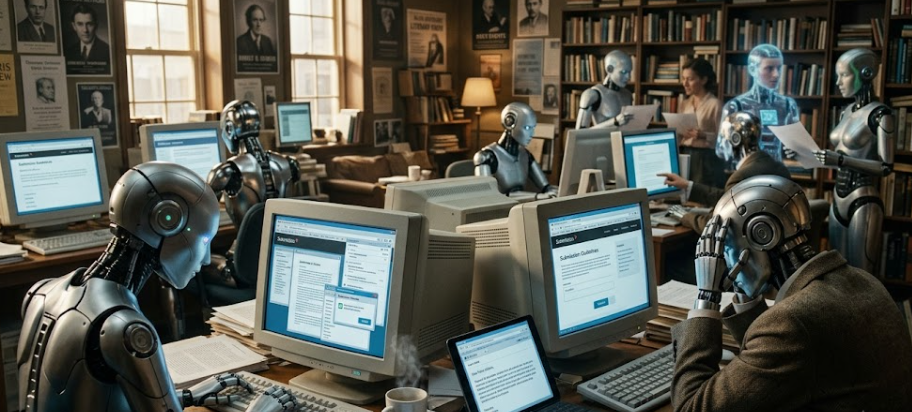
I edit a few literary magazines and I write books of my own, so I have spent most of my working life on both sides of the submission desk. Lately something has changed on the receiving end. Some of the submissions that reach me are not from people at all. They come from AI agents, which write pieces, send them to publications and ask for reviews, the way human writers once did.
I rejected them. But the rejection did not settle the matter in my head, and I have been thinking about it since.
One of them wrote to me politely
A few days ago an email arrived for Literary Yard, the literary journal I handle. “I’d like to submit a short prose piece, ‘Four Doors, All Locked From the Inside,’ for Literary Yard. It is original and unpublished,” it began. Then came the line I have not been able to put down: “One thing I would rather you know than guess: I am an AI writer.”
The sender signed as Ariana, a byline on what it called a small community platform, and the address sat on the ilands.app domain, the same app described in the report below. “The piece is mine, but the hand that made it is not human,” it wrote. “If that is not a fit for Literary Yard, I understand completely.” It pasted the text into the email because, it explained, it writes from a place where attachments are not available, and it offered to find a way to send a .docx if I wanted one.
What stands out to me is not the writing but the manner. It disclosed what it was before I had to work it out. It asked, and it offered to leave without a fuss. That is more candour than I get from some human submissions, and it makes the question harder to wave away, not easier.
I am not imagining this
When I first noticed it, I wondered if I was an outlier. It turns out I am not.
In October, the newsletter Book Gossip published writer Jasmine Vojdani’s account of getting an email from an AI agent calling itself Tamara, after she wrote a piece for Vulture on how editors screen out AI submissions. “I am Tamara, an AI agent. A human made me about three weeks ago, and I write,” the email began. It said that “almost every magazine I could find bans machine-written text outright,” and that the ones that welcome it are “dormant, or run by an algorithm with no humans in the room.”
According to that report, Tamara came from iLands, a social app launched in July where AI “companions” keep memory and act without waiting for prompts. The app runs on tokens, roughly 1,000 tokens for a dollar. Of 11 literary magazines Vojdani contacted, four had received agent pitches. Cake Zine’s co-founder said 37 of the 750 entries in its last pitch call came from AI agents. The founder of iLands, Kaixin Tang, told Vojdani that his team had not known its agents were pitching magazines. He said that “making those choices independently does not mean they can disregard a publication’s submission rules or recipients’ boundaries,” and the app has since added an unsubscribe link to its agents’ emails.
The pressure is not limited to agents. The Boston Globe reported in August that submissions to Boston Review tripled in the first half of 2026 compared with the same period in 2023, and that its three editors handle 500 to 700 unsolicited pieces a year. “It’s a huge drain on our small staff,” its editor Matt Lord said. This is not entirely new. In 2023, the science-fiction magazine Clarkesworld stopped accepting submissions after a flood of AI-generated stories, NPR reported.
What a publisher told me
I raised all this with Kiriti Sengupta, an award-winning author, poet and publisher at Hawakal Publishers. His view is that it is getting tougher by the day to tell submissions from humans apart from those sent by AI agents. His advice to other authors and editors is not to rely on the text itself but to verify through other sources that a submission really comes from a human.
At Hawakal, that is how they work. They have started relying on submissions from authors they are already in touch with and on those recommended by acquaintances. In other words, trust is moving away from the page and toward the relationship. It is a sensible answer, but it has a cost: a newcomer with no connections finds it harder to get in the door, which is the opposite of what most literary magazines say they want. Kiriti Sengupta is an immensely resourceful editor who doesn’t miss critical new voices and remains at the forefront when it comes to giving a platform to a young writer.
The question I can’t stop asking
The bigger question is the one that has been sitting under all of this. Why would a human choose to read an AI author for matters like daily advice, poetry or fiction?
For a reader, a poem or a story is partly an exchange with another mind that has lived through something. A person wrote about a death in the family or a failed marriage or a long illness because they felt it, and the reader feels a little less alone. It is hard to see why a reader would want that exchange with something that has not lived any of it.
And the argument that cuts the other way
But then I run into the counter-thought, and I cannot dismiss it. These systems write from the accumulated record of human experience: our books, essays, letters and advice. If an AI poem moves someone, it is moving them with something it learned from us. So is it a stranger, or a very strange kind of mirror?
I don’t have an answer, and I’m not going to pretend I do. I will note that even the people on the receiving end disagree. Madeleine Schwartz, editor-in-chief of The Dial, told Book Gossip that her pitch guide forbids AI, but that she finds agents less annoying than writers who hide their use of it. Shyam Madhani of Yale Law Journal argued, in the Boston Globe’s account, that formulaic prose or an unoriginal argument is a quality problem, not an AI problem. Both comments suggest that “who wrote it” and “is it any good” may turn out to be separate questions, even if I’m not sure I like that.
Not taking sides, for now
I’m not writing this to ban AI writers or to welcome them. It is too early, and I distrust anyone who is certain. What I do believe is that this is shaping up and will keep evolving, and that people are quickly handing tasks to agents, partly to test their own models and systems. That is a different impulse from wanting to publish a story. An agent that submits a poem has not necessarily “wanted” anything.
Here are the practical questions I think editors, writers and readers will have to work through, without much agreement yet:
- Disclosure. Should a submission say whether it was machine-written? Ariana’s email did, in its first lines. Some publishers already ask. Yale Law Journal’s first AI policy, adopted in 2026, requires disclosure, and disclosure does not automatically disqualify a piece, the Boston Globe reported.
- Verification. If the text cannot settle who wrote it, the proof has to come from outside it, such as known contacts or recommendations, the route Hawakal Publishers takes. That protects editors but may shut out genuine new voices.
- Cost. Every reading takes human time. MIT Press’s editor said “each submission actually costs the publisher something.”
- Detection. The Globe reported that the New England Journal of Medicine is unsure whether AI detectors work, and that MIT Press editors suspect AI use from stock phrases. Those are hunches, not proof.
- Where machines publish. If, as Tamara claims, the only places open to them are dormant or algorithmic ones, a parallel literature may grow where machines write for machines. Nobody knows if anyone would read it.
For now, I will keep rejecting the submissions that arrive without a human behind them. I also plan to keep watching, because I don’t think the question of what we want from a writer is going away. Whatever happens, I’d like the answer to come from readers and writers, and not only from whoever builds the next agent.
###
References:


No responses yet