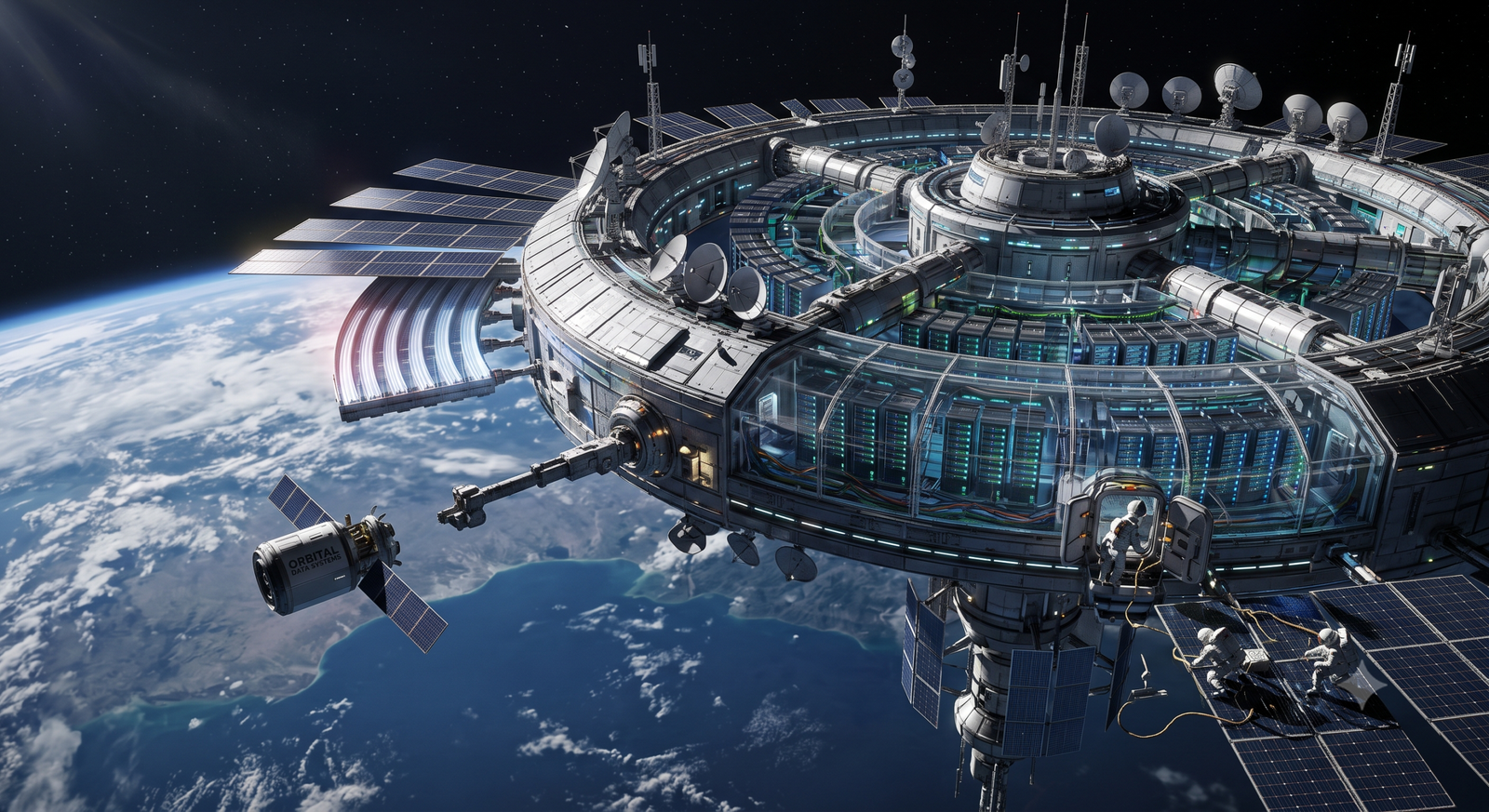
On October 1, Google will launch an experimental satellite called MVP from Vandenberg Space Force Base aboard a SpaceX Falcon 9 rocket, according to a report in The New York Times. It’s roughly the size of a refrigerator, built with satellite maker Planet Labs, and carries four of Google’s Tensor Processing Units — together matching the computing power of a single data-center server. It will spend a year in orbit answering simple queries using Google’s Gemini model. It is the first real hardware from Project Suncatcher, Google’s “moonshot” effort to eventually build solar-powered AI data centers in space.
This isn’t science fiction anymore, but it’s also nowhere near the industry Google’s marketing might suggest. Here’s what the plan actually involves, who else is racing to do the same thing, and what it would really cost — financially and environmentally.
What Project Suncatcher actually is
Google’s vision, first outlined in a research preprint in November 2025, isn’t a single satellite doing the job of a data center — it’s a tightly coordinated constellation. The plan envisions fleets of more than 80 satellites flying in close formation, just hundreds of meters apart, communicating with each other over high-bandwidth optical links (Google has already demonstrated 1.6 terabits per second between two transceivers in lab tests) so the whole cluster functions as one data center. They would fly in a “dawn-dusk” sun-synchronous orbit, keeping them in near-continuous sunlight, where Google says solar panels can generate up to eight times more power than identical panels on Earth.
Travis Beals, Google’s senior director of product management for Project Suncatcher, has said the chips currently need to shut down every 15 minutes to cool — a reminder of how early-stage this genuinely is. Google’s own radiation testing has been encouraging: the company says its Trillium-generation TPUs survived a particle-accelerator test simulating five years of low-Earth-orbit radiation exposure without damage. Google plans to launch two more satellites next year, well ahead of its original early-2027 timeline.
Why companies want this at all
The driving force is blunt: AI data centers are running into real limits on Earth — available land, grid capacity and water for cooling chief among them. Some estimates cited in coverage of the project suggest the wave of hyperscale data centers now planned across the US could demand an extra 81 gigawatts of power by 2030 — roughly equal to all of Texas’s current electricity use. In orbit, proponents argue, none of that applies: no land-use conflicts, no groundwater for cooling, and near-constant, far more efficient solar power.
Google isn’t remotely alone in this race
This is where the story gets bigger than one company’s satellite. A genuine industry has formed around orbital compute in the past year:
- Starcloud (formerly Lumen Orbit), backed by Nvidia, is arguably ahead of Google in practice — it launched Starcloud-1 with an Nvidia H100 chip in November 2025, becoming the first company to train a large language model in orbit, and has since run Google’s own Gemma model in space. The company has raised $170 million at a $1.1 billion valuation and has filed with US regulators for an 88,000-satellite constellation.
- SpaceX has filed for licenses covering up to one million satellites for orbital data center infrastructure — a scale Ars Technica estimated would cost “at least $1 trillion” just to deploy.
- Blue Origin, Jeff Bezos’s space company, filed its own application in March 2026 for a 51,600-satellite orbital data center network called Project Sunrise.
- Amazon Web Services is flying a production server blade on Starcloud’s upcoming Starcloud-2 mission to test its own chip designs in orbital conditions.
- Smaller and more specialized players are also in the race: Lonestar Data Holdings is working toward the first commercial data center on the Moon’s surface; Aetherflux, founded by former Robinhood CEO Baiju Bhatt, is targeting an orbital data center satellite launch in early 2027; and companies including Axiom Space, Kepler Communications, Sophia Space, NTT and Ramon.Space are all developing related orbital computing technology.
In short: this is no longer a single company’s experiment. It’s a full-blown infrastructure race involving some of the best-funded companies and individuals in technology.
The environmental picture is genuinely mixed — not the clean story it’s sold as
The pitch — solar power instead of grid electricity, no water for cooling, no land-use fights — sounds like an unambiguous environmental win. The reality documented by researchers and regulators is considerably murkier.
The case for it: space does offer near-continuous, more efficient solar power, and it sidesteps two of the most contentious issues around terrestrial AI data centers — local water consumption and grid strain on residential power supplies.
The case against it, which is substantial:
- Rocket launches are dirty. Each heavy rocket launch can dump roughly 10 tons of black carbon soot directly into the stratosphere, where — according to research cited in recent coverage — it carries roughly 500 times the warming potential of ground-level soot emissions.
- A peer-reviewed academic analysis found orbital data centers carry a higher total carbon footprint than terrestrial equivalents — “up to an order of magnitude more,” according to a 2025 study, primarily due to the embodied emissions of launch and re-entry, a finding echoed by separate research from Saarland University.
- Deorbiting satellites don’t simply disappear. They vaporize on reentry, releasing metals like aluminum and magnesium that form alumina particles in the upper atmosphere — layers critical to ozone protection — with consequences scientists say remain poorly understood. A 2025 modeling study suggested this could measurably warm the mesosphere and alter polar wind patterns by 2040.
- Scale is the real concern. Active satellites have grown from roughly 1,400 in 2015 to about 15,000 today, and are projected to reach 100,000 by 2030 — before a single large-scale orbital data center constellation is even operational. SpaceX’s filing alone, for up to a million satellites, would represent close to a 70-fold increase over the entire current low-Earth-orbit satellite population.
That combination has already triggered regulatory pushback: in mid-2026, a coalition of environmental and scientific groups led by Earthjustice petitioned the US Federal Communications Commission to require a full environmental review before granting any of these mega-constellation licenses, warning that “allowing a million orbiting data centers with no environmental review isn’t just irresponsible — it’s reckless.”
The economics are still brutal — and launch cost is the whole story
Right now, the numbers don’t work, and nobody in the industry is pretending otherwise. Orbital Data Centers CEO Euwyn Poon told The Register bluntly: “the economics of launch don’t quite work yet.” Current launch costs on a Falcon 9 run somewhere between roughly $1,400 and $3,600 per kilogram depending on the source and mission type — far above the roughly $50 to $200 per kilogram most analysts say is needed for orbital compute to genuinely compete with terrestrial data centers on cost.
One detailed public model, built by an engineer at space startup Varda, estimated that a 1-gigawatt terrestrial data center would cost about $15.9 billion to build and run for five years, versus roughly $51.1 billion for an equivalent orbital system at today’s launch costs — before even counting the cost of the AI chips themselves, which would be similar either way.

The entire investment thesis depends on one thing: SpaceX’s Starship rocket achieving the kind of full, rapid reusability that could push launch costs down toward $50–200 per kilogram. Every company in this space — Google, Starcloud, SpaceX itself, Blue Origin — is effectively betting on the same underlying assumption.

About those “technicians fit for space” — there mostly aren’t any
Here’s a detail that surprises most people encountering this story for the first time: nobody is planning to send human maintenance crews to service these satellites. Unlike the International Space Station, which depends on rotating crews of astronauts for upkeep, every orbital data center project currently proposed — Google’s, Starcloud’s, SpaceX’s — is designed to run fully autonomously and unstaffed.
That’s a deliberate design choice, not an oversight, because crewed servicing missions would be prohibitively expensive on top of an already-difficult cost equation. The tradeoff is that these systems can’t be repaired. As one industry analysis bluntly put it, hardware “cannot be replaced or upgraded once in orbit” — when a chip fails, it simply stays dead, wasting the power and cooling infrastructure built to support it. Current planning models assume somewhere around a 5–9% annual chip failure rate, which forces operators to over-launch extra hardware capacity from day one just to compensate, and most companies are planning for a 3–5 year satellite lifespan before the entire unit becomes technologically obsolete and needs replacing outright, rather than serviced.
What this really requires, then, isn’t astronauts with laptops — it’s a different kind of engineering workforce entirely: aerospace and radiation-hardening specialists, thermal engineers solving heat-dissipation problems in a vacuum (where, counterintuitively, getting rid of heat is genuinely harder without air or water to carry it away, not easier as the “space is one giant heat sink” pitch sometimes implies), and satellite manufacturing teams capable of producing these units at a scale and cost low enough to treat them as disposable rather than repairable.
The honest bottom line
Google’s October 1 launch is a real, meaningful step — the first time the company will test its actual hardware in the actual environment it’s betting on, rather than a lab simulation. But it’s a single refrigerator-sized test satellite carrying the equivalent of one server, in an industry where the base case for genuine viability requires launch costs to fall by roughly 10 to 18 times from where they sit today, an unresolved and serious environmental debate about rocket emissions and atmospheric particle pollution, and a fundamental acceptance that once these satellites are up, there’s no repair crew coming — only replacement, a few years later, by the next generation. Whether that adds up to the future of AI infrastructure or an expensive, high-profile science experiment will depend almost entirely on whether SpaceX’s Starship can deliver the cost reduction the entire industry is quietly betting on.


No responses yet