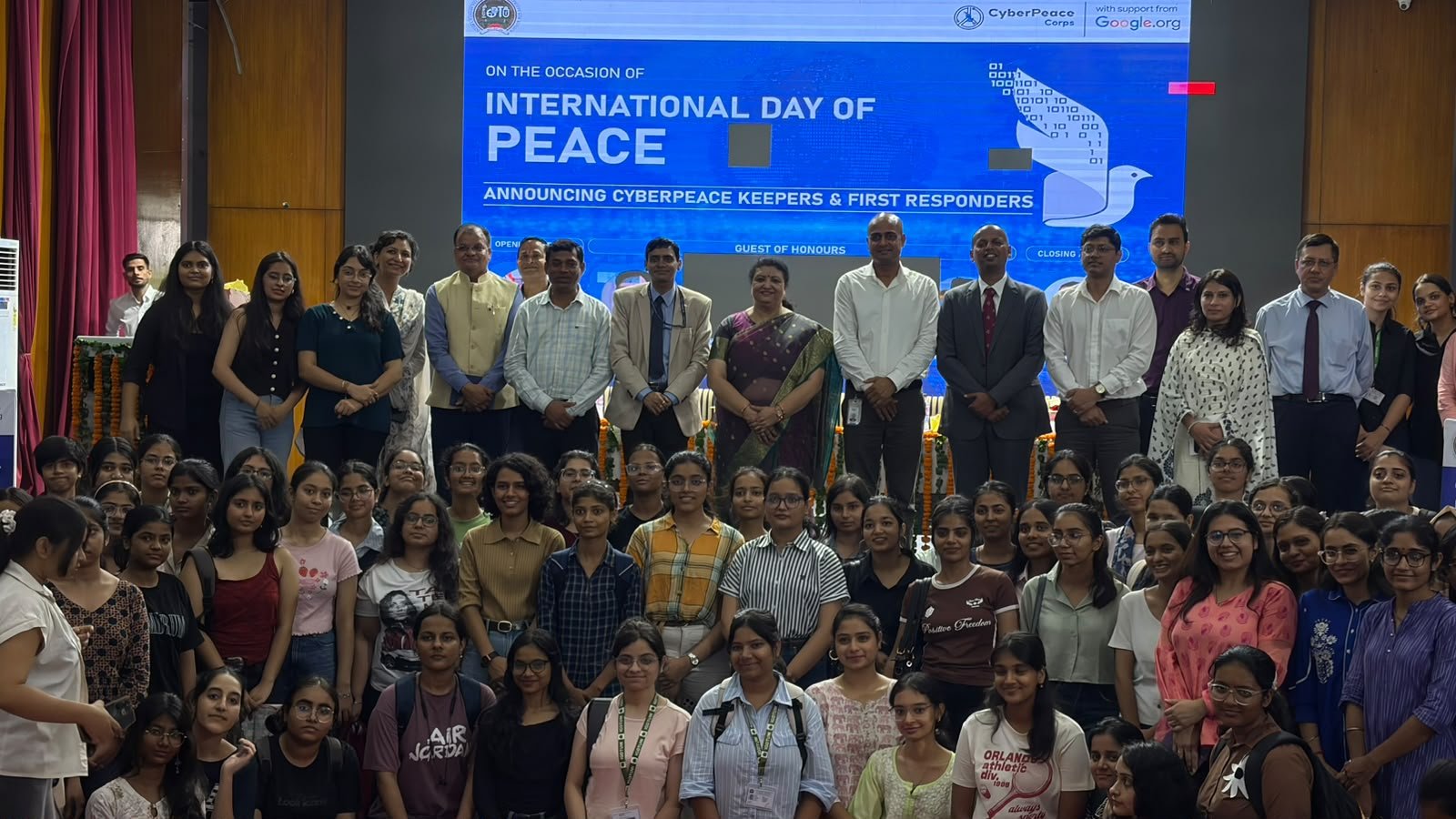
Indira Gandhi Delhi Technical University for Women (IGDTUW) and CyberPeace, with support from Google.org, have announced the CyberPeace Keepers and Cyber First Responders initiative — a trained cohort of students who will work towards building safer, informed and cyber-resilient communities. Announced in Delhi on September 23, 2026, the initiative brings the principles of peacebuilding into the digital age by creating a community-level network of trained young people capable of contributing to research, awareness, prevention and informed first response to emerging digital threats.
The student cohort will work towards understanding, identifying and researching technology-enabled harms such as online scams and frauds, deepfakes, AI-enabled deception, misinformation, impersonation and online abuse. They will also help communities adopt preventive digital practices and navigate appropriate reporting, grievance-redressal, victim-support and law-enforcement mechanisms. A key focus of the programme is research-to-action — documenting emerging patterns of technology-enabled abuse and translating experiences from communities into actionable insights that can strengthen awareness, capacity building, technological interventions, policy and response mechanisms.
The International Day of Peace programme began with an opening address by Prof. Ranjana Jha, Vice Chancellor, IGDTUW, and featured the announcement of the CyberPeace Keepers and Cyber First Responders cohort. Acknowledging the growing partnership between IGDTUW and CyberPeace, she also underscored the significance of the IGDTUW–CyberPeace Centre of Excellence in creating opportunities for young women to engage with emerging cybersecurity challenges. “When women come together with knowledge, confidence and opportunity, they do not merely enter new fields — they help redefine them,” said Prof. Ranjana Jha, Vice Chancellor, IGDTUW.
This was followed by keynote addresses from the distinguished Guests of Honour. Speaking on India’s evolving technology landscape, Dr. Buddha Chandrasekhar highlighted the country’s significant talent pipeline and the immense potential of its young population to shape the next generation of technological innovation. He emphasised the importance of developing indigenous AI capabilities and models, while also underlining the need for greater participation of women in science, technology and innovation. “India’s greatest technological asset is its talent; the opportunity before us is to transform that talent into indigenous innovation, particularly by bringing more women into the future of science and AI,” said Dr. Buddha Chandrasekhar, Chief Coordinating Officer, AICTE.
The discussion then moved towards the rapidly evolving frontier of artificial intelligence, with Mr. Rajesh Ranjan examining the opportunities and challenges presented by frontier AI. He spoke about the emerging “defender’s dilemma” — the challenge of ensuring that those protecting digital systems can keep pace with technologies that can simultaneously empower both defenders and malicious actors. His remarks explored the potential uses and misuses of increasingly capable AI systems and the implications for cybersecurity. “The same frontier AI capabilities that can strengthen our defenders can also empower those seeking to exploit our systems — and that is the defender’s dilemma we must prepare for,” said Mr. Rajesh Ranjan, Head of Government Affairs and Public Policy, Google.
In the second leg of the event, preceding the Cyber First Responder Programme, Prof. (Dr.) Shilohu Rao, Professor of Law, National Law University, Jodhpur, and Mr. Ankur Mishra, Senior Product Leader from Ontario, Canada, engaged in an insightful discussion on the continued importance of human intelligence and judgement alongside advanced technologies, the need to adapt emerging technologies to diverse use cases, and the evolving legal and regulatory frameworks governing their responsible adoption. Technical workshops focused on emerging cyber threats, digital safety and community cyber resilience were also held. The programme concluded with a closing address by Maj Vineet Kumar, Founder & Global President, CyberPeace.
As part of the programme, participants also visited the 24×7 IGDTUW–CyberPeace Center of Excellence, which showcased how a university-based platform can bring together students, researchers, technology and community engagement to address emerging digital challenges. The Center of Excellence will provide an important platform for the cohort to learn, research, experiment and contribute to real-world cyber safety and resilience initiatives.
Beginning with the cohort at IGDTUW, the vision is to develop a wider network of CyberPeace Keepers and Cyber First Responders across universities and communities, creating a distributed human layer of cyber resilience and empowering young people — particularly women in technology — to become researchers, responders, mentors and leaders for safer digital communities.


No responses yet