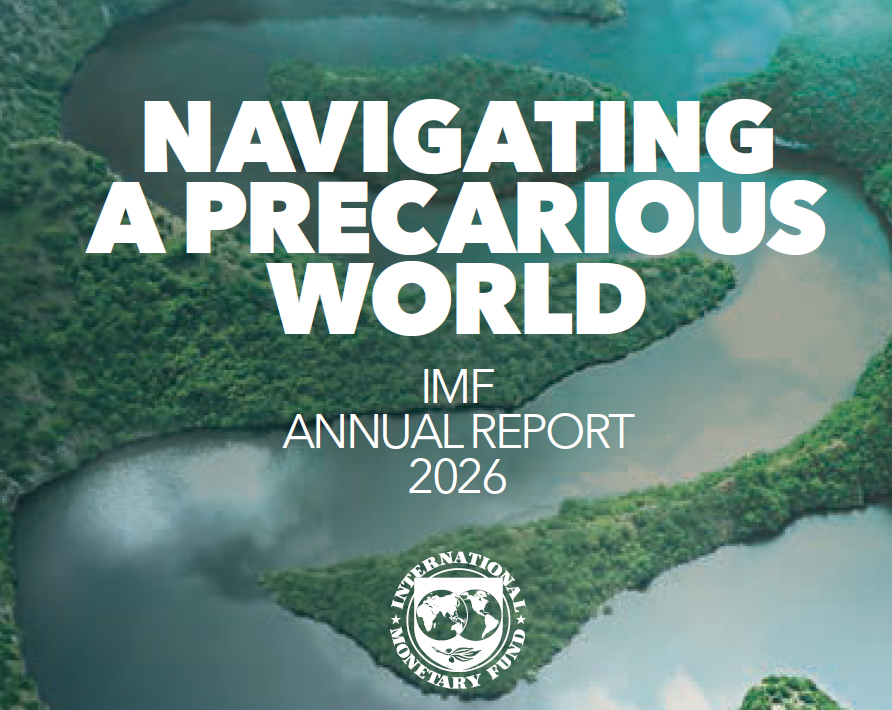
The International Monetary Fund has published its Annual Report for the financial year ending April 30, 2026, and it doesn’t hide the mood behind a bland title. The report is called Navigating a Precarious World — and inside, the IMF’s own Managing Director, Kristalina Georgieva, frames the year bluntly: “The global economy continues to show resilience in the face of more frequent and overlapping shocks. This year, it was war in the Middle East restraining growth, boosting inflation, and disrupting the supply of key commodities.”
Here’s what’s actually inside the 92-page report — and why several of its findings are worth far more attention than a routine institutional annual report usually gets.
The Middle East war caused the “largest-ever cut” to global energy supply
The single most dramatic line in the report concerns the war that began at the end of February 2026. Citing the International Energy Agency, the IMF states plainly: the conflict “and subsequent closure of the Strait of Hormuz—caused the largest-ever cut to global energy supplies.” That’s not IMF spin — it’s a direct citation of IEA data, and it’s a striking historical superlative for a global institution to put in print. The report notes the shock has had “knock-on effects on other commodities, food supplies, and broader supply chains,” and that the IMF is working with both the IEA and the World Bank to assess the fallout.
Global debt is racing toward World War II–era levels — by 2028
Even before the war, the report says global public debt “was already on track to reach World War II–era levels by 2028.” The conflict has made it worse by spiking energy prices, tightening financial conditions and slowing growth. One of the report’s most quotable statistics: “In just three years, interest payments have increased by almost half—from about 2 to nearly 3 percent of GDP—trillions of dollars globally that cannot be spent on education, infrastructure, or other pressing priorities.”
That’s a genuinely alarming framing from an institution not known for dramatic language — trillions of dollars in government budgets now going to debt servicing instead of schools, hospitals or roads.

AI could be a $2 trillion global investment story in 2026 — but the IMF is already flagging bust risk
The report’s dedicated section on artificial intelligence is arguably its most forward-looking, and most quietly worrying, chapter. It states that in 2025, “technology investments related to AI added an estimated 0.5 percentage point to US GDP growth,” and that “private-sector-driven investment in AI could top $2 trillion globally in 2026, according to some external estimates” — a figure the IMF calls one of the fastest-growing drivers of global growth in recent years.
But the same section contains a pointed warning: “there’s a risk that the payoff from expensive investments in AI, increasingly debt financed, could prove illusory. This could lead to a sharp reversal in equity valuations, wealth destruction, and layoffs.” The report specifically flags “circular financing arrangements—in which a small group of firms simultaneously act as each other’s customers, investors, and financiers” within the AI stack, including hyperscalers and chipmakers, as a channel through which “problems in one firm cascading to others” could spread — and says the IMF’s Executive Board is “regularly monitoring these risks.”
The report also singles out Singapore as sitting “at the top of the IMF’s AI Preparedness Index,” crediting its “strong digital infrastructure, education, and forward-looking regulation.”
AI’s labor market winners and losers, according to IMF research
One of the more nuanced — and more shareable — findings concerns who actually benefits from the AI boom. The report states that “people with jobs requiring AI-related skills earn more,” which isn’t surprising. What’s more interesting is who else benefits: “So are people in low-skill roles—such as restaurant staff—who provide services to higher earners.” The group being squeezed out, per the IMF’s own research, is different from what many assume: “Left out are middle-skilled workers whose jobs are highly exposed to automation.” That’s a clean, counterintuitive data point — AI polarizing the labor market rather than simply displacing low-wage work — that’s likely to resonate well beyond economics-focused readers.
Stablecoins now hold more US debt than Saudi Arabia does
Buried in the report’s section on digital finance is a genuinely striking comparison: “The two largest stablecoin issuers together now hold more US Treasury bills than Saudi Arabia.” It’s a single sentence, but it captures just how fast stablecoins have moved from a crypto-market curiosity to a meaningful holder of US sovereign debt — a shift the report frames as part of a broader “reorientation toward tech-led products and players that can operate fluidly across borders,” alongside continued progress on tokenization and central bank digital currencies. The European Central Bank, the report notes, “concluded the preparation phase for a digital euro in October 2025, laying the technical foundations for issuing a digital currency.”
The money: who actually got IMF loans this year, and how much
Stripping away the analysis chapters, the hard numbers on what the IMF actually did in FY2026 are straightforward. Per the report’s own summary: the Fund provided “A total of $40 billion to 18 countries, including about $2 billion to 9 low-income countries,” plus roughly $400 million worth of “hands-on technical advice, policy-oriented training, and peer learning” delivered as capacity development.
Three arrangements dominate the year’s lending by size. Mexico secured a Flexible Credit Line worth 17,825.40 million SDR — using the report’s own April 30, 2026 exchange rate (SDR 1 = $1.372020), that converts to roughly $24.5 billion, by far the largest single arrangement of the year. Ukraine’s Extended Fund Facility stood at 5,935.30 million SDR (about $8.1 billion), continuing support tied explicitly, per the report, to coping “with exacerbated economic challenges as a result of Russia’s war in Ukraine, including food insecurity.” Pakistan’s Resilience and Sustainability Facility came in at 1,000 million SDR (roughly $1.4 billion).

The institution’s own bottom line
Running the IMF itself isn’t cheap either: the report discloses a FY2026 gross administrative budget envelope of $1,991 million, with actual expenditure of $1,505 million — “equivalent to 97 percent of the approved net budget.” All of this in service of an institution that, as the report reminds readers, now counts 191 member countries.
Why this report matters beyond economists
Annual reports from multilateral institutions rarely make for gripping reading, but this one is unusually pointed for an institution that typically favors hedged, technical language. Between a war causing history’s largest energy-supply shock, government debt racing toward levels not seen since World War II, an openly flagged AI bubble risk sitting inside an institution’s own optimistic growth story, and stablecoins quietly out-holding a G20 oil power in US Treasury bills, Navigating a Precarious World reads less like bureaucratic housekeeping and more like a candid status report on just how many simultaneous fault lines the global economy is currently balancing on — in the IMF’s own words, rather than any outside commentator’s.


No responses yet