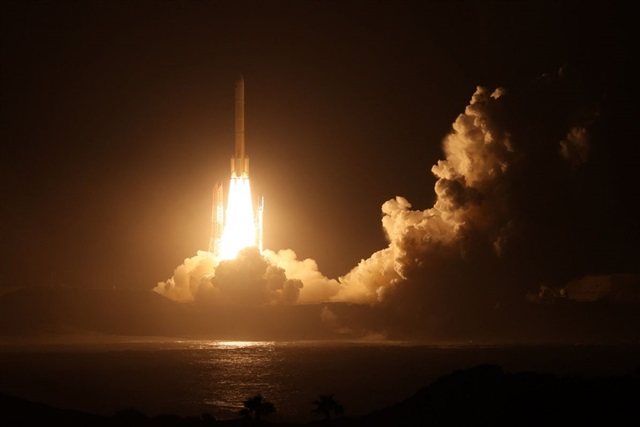
Japan’s space agency JAXA has launched its Martian Moons eXploration (MMX) spacecraft, a mission to collect and return material from Mars’s moon Phobos.
An H3 rocket, flight No. 10, lifted off from the Tanegashima Space Center at 4:41:03 a.m. Japan time. JAXA said the rocket “flew as planned.” About 71 minutes and 13 seconds after liftoff, the agency confirmed that MMX had separated from the rocket and been injected into its planned orbit. The launch had been scheduled for this date, with a reserve window running to November 7.
The spacecraft will take about a year to reach Mars, according to the European Space Agency (ESA), a mission partner. It is expected to enter Mars orbit in August 2027 and begin orbiting Phobos in September 2027.
The mission aims to settle a long-running question: whether Mars’s moons are captured asteroids or formed from debris after a large impact on Mars. MMX plans to collect at least 10 grams of material from Phobos, make observations of the other moon, Deimos, and monitor Mars’s climate.
ESA’s timeline has a small rover, IDEFIX, deployed to Phobos’s surface in early 2029 to scout the terrain. The rover, built by France’s space agency CNES and Germany’s DLR, weighs 25 kg on Earth but would weigh the equivalent of about 15 grams on Phobos, ESA said. The main spacecraft is due to land to collect samples in 2030, and the return capsule is due back on Earth in 2031, landing in Australia before the samples are taken to Japan. Some earlier references give a Phobos landing date of 2027, but ESA’s schedule puts the sample landing in 2030.
The launch also matters for the H3 rocket, which JAXA develops with Mitsubishi Heavy Industries. It lost the Michibiki 5 navigation satellite in December 2025, a failure JAXA traced to a damaged payload adapter, and returned to flight in June 2026 with six satellites, according to Space.com. NASA, ESA, CNES and DLR are partners alongside JAXA, which leads the mission. “The data and samples returned by MMX are a window to study the evolution of Mars and the Solar System,” ESA project scientist Elliot Sefton-Nash said.


No responses yet