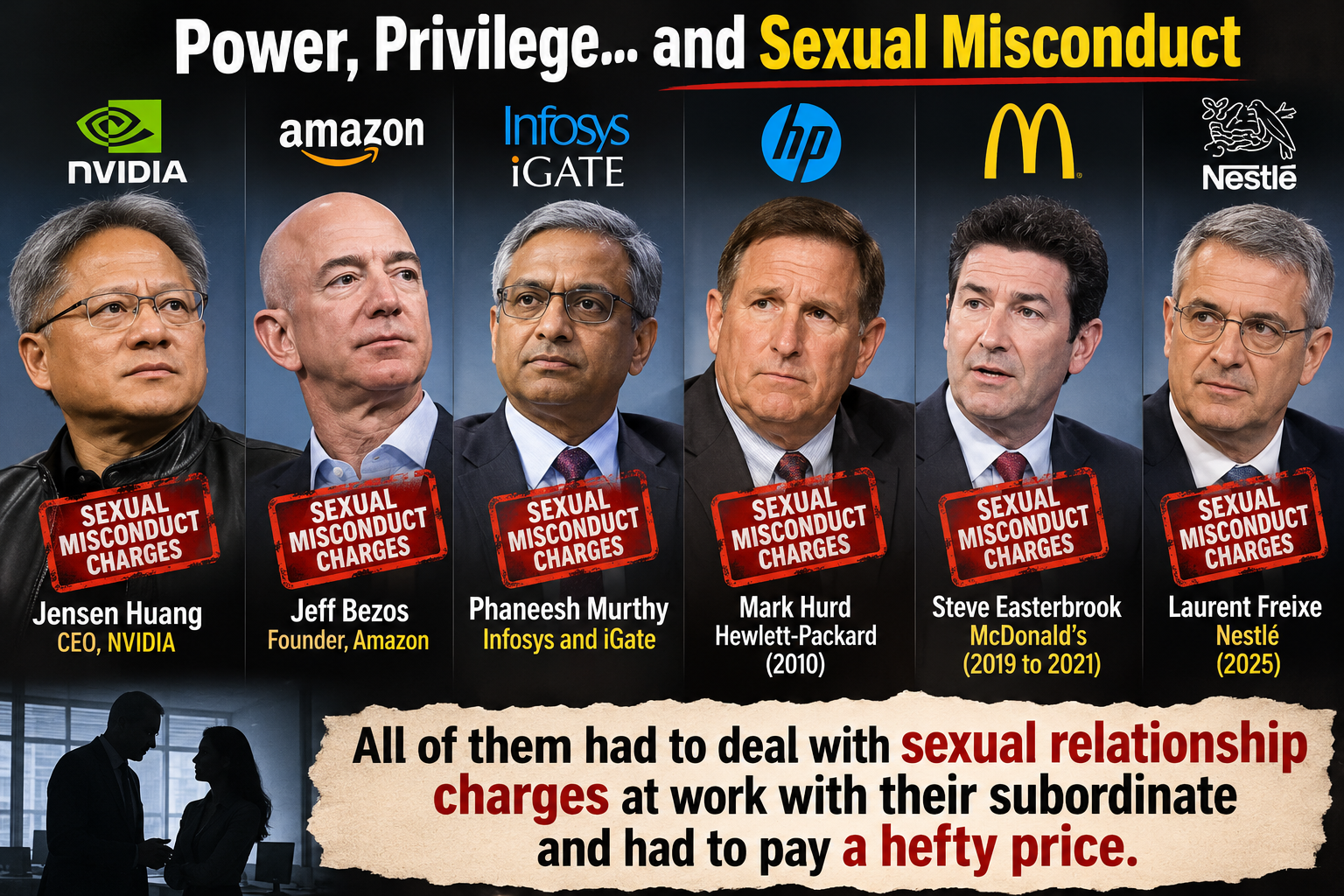
Nvidia’s board is now investigating chief executive Jensen Huang, and the company’s shares fell about 5.5% on Tuesday. Huang is the latest in a long line of corporate leaders whose personal conduct turned into a governance problem. The pattern across earlier cases is consistent: the relationship itself was rarely what ended a career or drained a bank account. Concealment, false paperwork, misuse of company process or a failure to disclose usually did that.
Where Nvidia stands.
Nvidia said on November 8 that a committee of independent directors will investigate Huang, according to 24/7 Wall St. The probe followed Financial Times and New York Times reports that US officials believed Huang had a relationship with a Chinese woman recruited to spy for China. Those allegations have not been publicly established. Huang told employees he had an extramarital affair and apologised, the report said, and the board said it has no reason to believe national security or company secrets were exposed. Nvidia and Huang have also been sued in the US over the matter. Nvidia’s stock closed Tuesday at about $168.80, according to Yahoo Finance, and the company reports earnings on November 17. No outcome has been announced, and the cases below are history, not a forecast for Huang.
Jeff Bezos, Amazon (2019)
Bezos kept his job but paid in money and privacy. On January 9, 2019, he and MacKenzie Bezos announced their divorce on Twitter, and that evening the National Enquirer published its first online story about his relationship with Lauren Sanchez, according to a timeline in TBS News’ account of the saga. On February 7 he published a Medium post, titled “No Thank You, Mr. Pecker,” releasing emails from the Enquirer’s publisher, American Media (AMI), which Bezos’s team viewed as extortion; AMI proposed not publishing further material if he publicly rejected claims of political motives. Federal prosecutors later dropped the extortion matter without charges, according to the same account. The divorce terms announced on April 4, 2019 gave MacKenzie 25% of the couple’s Amazon stock, about a 4% stake in the company, valued at around $35 billion at the time, while Jeff Bezos kept 75% and voting control over her shares, according to Complex. Bezos stepped down as Amazon chief executive in 2021, but nothing in these reports ties that to the scandal.
Phaneesh Murthy, Infosys and iGate
Murthy was among the most prominent Indian executives in Silicon Valley, running Infosys’s global sales from California. In 2002 a former secretary, Reka Maximovitch, filed a sexual harassment case against him. Infosys settled out of court for $3 million in April 2003; the company paid $1.5 million and its directors-and-officers insurers paid the rest, and Murthy contributed nothing, according to CIOL. Infosys chairman N R Narayana Murthy said the company settled partly because of the risk under California law and to move past the distraction, and the company said it retained the right to take legal action against Phaneesh Murthy. He left the company; a 2013 report said Infosys had dismissed him for violating its ethical and governance standards. He later became chief executive of iGate, where history repeated: in May 2013, iGate’s board dismissed him after investor relations manager Araceli Roiz filed a written harassment complaint. Outside counsel found he had not violated the harassment policy, but that his failure to report a relationship with a subordinate breached company policy and his employment contract. Murthy admitted the relationship, denied the harassment charge, and called the charges “completely false,” according to Millennium Post.
Mark Hurd, Hewlett-Packard (2010)
Hurd resigned as chairman, chief executive and president on August 6, 2010, after HP completed an investigation of a sexual-harassment complaint from a contractor, Jodie Fisher. Investigators found no violation of the harassment policy but did find that Hurd broke HP’s Standards of Business Conduct, with general counsel Mike Holston citing “inaccurate expense reports submitted by Mark or on his behalf,” reportedly to hide a relationship he had not disclosed. Fisher denied a sexual relationship, and her complaint was settled, according to the Palo Alto Online report.
Steve Easterbrook, McDonald’s (2019 to 2021)
McDonald’s board fired Easterbrook in November 2019 after an internal probe found a consensual relationship with an employee, and granted him a severance package that Equilar valued at about $42 million at the time. In August 2020 the company sued, alleging he had lied during the probe, destroyed information, and had three further relationships with employees. The case settled in December 2021, with Easterbrook returning cash and equity valued by the settlement at $105 million, according to CNBC. He apologised to co-workers, the board, franchisees and suppliers.
Laurent Freixe, Nestlé (2025)
Nestlé dismissed its chief executive of about a year, effective immediately on September 1, 2025, after an investigation found an undisclosed romantic relationship with a direct subordinate that violated the company’s code of conduct. Chairman Paul Bulcke called it “a necessary decision,” and Philipp Navratil, formerly head of Nespresso, took over, according to PBS NewsHour.
Andy Byron, Astronomer (2025).
Byron resigned as chief executive of the data-software company Astronomer after a video from a Coldplay concert in Foxborough, Massachusetts, went viral. The board accepted his resignation, announced on July 19, 2025, and said leaders were expected to set a standard of conduct that was not met. Co-founder Pete DeJoy became interim chief executive, according to ABC7.
What the cases share
In most of these, the penalty followed what the leader did after the relationship, or what the company’s rules required: a concealed relationship at iGate and Nestlé, falsified expenses at HP, a disputed investigation at McDonald’s. The costs ranged from a $3 million settlement shared with insurers (Infosys) to a $105 million clawback (Easterbrook) and a division of a fortune (Bezos), and in every corporate case but Bezos’s, the job. Whether Huang’s case follows that arc depends on what the board’s committee finds about disclosure, security and shareholder information, none of which has been reported yet. Details for each executive are drawn from the reports cited here; several involve allegations that were disputed, denied or settled without any ruling. This article is for information only and is not legal or investment advice.


No responses yet