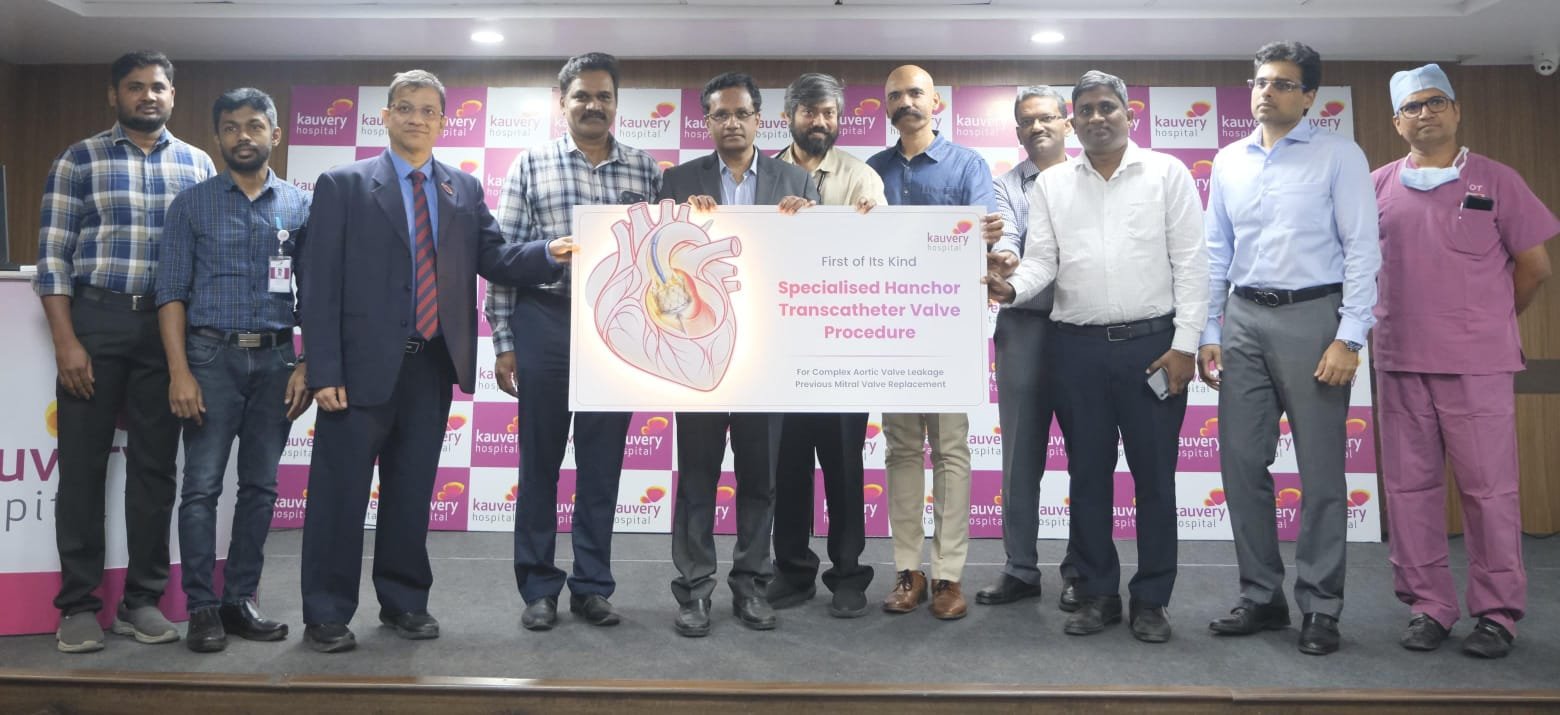
Kauvery Hospital, Alwarpet, says it has treated a 63-year-old man with severe aortic valve leakage using a transcatheter aortic valve replacement (TAVR) with a specialised valve called HANCHOR. The hospital describes it as the first procedure of its kind in a patient with this combination of conditions, a claim that has not been independently verified.
The patient had pure native aortic regurgitation (PNAR), in which the aortic valve does not close properly and blood flows back into the heart. In his case a perforation in one leaflet of the native valve was causing the leak. He had also had a mitral valve replacement earlier, which the hospital says added complexity to planning.
The hospital explains why such cases are hard to treat through a catheter. In aortic stenosis, calcium deposits on the valve help hold a replacement in place. In pure regurgitation there is often little or no calcium, which makes stable positioning and anchoring difficult.
The HANCHOR valve is designed for this problem, according to the hospital. It combines a balloon-expandable frame with an anchoring element made of nitinol, a flexible metal alloy, that engages the native valve leaflets to help stabilise the new valve where surrounding anatomy gives limited support. The valve was delivered through a catheter and placed inside the existing aortic valve, avoiding conventional open-heart valve replacement surgery, “where clinically appropriate”.
After the procedure, the hospital reports no residual aortic regurgitation, no valve stenosis, no paravalvular leak (leakage around the implanted valve) and no significant abnormality in the heart’s electrical conduction. The patient was discharged after three days.
“The HANCHOR valve’s dedicated anchoring mechanism helped us address the challenges of valve positioning,” said Dr. Rajaram Ananantharaman, Senior Consultant Interventional Cardiologist at Kauvery Hospital, Alwarpet. “The immediate post-procedure findings were encouraging, with no residual aortic regurgitation or leakage around the implanted valve reported.”
This is a single case, and the results described are immediate post-procedure findings. The release gives no follow-up beyond discharge, does not name the valve’s maker, and does not say whether it is approved for routine use in India or was used under a special arrangement. A search turned up no independent information on the HANCHOR valve itself, so its design and the “first of its kind” claim rest on the hospital’s account.


No responses yet