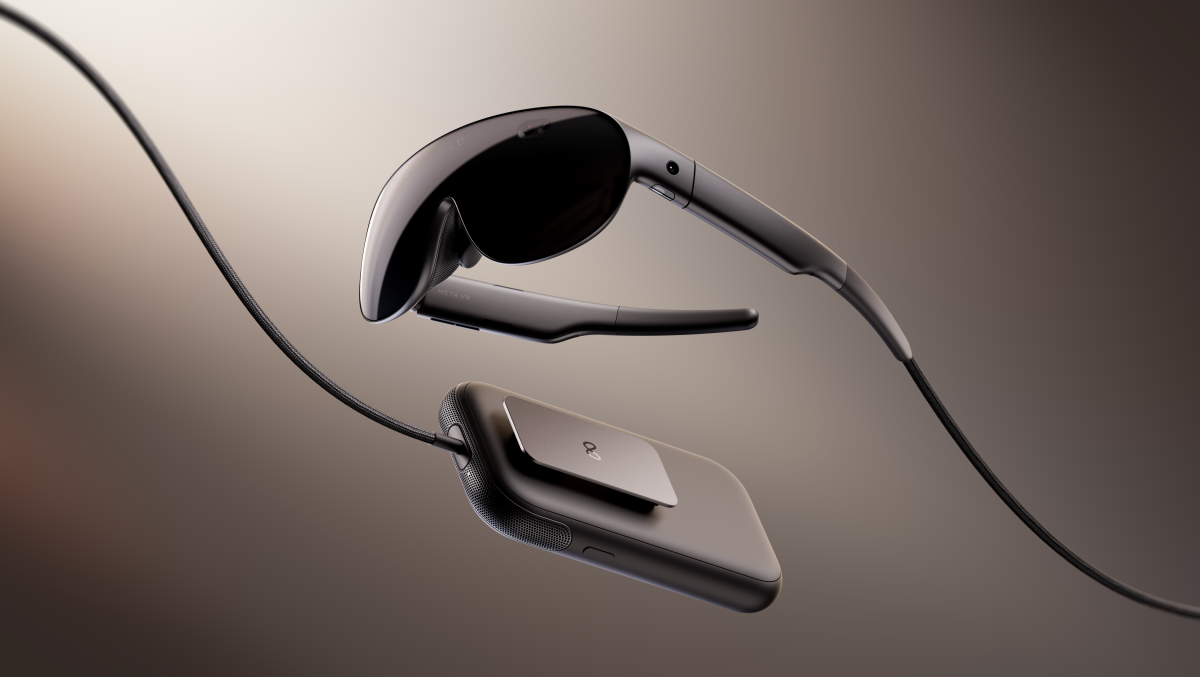
Meta is having another go at making virtual reality feel less like a chore to wear. At its Connect event, the company unveiled Meta VR Glasses, its newest entry into the VR market — and this time, the pitch leans heavily on comfort and cinema-grade entertainment rather than raw immersion alone.
Five times lighter, and built like actual glasses
The headline change is physical. Meta says the new glasses are five times lighter than the Meta Quest 3, and they’re designed to look far closer to a normal pair of glasses than the bulky headsets the company has shipped in the past. They’re built from magnesium alloy and run on Qualcomm’s Snapdragon Reality Elite processor. Rather than housing all the computing power on the face itself, the glasses connect to a separate computing puck that doubles as their battery — small enough, presumably, to slip into a pocket, letting the glasses be worn out and about rather than tethered to a couch.
The pitch: an IMAX theater on your face
Where these glasses really differentiate themselves is on the entertainment side. They pack micro-OLED panels directly into the lenses, delivering what Meta calls a 5K Infinite Display at 37 pixels per degree, along with Dolby Vision and Dolby Atmos support for downloaded and streamed movies.
The standout claim, though, is IMAX compatibility. Meta is calling its new glasses the “first IMAX Enhanced certified VR device ever,” positioning them as one of the only ways to experience IMAX’s signature expanded aspect ratio outside an actual IMAX theater. The glasses also support 3D content and movies that incorporate a viewer’s physical surroundings into the experience — effectively turning a film into something closer to a VR environment. Meta says it has partnered with Disney so that, starting in November, Disney+ subscribers will be able to stream select titles — including certain Marvel movies — in 3D through the glasses, with surroundings “transformed with immersive environments, dynamic effects, stunning 3D visuals, and spatial audio.”
Meta AI baked in
The glasses also ship with Meta AI built in, letting wearers control the device by voice — asking it to start a movie, for instance — or through hand gestures, continuing Meta’s push to make its AI assistant a default layer across its hardware line rather than an optional add-on.
Price and availability
Meta says the VR Glasses will launch next spring, starting at $1,299.99.
Why it matters
This marks Meta’s latest attempt to find a version of VR that people will actually want to wear regularly — after years of headsets that delivered strong immersion but struggled with comfort, weight and everyday practicality. By leaning into a lighter form factor and framing the device primarily as a premium way to watch movies rather than a full computing or gaming platform first, Meta appears to be betting that entertainment — anchored by a genuine IMAX and Disney partnership — is the wedge that finally gets more people to put a VR device on their face outside of gaming sessions.


No responses yet