The 2026 Nobel Prize in Physiology or Medicine has gone to Karl Deisseroth of Stanford University, Peter Hegemann of Humboldt University of Berlin and Georg Nagel of the University of Würzburg, for “their discoveries concerning light-gated ion channels and optogenetics.” The Karolinska Institutet in Stockholm announced the prize on Monday, October 5. The three will share 12 million Swedish kronor, about $1.2 million, equally.
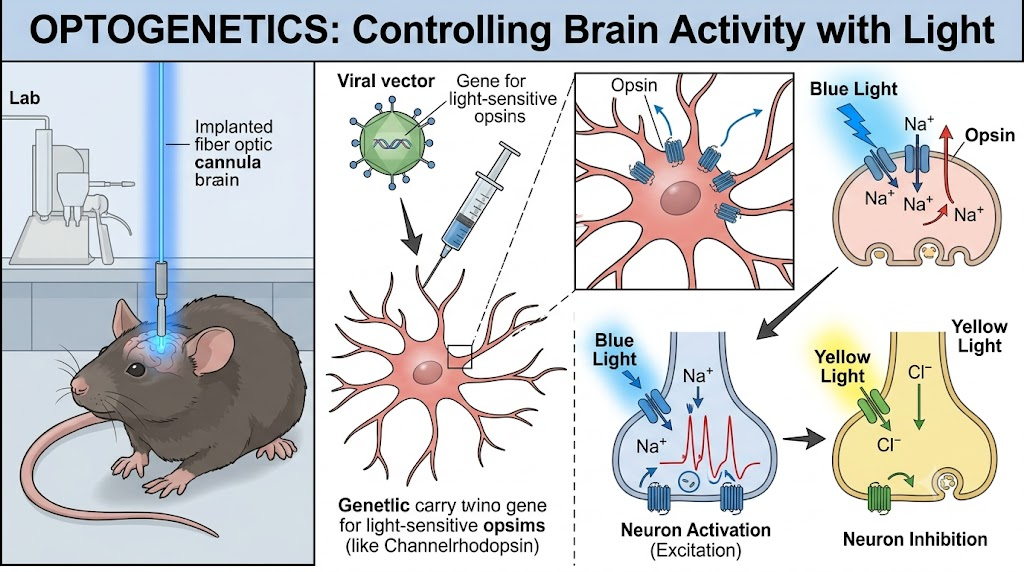
Optogenetics is a method that lets scientists switch individual nerve cells on or off in a living brain, using light. According to the Nobel Committee, it has changed how researchers study the brain, and it is now being tested as a way to restore sight.
The winners
Deisseroth (born 1971) is a professor of bioengineering and of psychiatry and behavioural sciences at Stanford and an investigator at the Howard Hughes Medical Institute, which says he is the 36th current or former HHMI scientist to win a Nobel. Hegemann (born 1954) is a professor of experimental biophysics at Humboldt University in Berlin, and Nagel (born 1953) is a professor of neurophysiology at the University of Würzburg.
Committee secretary Thomas Perlmann said that when the three were told they would share the prize, each said the same thing: that it was wonderful to receive it with the other two, whom they called “my friends.” Deisseroth, who was woken after midnight by the call, said the call was “very unexpected, but of course very delightful.”
The discovery, in plain words
The story begins not with the brain but with a single-celled green alga called Chlamydomonas. In the early 1990s, at the Max Planck Institute, Hegemann wanted to know how this tiny organism swims toward light. Working with Nagel, he found the answer: a protein called channelrhodopsin, which sits in the cell’s membrane and opens within a split second when light hits it.
That matters because nerve cells work by letting charged particles, called ions, flow through tiny gates in their membranes. A protein that opens such a gate when struck by light is, in effect, a switch. Hegemann and Nagel found that it worked in other types of cell as well, not just in the alga.
Deisseroth then took the next step. In 2005, his Stanford lab put the gene for the protein into rat nerve cells and showed that blue light could trigger a nerve signal. The method was given the name optogenetics a year later. Two years after the first demonstration, his lab made it work in the brains of living mice, according to GEN. That same year, working with other researchers, he used it to wake sleeping mice on cue, the Nobel Committee notes.
How optogenetics works
- Pick the cells. Scientists use genetic tools to deliver the gene for a light-sensitive protein only to a chosen type of neuron.
- Shine light. Light, usually delivered through a thin optical fibre, is directed at those cells.
- Watch what happens. The cells fire when the light switches them on, or fall silent when a different light-sensitive protein switches them off. The researcher can see which behaviour, memory or feeling follows.
The advantage over older tools is control. As the Nobel Committee’s science writers put it, earlier methods were too blunt to show whether the activity of particular nerve cells actually caused a given response. Deisseroth told STAT the idea reverses how light is normally used in science: “We’re not using light to collect information, we’re using light to cause things to happen,” he said, with millisecond precision and at the level of single cells. Per Svenningsson, chair of the Nobel Committee, said the method offers opportunities for mapping the brain “in a way that we could once only dream of.”
What it has taught us
Researchers have used optogenetics to find which cells are responsible for which functions and how they are connected to one another. It has been used to search for the “memory engram,” the physical trace a specific memory leaves in cells, and to untangle how brain circuits go wrong. The Nobel Committee says the work has deepened understanding of psychiatric and neurological disorders such as depression, anxiety, schizophrenia, Alzheimer’s disease and Parkinson’s disease.
Committee member Abdel El Manira said at the announcement that the technique began as a bold idea from Francis Crick, a 1962 Nobel laureate, who suggested that light might be the way to control specific cells. It “seemed entirely far-fetched” at the time, he said.
From the lab towards the clinic
The most advanced medical use so far is in vision. In retinitis pigmentosa, an inherited disease in which the eye’s light-sensing rods and cones die, the idea is to introduce a light-sensitive protein into other retinal cells so they can take over some of the job. The Nobel Committee says clinical trials are ongoing. A case reported in 2021 showed partial recovery of visual function in a patient who had been blind from the disease for 14 years.
Two caveats matter. These are still trials, not a standard treatment. And outside the eye, optogenetics is overwhelmingly a research tool: delivering genes and light into the brain is hard, and the Nobel Committee’s wording on disorders like depression and Parkinson’s is about understanding them, not treating them.
A shared prize, and a larger community
The Nobel rules limit an award to three people. Deisseroth acknowledged that, saying that many problems had to be solved along the way, by “a very broad network of collaborators” and students. Others have shared earlier honours for related work: for example, Deisseroth, Hegemann, Edward Boyden and Gero Miesenböck shared the 2019 Warren Alpert Foundation Prize, and the 2021 Lasker Award went to Deisseroth, Hegemann and Dieter Oesterhelt.
By the numbers
STAT notes that the medicine prize has now been awarded 117 times to 235 laureates since 1901, of whom 14 are women. It has gone to a single person 40 times, to two people 36 times and to three people, the maximum, 41 times.


No responses yet