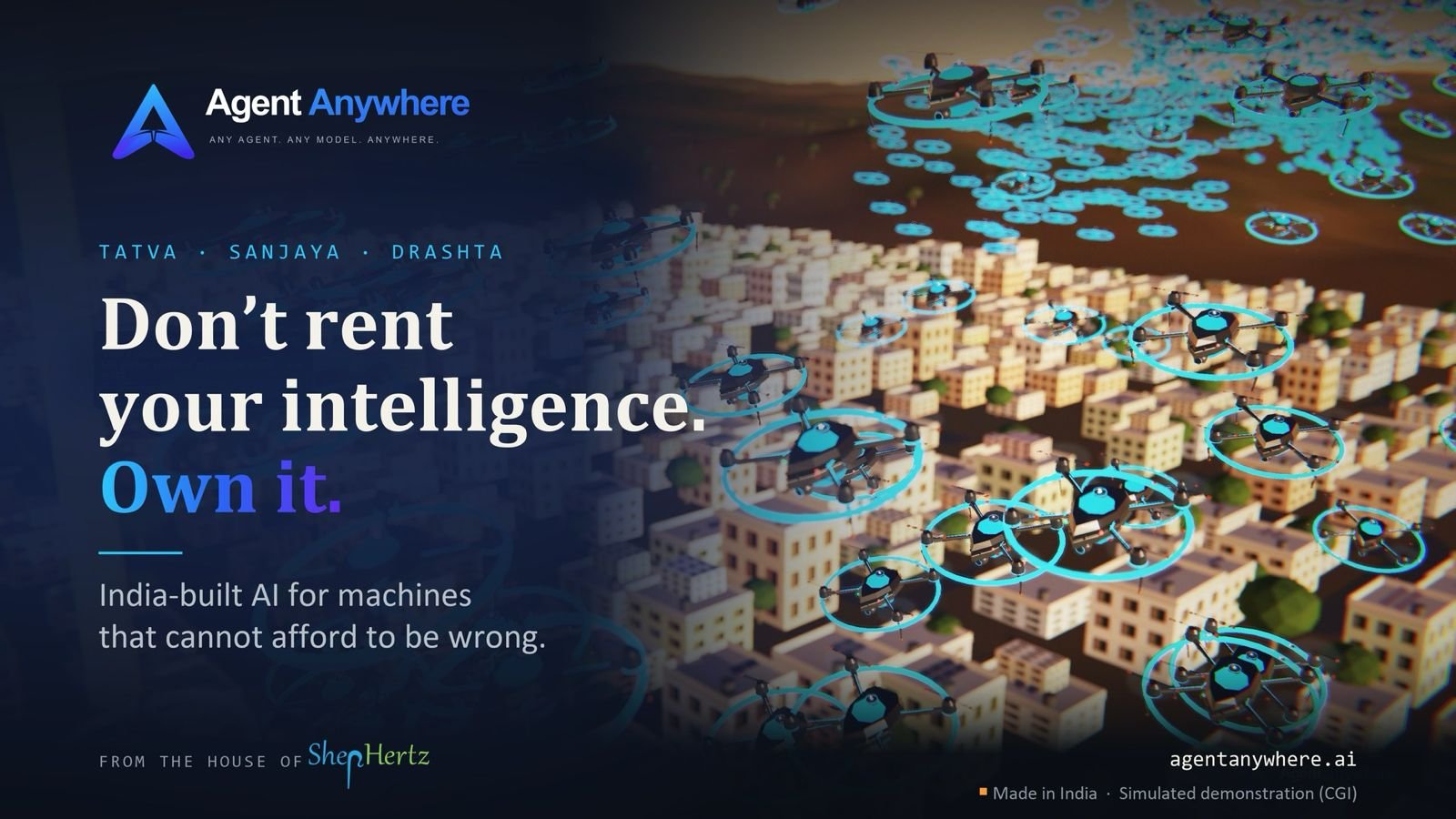
ShepHertz Technologies introduced three AI model families at Drone Expo 2026 that, as per the company, are built in India and designed to run fully offline on constrained hardware, from satellites and drones to phones, smart glasses and rings. The models are part of the company’s AgentAnywhere platform, which it describes as a sovereign AI platform. ShepHertz also said it is releasing parts of its toolchain as open source.
The three models
According to ShepHertz, the models are small enough to run without any connection to a cloud.
- Tatva (तत्त्व) is for on-device command. The company says it converts an operator’s plain words in English, Hinglish or Indian languages into exactly one command a machine understands, or into no action at all. It is described as running on devices ranging from Raspberry-Pi-class boards to laptops and servers, with Edge, Nano, Micro and Indic variants sized from wearables to ground stations.
- Sanjaya (सञ्जय) is for fleet and telemetry intelligence. As per the company, it gives mission control a single live picture across fleets of drones, satellites and vehicles, and keeps a fleet coordinated when links fail or its leader drops out.
- Drashta (द्रष्टा) is for machine vision. ShepHertz says it reads satellite and aerial imagery offline and maps objects of interest for analysts to review, and that it serves defence and strategic users inside air-gapped perimeters, with a named officer in command of every consequential step. The company states it is never placed in a weapons-release chain. Its vision capabilities for inspection and agriculture are, per the company, still being built with design partners.
The control model
ShepHertz says all three follow one rule: the model proposes, a policy outside the model checks, and a person approves anything that matters. The company claims every step leaves a signed record that can be verified offline. It also says the customer defines each machine’s command vocabulary and that anything outside it is refused. For armoured and utility vehicles, the company states the models are never connected to weapons.
Demonstrations
ShepHertz said its stand at the three-day Expo drew defence, agriculture, infrastructure and space teams. Demonstrations included a 500-drone swarm that elects a new leader on board when its leader is lost, and a humanoid robot that takes tasks in plain language and refuses unsafe ones. The company also listed border reconnaissance, Farm Watch, Sky Canvas, rooftop solar inspection, and flood search and rescue. It said the drone swarm and humanoid demonstrations are simulations, while every Tatva output shown in them is real recorded model output. The release does not name any customers.
Data and privacy claims
As per ShepHertz, Tatva is trained from scratch in India on openly licensed, licence-recorded data, with its training corpus built and receipted using a tool called Shuddhi (शुद्धि). The company says every model runs inside the customer’s own perimeter, including air-gapped sites, that no data leaves for a foreign cloud, and that customer data never trains ShepHertz models. It describes a trust layer in which a component called Veil masks personal and regulated data before any model sees it, and another called Kavach screens each request and response for attacks and leaked secrets. Each answer and command is then sealed with a signed trust receipt that an auditor can verify offline, the company says. These claims were not independently verified, and the release gives no benchmarks or model-size figures.
Open-source release
ShepHertz said it is opening its trust toolchain under the Apache 2.0 licence, starting with Shuddhi, which it describes as a data factory that turns raw text into a clean training corpus and issues a hash-chained receipt showing what went in and what was filtered out. The code is listed at github.com/agentanywhere/shuddhi. Over the next three weeks, the company said it will also open-source Model Hub, the Agent Universal Gateway, the Annotator and Nabhika OS, which it describes as the node layer that installs AI on a machine and proves what is running on it.
Availability
Tatva Edge enters private preview on October 5, with access opening in waves through a waitlist at agentanywhere.ai. Sanjaya and Drashta are available to design partners, and paid design-partner pilots on customers’ own hardware are open now, according to the company.
Company statement
Siddhartha Chandurkar, Founder and CEO of ShepHertz Technologies, said, “India cannot be sovereign in AI by renting its intelligence from abroad. The machines that watch our borders, fly our skies and orbit above us must think in India, answer to the people who command them, and prove every step they take. Tatva, Sanjaya and Drashta are built for exactly that. And trust cannot be a black box, so we are opening the tools that make it verifiable to every builder in India and beyond.”


No responses yet