A reflection on language, exile, and the long road back to a homeland still out of reach
By Onkar Sharma
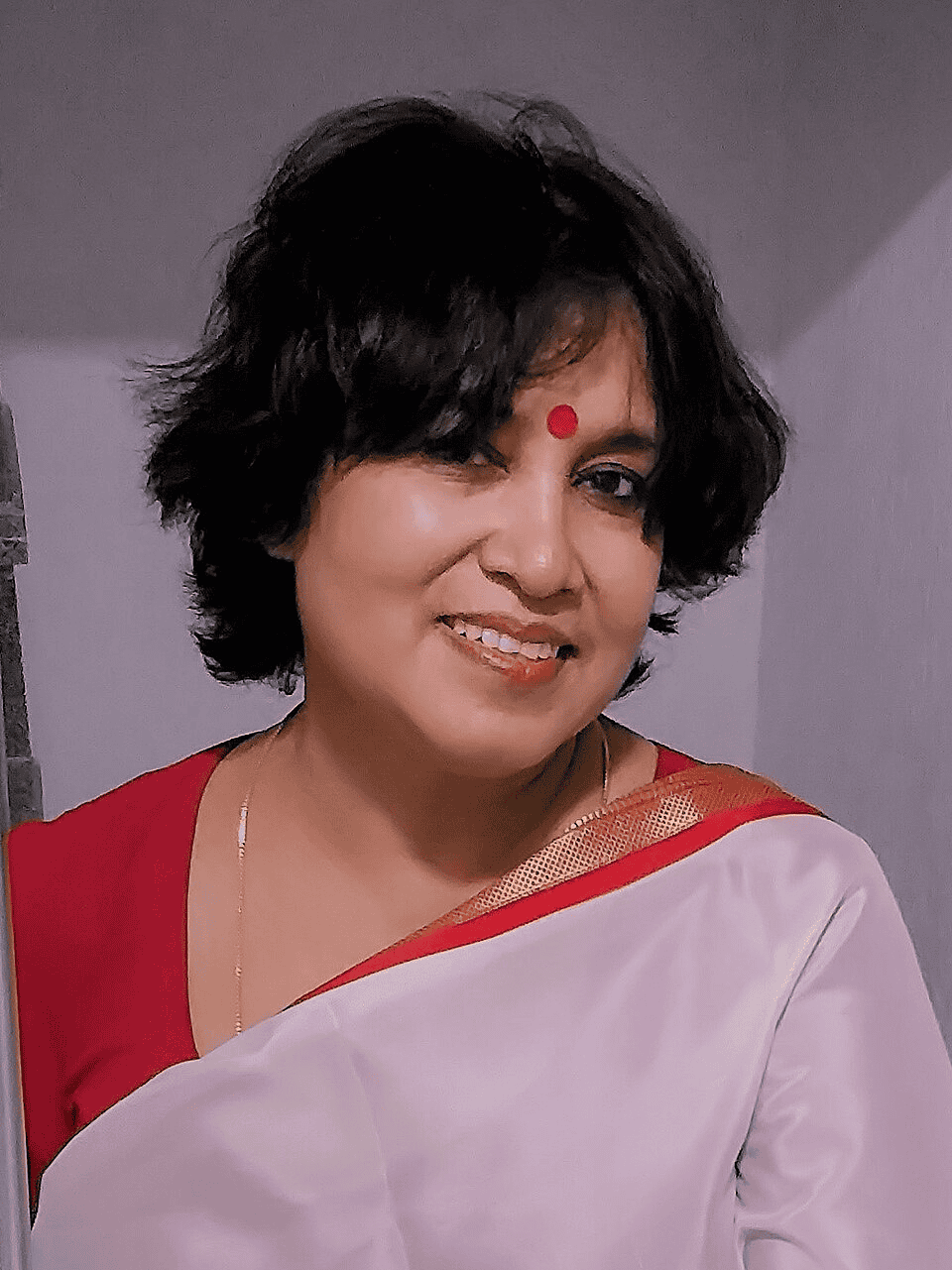
There is a particular kind of homelessness that has nothing to do with the absence of a roof. It is the homelessness of a writer who has a mother tongue but no country willing to let her speak it in peace. Taslima Nasrin has lived this condition for over thirty years now — driven from Dhaka in 1994, driven from Kolkata in 2007, and kept, in one form or another, at the margins of both ever since. So when she walked into the Indian Coffee House on College Street on 3 August 2026, signing the visitors’ register the way generations of Bengali writers before her had done, it was not simply a literary pilgrimage. It was the closest thing to a homecoming that history has so far allowed her.
I do not use that word loosely. Bangladesh is Nasrin’s home in the sense that matters most to any writer — it is the soil, the light, the particular cadence of Bengali that her poetry was born speaking. But Bangladesh remains a country she cannot enter; the fatwas and the revoked passport of 1994 were never formally undone, and no government in Dhaka has since been in a hurry to invite her back. Kolkata, by contrast, is the next best thing to home that exists for a Bengali writer barred from her own capital — a city that speaks her language, reads her books, argues about her at the very same Coffee House tables where Bengal has always argued about its writers. It is not Bangladesh. But it is Bangla. And for Nasrin, that has always counted for a great deal.
A Second Exile, Under a Different Government
It is worth being precise about how she came to be shut out of even this adopted home. The rupture is usually dated to November 2007, when protests over passages in her memoir Dwikhandito turned violent enough that the Left Front government of Buddhadeb Bhattacharjee deployed the Army in central Kolkata and had her removed from her rented residence within days, first to Jaipur and then to Delhi (Wikipedia: 2007 Kolkata riots; Deccan Herald). But what is easy to forget, and what deserves to be said plainly, is that the door did not reopen when the Left Front eventually fell. Mamata Banerjee’s Trinamool Congress swept to power in 2011 promising a break from three decades of Left rule — yet the informal ban on Nasrin’s presence in Bengal held firm through that government as well, remaining in force by most accounts through 2016 and beyond (Prokerala). In 2013, a Bengali television serial she had scripted, Dussahobas, was pulled before its premiere after Kolkata’s Tipu Sultan Mosque clergy objected and police warned the broadcast could stir unrest (Al Jazeera). In 2016, the release of Nirbasan — her memoir of the very expulsion that had exiled her from the city — was itself cancelled at the Kolkata Book Fair after what she called religious fanatics objected, forcing her publisher to hand out the book in the open air outside the tent built for it (BBC). The book sold out within a day of that improvised, tentless launch (Deccan Herald).
The pattern that emerges across governments of very different ideological colour is a sobering one: whichever party held Writers’ Buildings, the calculation about Nasrin’s safety and welcome in Bengal rarely changed. It was always easier to manage the street than to defend the writer.
What changed, finally, was the 2026 West Bengal Assembly election, in which the Bharatiya Janata Party won a decisive majority of 207 seats, ending Mamata Banerjee’s fifteen-year rule and installing Suvendu Adhikari as the state’s first BJP Chief Minister (Britannica; Wikipedia: Suvendu Adhikari ministry). Within months of taking office, Adhikari’s government did what three preceding administrations across two rival parties had not: it formally invited Nasrin back, gave her a civic reception, and organised a felicitation in her honour at Rabindra Sadan, telling her she was free to visit the state as often as she liked and that her security was now the Chief Minister’s personal responsibility (The Week; Republic World). Nasrin herself was careful, in her remarks at that felicitation, to insist that her life’s fight has been for women’s rights and free expression, not for or against any political party — a distinction worth honouring even as one notes which government, at last, chose to act on it (Metro Vaartha).
Even that evening was not entirely without the old friction. When Nasrin invited the poet Joy Goswami onto the stage, a section of the audience broke into protest, briefly halting the proceedings — a small reminder that the currents which drove her out in 2007 have not vanished from Bengal, only receded a little (Metro Vaartha).
The Long Road That Started in Dhaka
Bengal’s chapter, painful as it has been, is really only the second act of a story that began further east. Nasrin fled Bangladesh at the end of 1994, after her novel Lajja — an account of the persecution of Bangladesh’s Hindu minority following the demolition of the Babri Masjid — drew fatwas, a bounty on her head, and threats severe enough that one militant faction reportedly threatened to release thousands of poisonous snakes in Dhaka unless she was executed (Wikipedia: Taslima Nasrin). She spent two months in hiding before escaping to Sweden, her Bangladeshi passport revoked, her medical career abandoned for good. It is a measure of how far that rupture still reaches that thirty years on, she remains a Swedish citizen living in exile from the country her poetry still writes about, in the language it still writes in.
India, and Kolkata specifically, became the compromise — close enough to home to matter, far enough to survive in. She was not always safe there either: at the release of the Telugu edition of her book Shodh in Hyderabad in August 2007, some hundred protesters led by three state lawmakers stormed the press club, and Nasrin was reportedly slapped in the melee before organisers pulled the crowd back (NBC News). But Bengal, unlike Andhra Pradesh, was supposed to be different — it was supposed to be hers, in the way that a shared language makes a place feel owned rather than merely visited.
Why the Coffee House Mattered More Than the Reception
Official receptions can be arranged by any government with sufficient will. What cannot be arranged, and what therefore carries more weight, was the unhurried afternoon Nasrin spent at College Street two days after her formal felicitation — sitting in the same worn chairs where Bengal’s writers have debated literature and politics over cold coffee for the better part of a century, an experience she described simply as getting her life back (ETV Bharat). She spoke, too, of hoping to return for next year’s Kolkata Book Fair — the very institution that had once cancelled her book launch and then quietly sold out her memoir of exile from the open air outside its gates.
That is the real measure of what “home” means for a writer in Nasrin’s position. It is not a passport, and for her, tragically, it is still not Dhaka. It is a language spoken back to her without suspicion; a bookstall that stocks her without controversy; a coffee house that lets her sit unremarked among its regulars. Bengal has now offered her that, however belatedly, and however entangled the offer is with the politics of the government that extended it. Bangladesh has not, and there is no clear sign yet that it will.
An Unfinished Journey
Nasrin herself put it best, standing at Rabindra Sadan and telling the gathering that injustice, however long, cannot be permanent (Metro Vaartha). It is a line that carries the authority of someone who has tested the proposition against her own life not once but twice — first against Dhaka, then against Kolkata — and who is still, by her own admission, only halfway home. Bengal has reopened its doors. Bangladesh, the true north of her writing, remains a country she can enter only on the page. Until that changes, Kolkata — with its shared alphabet, its shared adda, its shared argument over what a woman is permitted to write — will have to remain the nearest thing to home that the world has been willing to give her.


No responses yet