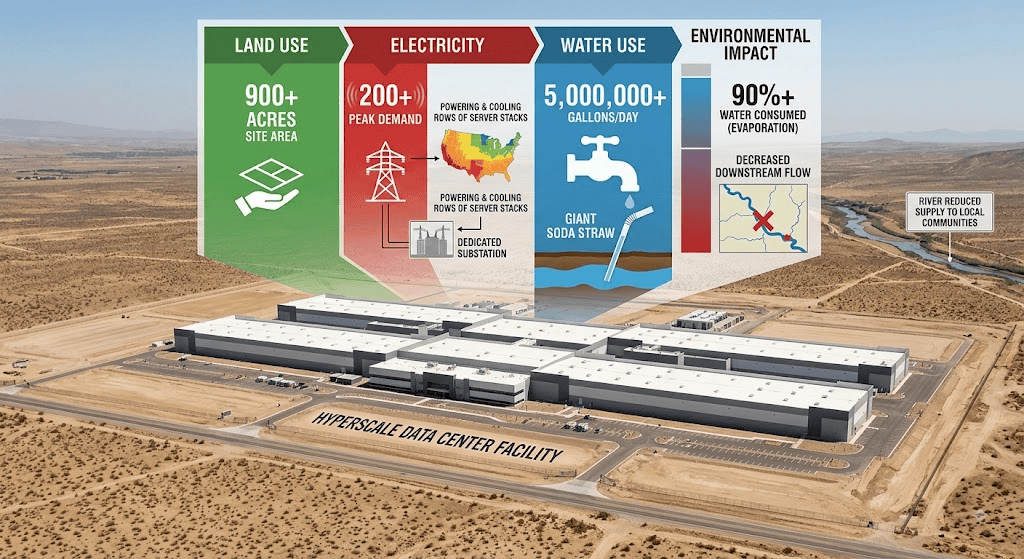
Every conversation about AI tends to circle back to models, benchmarks, and chips. What gets far less attention is the physical footprint underneath all of it — the gas turbines, pipelines, and water systems that keep data centers running around the clock. Two recent developments, one in the U.S. energy sector and one in coastal Andhra Pradesh, make that footprint impossible to ignore.
Why data centers are turning to gas in the first place
A recent industry analysis from energy data firm Enverus lays out a problem that’s now shaping where and how data centers get built: grid interconnection queues have become so backed up that waiting for a standard utility connection is no longer commercially viable for AI-scale facilities. Queue-to-commercial-operation timelines have stretched by roughly 60% since 2017, with projects targeting a 2025 first-power date now facing average waits of over 2,100 days — north of five years. Of the capacity currently sitting in these queues, only about one in ten projects is expected to actually get built.
Faced with that bottleneck, developers are increasingly generating power on-site rather than waiting on the grid — a model known as “behind-the-meter” (BTM) generation, where power flows directly from a turbine to the facility without ever touching the public grid. According to the Enverus analysis, natural gas has become the default fuel of choice for this approach, largely because renewables can’t currently match the continuous, high-density baseload that AI compute demands at scale. Solar and wind need land data centers don’t have to spare, and pairing renewables with enough battery storage to run 24/7 remains cost-prohibitive for most developers today.
The numbers involved are enormous. A single gigawatt of data center capacity running on gas is estimated to consume around 140 million cubic feet of gas per day — a figure that, industry analysts note, is still under 1% of daily production in a basin like Appalachia, but adds up quickly as more facilities come online simultaneously. That demand is now reshaping site selection itself: proximity to gas pipelines and firm transport capacity has become as important a factor for developers as land cost or fiber connectivity — sometimes more so.
What’s conspicuously unresolved, per the same industry reporting, is how emissions from all this behind-the-meter gas generation will actually be accounted for. Natural gas is often described by hyperscalers as a “bridge fuel” — a stopgap until cleaner baseload alternatives mature — but there’s no settled industry standard yet for how those emissions get reported or offset under corporate sustainability commitments. In effect, a huge and fast-growing category of emissions is being built first and audited later.
The other resource under strain: water
If gas is the flashpoint in the U.S., water is fast becoming the flashpoint in India — and the controversy playing out around Google’s largest-ever India investment shows exactly why.
Google has partnered with Gautam Adani’s group to build a $15 billion data center hub near Visakhapatnam in Andhra Pradesh, a project state officials have called historic and one that could create up to 188,000 jobs. But according to Reuters reporting from the construction site, the project is now facing multiple legal challenges and organized protests from environmental groups over exactly the two resources data centers are most notorious for straining: water and land.
The core of the dispute is stark. Visakhapatnam, a city of 2.5 million people where water rationing is already common, reportedly receives around 410 million litres of water a day against a stated requirement of 480 million — a shortfall even before a new industrial-scale water user enters the picture. An activist group called Jal Biradari (“Water Community”) has approached the Andhra Pradesh High Court arguing the project will strain supplies further, while a separate group, Green Visakha, has publicly questioned the state’s promise of a “guaranteed” 20-year water supply to the project given the city’s existing shortages. Separately, the Human Rights Forum has filed cases at India’s environmental court alleging the project was cleared without adequately assessing its impact on a rural drinking-water scheme.
The state government has pushed back firmly, telling Reuters that no water meant for rural or residential use will be diverted to the data centers, and that a nearby reservoir will not supply the project at all. Google, for its part, said the facility will use “advanced air cooling” specifically designed to protect local water resources, and that construction will proceed in line with applicable law. A separate strand of the litigation, still before the Andhra Pradesh High Court, concerns the project’s proximity — under a kilometre — to the Kambalakonda Wildlife Sanctuary, home to leopards and pangolins.
It’s worth noting this isn’t an isolated, India-specific backlash. Reuters reporting points out that similar opposition has been building in the U.S. too, with 142 separate protests recorded across 42 states in July alone, all raising comparable concerns about data centers’ water and electricity consumption. What’s different — and what several of the activists quoted in coverage of the Visakhapatnam project have stressed — is that the impact of that same global buildout pattern lands harder in a city already living with water rationing than it would in a water-secure one.
Two resources, one underlying story
Put side by side, the American gas story and the Indian water story are really the same story told through two different natural resources. In both cases, the industry’s timeline — chips shipping, models training, capacity going live — is moving faster than the infrastructure planning, regulatory review, and public consultation processes meant to govern how much gas gets burned or how much water gets drawn from an already-stressed system.
Neither Enverus’s operational guidance for gas-supply contracting nor the legal filings in Andhra Pradesh suggest anyone is deliberately cutting corners. What they do suggest is an industry that is, by its own admission, building the physical infrastructure of the AI boom before it has fully worked out how to measure, disclose, or govern that infrastructure’s environmental cost. For a technology sold on efficiency and optimization, that gap deserves as much scrutiny as the next model release.


No responses yet