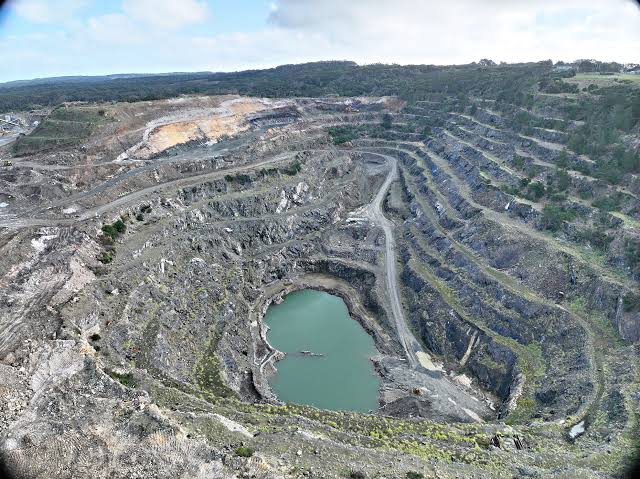
There’s a small, wind-battered mine on King Island, off Tasmania’s northwest coast, that has an unusual track record: for more than a hundred years, it has opened when the world is heading toward war, and closed when peace returns. It just reopened. And the reasons why — plus what it will take to run it — say as much about the planet’s environmental strains as they do about geopolitics.
A mine that tracks wars, not markets
The Dolphin tungsten mine first opened in 1917, in the middle of the First World War. It shut when the war ended, reopened in 1938 as the world edged toward the Second World War, got a boost from the Korean War, nearly died after Sputnik reshaped defence priorities, limped through Vietnam, and was mothballed when the Cold War ended in 1992. As Bloomberg Opinion columnist David Fickling put it in his account of visiting the site, tungsten mining functions almost like a “century-old prediction market for war” — despite having no futures contracts or forward curve to speak of.
On August 24, 2026, Dolphin returned to commercial operation for the first time in over three decades, backed by roughly $77 million in investment — a small sum by the standards of modern industry, but enough to reopen a mine that had waited out an entire post-Cold War peace. It’s expected to run for about 13 years, producing an average of 2,300 tonnes of tungsten annually, according to reporting from AAP.
Why tungsten, and why now
Tungsten is dense, has the highest melting point of any metal, and is used in armor-piercing rounds, missile components and armor plating — which is exactly why armies have wanted it since the First World War. What’s changed is the supply picture. China currently produces around 80% of the world’s tungsten, and it has increasingly been willing to use that dominance as leverage: weeks after President Trump took office in early 2025, Beijing imposed export controls on tungsten, joining rare earths, antimony and gallium as materials it has restricted for geopolitical effect. By mid-2026, China’s control over rare-earth magnet supplies had already forced a climbdown from the US on tariff policy — a preview of how tungsten controls could be used in a harder confrontation.
The price has responded accordingly. Tungsten has gone from roughly $300 per dry metric ton unit in early 2022 to more than $3,000 by mid-2026 — a tenfold jump — driven largely by China’s restrictions and what Fickling describes as “a strategic reassessment of warfare itself,” per his Odd Lots interview coverage. Ongoing conflicts are accelerating the squeeze: cruise missiles fired in Ukraine and the Middle East are steadily drawing down global tungsten stockpiles, industry analysts note.
Washington has responded with policy, not just rhetoric. US Department of Defense sourcing rules taking effect January 1, 2027 will restrict the use of tungsten metal powders and heavy alloys mined, refined or produced in China, according to CNBC’s reporting. That’s pushing new supply projects forward — Canada’s Almonty Industries restarted South Korea’s Sangdong mine after 30 years dormant, and a project in Kazakhstan is targeting 12,000 metric tons a year, about 15% of current global output. Australia, sitting on some of the world’s largest reserves of tungsten, lithium, rare earths, nickel and cobalt, is positioning itself as what Prime Minister Anthony Albanese has effectively called an offshore mine for the United States.
The environmental thread running through the same story
Here’s where the war-signal narrative and the environmental one intersect, and neither can really be told without the other.
First, the obvious tension: tungsten isn’t only a weapons material. It’s also used to harden wind turbine components, and it sits on Australia’s official critical minerals list alongside materials essential to renewable energy and battery technology, not just defence. The same supply chain squeeze that worries defence planners also threatens the rollout of clean energy infrastructure — meaning a rush to secure tungsten for missiles competes, materially and financially, with a rush to secure it for turbines.
Second, restarting century-old mines and greenlighting new ones from Kazakhstan to Tasmania inevitably raises the question of environmental cost — land disturbance, water use, and habitat impact — at exactly the moment global mineral demand is climbing for both military and green-tech reasons simultaneously. Dolphin’s operator, Group 6 Metals, has had to work through a formal Tasmanian Environmental Protection Authority approval process, including a mine closure, decommissioning and rehabilitation management plan that must be renewed annually, as reported by SmallCaps. The company has committed 33.7 hectares of land at the site as a conservation covenant to protect Blue Gum eucalyptus forest that provides habitat for threatened flora and fauna on King Island, and has pointed out that the mine’s redevelopment sits within the historical mine footprint rather than expanding the disturbed area, according to Australian Mining.
The mine has also drawn on Tasmania’s renewable-heavy grid — a $2 million government grant upgraded the power line supplying King Island, much of it generated from renewable sources, specifically to lower Dolphin’s carbon footprint during construction and operation. Group 6 Metals has additionally partnered with the University of Tasmania’s Centre for Ore Deposit and Earth Sciences, backed by a $3.5 million federal grant, to research more environmentally sustainable extraction methods for tungsten and other critical minerals — an acknowledgment that the industry’s environmental record needs active management, not just approval paperwork, as detailed by SmallCaps.
What it means
None of this guarantees a war is imminent — tungsten’s history as a leading indicator is suggestive, not predictive, and plenty of geopolitical tension resolves without conflict. But the reopening of a mine that has only ever come back to life ahead of major wars, at a moment when China is actively weaponizing its mineral dominance and Western governments are racing to build parallel supply chains, is a signal worth taking seriously rather than dismissing as a mining-sector curiosity.
What makes this moment distinct from earlier tungsten cycles is that the environmental stakes are now explicit and unavoidable. Every new mine approved to feed defence stockpiles also has to answer to environmental regulators, climate commitments and the same critical-mineral demand curve that clean energy depends on. The Dolphin mine’s own approval process — conservation covenants, renewable power, university research partnerships — shows an industry trying to reopen without repeating the environmental shortcuts of its earlier incarnations. Whether that holds as demand accelerates, and as more mines follow Dolphin’s lead in Kazakhstan, South Korea and elsewhere, will say a lot about whether the world can rearm and decarbonize at the same time — or whether one goal will end up quietly overriding the other.


No responses yet