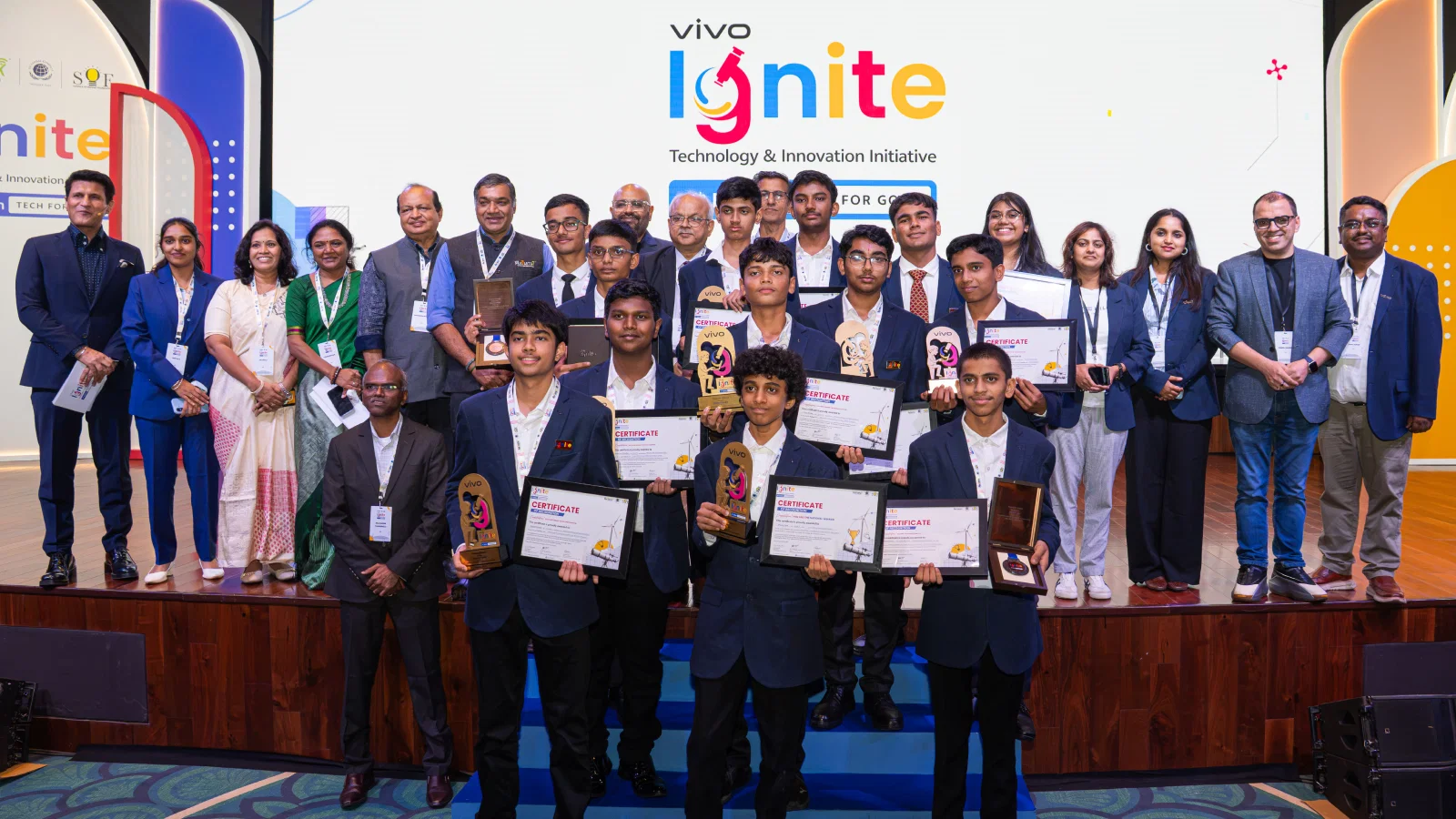
A Surat schoolboy’s machine-learning tool for estimating groundwater has won the fourth edition of vivo Ignite, the student innovation programme run by smartphone maker vivo India. Four of the top ten projects deal with water and the rest with personal safety or assistive technology, which suggests the kind of problems school students chose to tackle.
New Delhi, October 29, 2026: vivo India has named Dheyay Shah of RMG Maheshwari English School, Surat, Gujarat, the national winner of vivo Ignite 2026 for JALAAKAR – The Shape of Water: Predict, Alert, & Act. The result was announced at the National Finale at Bharat Mandapam, New Delhi, on October 28. The programme is open to students in Grades 8 to 12.
JALAAKAR combines historical borewell records, rainfall and soil-related data with machine-learning techniques to estimate groundwater availability at the taluka level, the company says, in order to support water-management decisions.
The programme in numbers
vivo says this edition drew more than 38,000 registrations and over 6,100 student ideas from more than 12,000 schools, across 4,500 cities and 705 districts, covering all 28 states and eight Union Territories, including 92 Aspirational Districts. The ten finalist projects involved 13 students: eight individual entries and two group projects. They were judged by a panel of academicians and industry experts on creativity, scientific application, feasibility, cost-effectiveness and potential social impact.
The programme offers educational scholarships and rewards worth up to ₹35 lakh, subject to terms and conditions. The release does not say how that sum is split among the winner, runners-up and other participants.
The top 10 projects
- JALAAKAR (Dheyay Shah, RMG Maheshwari English School, Surat): estimates groundwater availability at the taluka level using borewell records, rainfall and soil data.
- JalRakshak (Vidyut Sundar and Shreyan Limaye, Dhirubhai Ambani International School, Mumbai): uses borewell-specific time-series analysis to predict water-level decline, accounting for rainfall recharge and extraction.
- HydroPlastiNet (Anish Srinivas, Achyutha Pranav V Subramanian and Akhilesh Ram R, Padma Seshadri Bala Bhavan Senior Secondary School, Chennai): combines mechanical filtration with bentonite and activated charcoal to trap microplastics and adsorb dissolved pollutants.
- Project Unmuted – The Voice of Women (Anushka Bhattacharya, SNBP International School, Rahatani, Maharashtra): a platform using AI, cybersecurity and secure data management to give structured guidance to women facing cybercrime, drawing on existing deepfake-detection technology.
- Project IRIS (Ayushman Choudhary, Bhavan’s B.P. Vidya Mandir, Ashti, Nagpur): combines infrared reflectometry and inertial measurement to track eye direction and head movement, with potential assistive uses.
- AVRODH (Shaurya Dubey, Army Public School, Bareilly Cantt, Uttar Pradesh): uses safety interlocks, gas-threshold sensing, RFID presence detection and authorisation checks to help prevent unsafe entry into hazardous environments.
- Smart Device for Instant Helping during Vehicle Accidents (Abhinav Srivastava, SJS Shaktingar, Sonbhadra, Uttar Pradesh): senses potential accidents and can switch to backup power before placing a voice call to 112.
- DrishtiBodh (Jitesh Ladda, Scottish Academy, Parbhani, Maharashtra): a LiDAR-based collar that detects obstacles and gives directional vibration alerts to visually impaired users.
- AquaSentinel AI (Sai Adhrit Singh, Dr. Virendra Swaroop Education Centre, Kanpur): a school-level device that uses a colour-based chemical test, light sensing and an offline machine-learning model to estimate fluoride concentration in water.
- Neuradrive: Movement for All (Advik Jain, The Emerald Heights International School, Indore): explores using electrooculography and electroencephalography signals to turn eye movements and brain activity into commands for assistive applications.
The top two entries address groundwater and the third addresses water quality. The release describes the projects’ methods but not whether any has been tested outside a prototype or school setting.
Teachers and partners
vivo also honoured 10 educators under the National Teacher Innovation Fellowship, an extension of Ignite for innovative approaches to STEM teaching. They were selected from over 200 applications across 14 states and 26 districts. Knowledge partners for the edition were IITM Pravartak Technologies Foundation (the Technology Innovation Hub at IIT Madras), the Science Olympiad Foundation and UN Global Compact Network India, with Grant Thornton as process validator. The event was hosted by Rajiv Makhni.
“Our ambition is to build on this momentum by expanding our reach, particularly across government schools and Aspirational Districts, while strengthening mentorship and opportunities for students to take their ideas beyond the classroom,” said Geetaj Channana, Chief Corporate Communications Officer, vivo India. The company says it envisions Ignite “becoming India’s most credible school-level innovation platform.”
That ambition is the company’s own. The release gives no figures for the share of government-school participants, or for how many past winners have taken their ideas further.


No responses yet