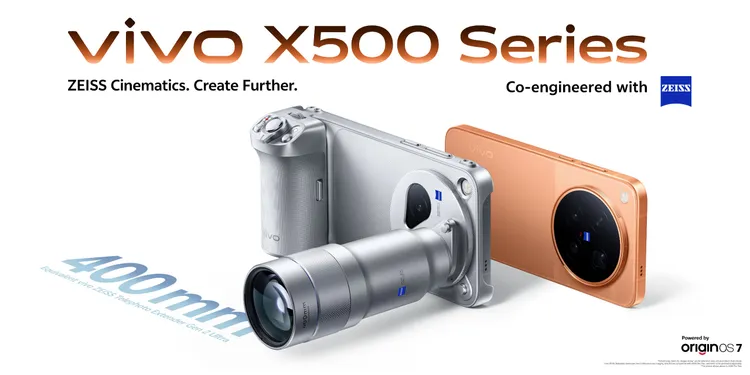
Vivo has never been shy about chasing the smartphone camera crown, and its newly unveiled X500 Pro Max looks like its most aggressive swing yet. Launched at an event in Shanghai, the phone leans almost entirely on imaging hardware and computational muscle to make its case — and in doing so, it pushes the entire camera-phone category a notch higher.
A camera system built with outside help, not just in-house tuning
The headline spec is a 1/1.28-inch 50MP main sensor — Sony’s newly developed Lytia 910 — paired with a 200MP telephoto lens offering 3.5x optical zoom and a 50MP ultrawide module. That combination alone would be notable, but what sets the X500 Pro Max apart is how deliberately Vivo has framed the camera as a joint engineering effort rather than a component checklist. The company calls its approach the BlueImage Dynamic Imaging Technology Stack, built through direct collaboration with three separate specialists: Sony for the sensor hardware, MediaTek for a chip tuned specifically around imaging workloads, and ZEISS for gimbal-level stabilization. Vivo is essentially arguing that no single supplier’s part can deliver flagship-grade photography on its own — the benchmark has to be set by how well the pieces are stitched together.
That stitching shows up most clearly in video. The X500 Pro Max can shoot 4K at 240 frames per second for slow-motion cinematic footage, alongside full 8K capture, powered by Vivo’s own custom V3 and VS1 imaging chips designed purely to boost image and video fidelity. Where past generations of camera phones treated video as an afterthought to still photography, Vivo is explicitly building this phone — and its Pro sibling — around video-first use cases, following the same playbook it used with the X300 Ultra earlier this year.
The rest of the hardware isn’t an afterthought either
Camera aside, the X500 Pro Max is a genuinely large flagship: a 6.85-inch AMOLED display running at a sharper 3168 x 1440 resolution than last year’s model, and an 8,000mAh battery — the biggest Vivo has ever put in a phone — which should comfortably stretch to roughly three days of typical use. Power comes from MediaTek’s newest Dimensity 9600 Pro chipset, built on a 2nm process, which brings a meaningful efficiency jump over the previous generation’s 3nm chips and helps justify a battery that size without the phone becoming a brick. It ships running OriginOS 7 on top of Android 17.
Vivo is also fielding two other variants alongside the Pro Max. The standard X500 Pro drops the telephoto lens but otherwise mirrors the Pro Max’s camera and video capabilities. The base X500 steps down to a Dimensity 9600M chipset and a less ambitious camera setup, but compensates with a still-substantial 7,500mAh battery.
Pricing and what comes next
In China, the X500 starts at roughly $830 (CNY equivalent), the X500 Pro at about $970, and the range-topping X500 Pro Max at approximately $1,045. Vivo has confirmed a global rollout is coming, though it hasn’t announced international timing or pricing yet — and international pricing for Vivo’s X-series phones typically runs well above the China launch price once import duties, taxes and market positioning are factored in.
Why this matters for the camera-phone race
Vivo’s X-series has spent the last couple of years steadily closing the gap with — and in several respects, moving ahead of — established camera-phone leaders like Samsung’s Ultra line and Apple’s Pro Max models, largely by treating the camera stack as a systems-engineering problem rather than a spec-sheet contest. The X500 Pro Max continues that trajectory: a large 1-inch-class main sensor, genuine optical zoom rather than aggressive digital cropping, and video specs (8K capture, 4K240 slow motion) that push past what most competing flagships currently offer out of the box. Combined with a battery capacity most rivals still don’t match, it’s a strong signal that Vivo intends the X500 Pro Max to be judged not against other Vivo phones, but against the best camera phones on the market, period — however long it takes to actually reach global shelves.


No responses yet