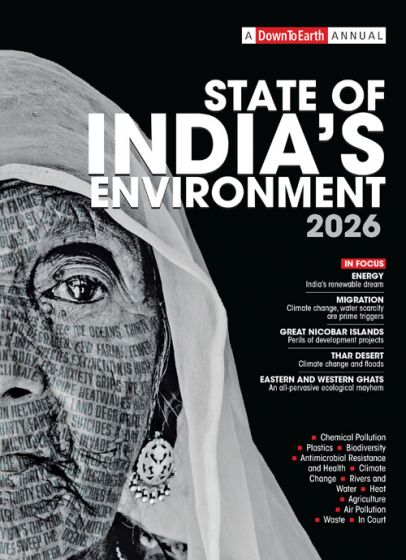
Every year since 1982, the Centre for Science and Environment (CSE), publisher of Down To Earth, has produced a document that functions less like a report card and more like a diagnostic scan. The State of India’s Environment 2026 is the latest edition, and its headline finding deserves to sit alongside GDP growth figures and infrastructure announcements in any serious conversation about where the country is headed: seven of the nine scientifically defined planetary boundaries have now been breached.
This is not an abstract global statistic being imported into an Indian news cycle. It is a framework increasingly used to explain why floods, heatwaves, crop failures and pollution spikes inside India are not isolated weather events but symptoms of systems under sustained ecological strain.
What a “Planetary Boundary” Actually Means
The concept, developed by earth-system scientists over the past decade and a half, identifies nine processes that keep the planet in the relatively stable state that allowed human civilisation to flourish — things like a functioning climate, intact biodiversity, and predictable freshwater cycles. Each boundary marks a threshold beyond which the risk of abrupt, potentially irreversible change increases sharply. Staying within them isn’t an environmental nicety; it’s closer to an operating manual for a habitable planet.
According to the CSE report, the seven boundaries now breached are:
- Climate change
- Biosphere integrity (biodiversity loss)
- Land-system change
- Freshwater depletion
- Biogeochemical flows (nitrogen and phosphorus cycles, largely from fertiliser use)
- Novel entities (plastics, synthetic chemicals, and other human-made substances now embedded in ecosystems)
- Ocean acidification — the newest addition to the list
That last one is worth pausing on. Ocean acidity has risen by an estimated 30–40 percent since the industrial era began, a shift that threatens marine food chains and, by extension, the protein supply of coastal populations far beyond India’s own shoreline. Its inclusion signals something important: the safe operating space for the planet is not shrinking gradually. It is shrinking in discrete, trackable jumps, and India — despite contributing a fraction of historical global emissions — is not insulated from any of them.
The Numbers Inside India’s Borders
If the planetary-boundary framework can feel distant, the report’s domestic figures are not. 2025, it notes, experienced extreme weather on 99 percent of days — the highest proportion in four years. Heatwaves, cold waves, heavy rainfall and flooding are no longer “unusual” events dotting the calendar; they are close to becoming the calendar’s default setting. The human cost attached to that number is stark: 4,419 deaths in 2025 attributed to extreme weather.
There is also a quieter, more structural failure buried in the report: India’s capacity to even measure the crisis is thin. Only 15 percent of the population lives within 10 kilometres of an air-quality monitoring station, meaning the remaining 85 percent — disproportionately concentrated in smaller towns and industrial belts rather than the metros that dominate pollution headlines — are essentially flying blind on one of the most immediate health hazards they face. You cannot manage what you do not monitor, and right now, most of India isn’t being monitored at all.
Layer on top of this the near-term forecast: the India Meteorological Department flagged in late August that strong El Niño conditions are strengthening over the equatorial Pacific, raising the likelihood of below-normal rainfall this monsoon season. A weak monsoon does not just mean a dry news cycle — it means pressure on crop yields, rural incomes and food prices, compounding the structural stress the CSE report describes.
The Viksit Bharat Collision Course
None of this arrives in a vacuum. India’s official long-term ambition, laid out repeatedly by the government, is Viksit Bharat @2047 — a “developed nation” vision timed to the centenary of independence, built on rapid industrial growth, energy expansion, urbanisation and digital infrastructure. It is, by most conventional economic measures, an admirable and necessary goal for a country still lifting hundreds of millions of people toward middle-class security.
But the CSE report’s implicit — and at points explicit — argument is that the current model of growth is running on a form of ecological credit that is close to being called in. The report frames this as a choice between two postures: one that treats environmental damage as something to be compensated for after the fact — offset schemes, afforestation drives launched in response to a specific project’s clearance, disaster relief funds — and one that treats ecological health as an input to be actively restored and protected before the damage occurs. The report’s own framing is blunt about the stakes: a degraded environment is not a side effect that can be cleaned up later at no cost to the economy — the two are inseparable.
That distinction matters enormously for how “development” gets defined over the next two decades. A reactive model can still produce impressive-looking growth numbers in the short term while quietly eroding the freshwater, soil and climate stability that long-term growth actually depends on. A restorative model asks harder, slower questions upfront — about where a data centre gets sited, what powers it, how much water a growing city can actually sustain, and whether a coal plant’s economics still hold up against the mounting cost of the weather extremes it helps drive.
Why This Should Matter to Anyone Outside the Environment Beat
It’s tempting to file planetary-boundary science under “climate reporting” and move on. That would be a mistake, for three reasons specific to India’s current moment.
First, the economic exposure is direct. Agriculture still employs a huge share of India’s workforce, and a country experiencing extreme weather on essentially one day in every one strains harvests, insurance markets, and rural demand — all of which ripple into the broader economy that Viksit Bharat depends on.
Second, the infrastructure buildout underway right now is planetary-boundary-relevant by design. India’s AI and data centre expansion, its EV transition, and its renewable energy build-out are all, in effect, bets on how the country manages freshwater depletion, land-system change and biogeochemical stress simultaneously with growth. Get the sequencing wrong, and the same infrastructure meant to power a “developed” India in 2047 could accelerate the very breaches the CSE report is warning about.
Third, and perhaps most consequential: measurement gaps are policy gaps. An 85-percent air-quality monitoring blind spot doesn’t just obscure a health crisis from the public — it obscures it from the policymakers who are supposed to be managing it. Restoration, in the CSE report’s own framing, is impossible to do proactively if you cannot see the problem coming in the first place.
The Twenty-Year Question
Viksit Bharat @2047 is, at its core, a bet on the next two decades. The State of India’s Environment 2026 report is a reminder that the ecological ledger on which that bet is being placed is already substantially overdrawn — not hypothetically, not in some distant future scenario, but across seven of nine measurable planetary systems, right now.
The report doesn’t argue against development. It argues against a specific kind of development — one that treats the environment as a cost centre to be managed after the fact rather than an asset to be protected while the growth is still happening. Whether India’s institutions, markets and infrastructure planners absorb that distinction in time may end up mattering more to the “developed nation” ambition than any single GDP target on the road to 2047.


No responses yet