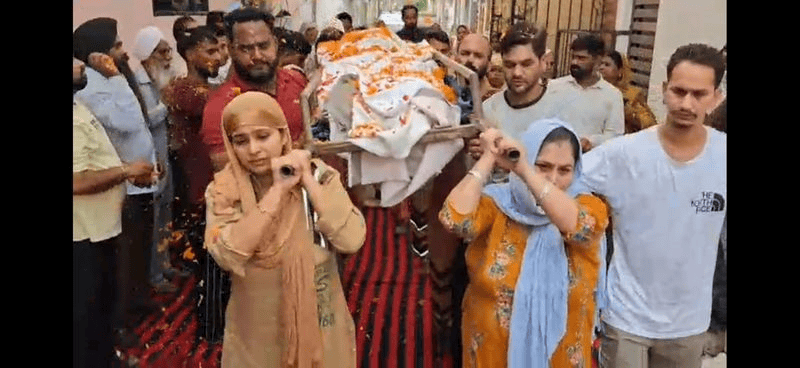
In most parts of North India, the sight of a funeral procession follows a script so familiar it barely registers as ritual anymore — it simply looks like “how things are done.” Sons lead. Sons lift the bier. Sons light the pyre. Daughters, and especially daughters-in-law, stand at the margins: mourning, feeding guests, comforting the family, but almost never touching the body itself. It is one of the last rituals in Indian life still governed almost entirely by gender, largely uncontested because death rites are treated as sacred, not social.
That is what makes a recent scene from Ludhiana worth pausing over.
According to The Tribune‘s report, when Sukhdev Kaur passed away, her family did something almost nobody in her village had seen before: her two daughters-in-law placed her body on their shoulders and led the funeral party toward the ambulance, walking in front while her sons followed behind. The family had pledged, nearly a decade earlier, to donate Sukhdev Kaur’s body to a medical college for research and her eyes to an eye surgeon — itself a quiet departure from convention. But it was the sight of the women carrying her, not the men, that turned a private family decision into a video shared across social media.
Per the report, the family follows Dera Sacha Sauda, whose teachings the family credits for their approach to gender. Sukhdev Kaur’s son, Yadvinder Singh, said his mother had told her daughters-in-law long before she died that they — not her sons — would carry her on their shoulders during her final journey, because “our Dera teaches us the importance of girls in society.” Another Dera follower quoted in the piece, Butta Singh, pointed to the group’s practice of mass marriages, where grooms are sometimes taken to live with the bride’s family instead of the reverse, as evidence of a broader belief that men and women should be treated as equals.
Why a Shoulder Means So Much
To an outsider, it might look like a minor procedural change — who holds which end of a stretcher. But in the logic of Hindu, Sikh, and broader North Indian death customs, who is allowed to touch, carry, or perform rites for a body is not incidental. It is the ritual’s entire meaning.
Last rites in most of these traditions are built around the idea of lineage continuation: a son (ideally the eldest) lights the pyre because sons are understood to carry the family name and its debts — including a symbolic debt to parents — forward. Daughters, once married, are traditionally considered to belong to their husband’s family, severed ritually from their natal home. Daughters-in-law, by contrast, are considered “outsiders” who have married into the family; their role at a death is almost always in the domestic, emotional periphery — never in the procession itself, and certainly never as pallbearers.
So when two daughters-in-law shoulder their mother-in-law’s body, they are not just doing a physically demanding task usually reserved for men. They are being formally recognized, in the community’s most symbolically loaded ritual, as full members of the family — as trusted, as capable, as worthy of literally bearing the family’s weight. That recognition, extended by a mother-in-law to her daughters-in-law specifically, cuts against one of the most durable and least-discussed hierarchies in Indian domestic life: the traditional power imbalance between a mother-in-law and the women who marry into her household.
What It Says About the Patriarchal Household
Indian feminist scholarship has long pointed out that patriarchy in South Asia doesn’t operate only, or even mainly, through men oppressing women. It is frequently enforced and reproduced within the household by older women — mothers-in-law who impose on daughters-in-law the same restrictions, deference, and diminished status they themselves once endured. This is sometimes described as patriarchy’s way of co-opting women into maintaining the very system that constrained them.
Seen against that backdrop, Sukhdev Kaur’s choice becomes more pointed. She did not simply tolerate a modern shift; she actively planned it, telling her daughters-in-law years in advance that they would lead her final procession. In effect, a mother-in-law used her own funeral — the one ritual where a family’s real hierarchy is laid bare for the whole community to see — to publicly elevate the standing of the women who married into her family. It is a rare instance of an older woman using the weight of tradition itself to dismantle a small piece of it, rather than defend it.
That the family additionally chose to donate her body for medical research and her eyes for transplant only reinforces the theme: these are decisions that treat the body pragmatically and communally, rather than as an object bound entirely by caste, gender, or ritual purity rules — decisions the report says were themselves shaped by the family’s spiritual convictions about gender equality.
Ritual as a Site of Slow Social Change
It would be easy to read a single family’s funeral as too small an event to carry sociological weight. But rituals — weddings, funerals, naming ceremonies — are precisely where patriarchal norms are most rigid and, historically, where change has been slowest to arrive, because they are wrapped in religious sanctity rather than treated as negotiable social custom. Reforms to inheritance law, workplace equality, or education access have moved faster in India over the last few decades than reforms to who is “allowed” to perform a parent’s last rites.
That’s also why moments like this one travel: a video of two women carrying a body is startling not because it is radical in a legal or political sense, but because it visibly breaks a script millions of people have never seen broken. Viral attention to scenes like this can matter less for the specific family involved and more for what it makes newly imaginable to everyone watching — a daughter-in-law in Punjab, a mother-in-law in Haryana, a son who has always assumed the role was automatically his.
None of this suggests Dera Sacha Sauda’s practices, mass marriages included, are free of controversy, nor that one family’s ritual choice signals an imminent, wholesale shift in Indian funeral customs, which remain overwhelmingly patrilineal. But it does suggest something worth noticing: that gender equality in India is being renegotiated not only in courtrooms, boardrooms, and legislatures, but sometimes on a village road in Ludhiana, on the shoulders of two women carrying a woman who chose, quite deliberately, to trust them with her final journey.


No responses yet