Most “best teacher” stories lead with the medal. This one leads with the moss.
Long before Manjari V. Mahajan’s name appeared on a national shortlist, students at a modest government senior secondary school in Hamirpur district were doing something unusual for a school timetable: learning to weave with wild grass. It’s a craft that had been quietly vanishing from Himachali households for a generation — the kind of skill grandmothers once passed down and modern classrooms had no room for. Mahajan’s school found room for it, folding it into lessons on waste segregation, water harvesting and campus biodiversity rather than treating it as a one-off cultural activity day.
That combination — heritage skills stitched into environmental science — is what separates this story from the usual “school wins award” template, and it’s also what eventually caught the attention of India’s Ministry of Education.
From a Single School’s Habit to a State Award
The transformation took root at Government Senior Secondary School, Bhaleth, where Mahajan served as principal before her recent transfer. Under her charge, the school didn’t just talk about sustainability — it built a track record. Bhaleth picked up the Waste Warrior Award in 2025 for its waste-management practices, and followed it up with the Environment Leadership Award in 2026, recognition for sustained work on conservation and campus ecology rather than a single showcase project.
Two consecutive environmental honours for the same school, under the same leadership, is the kind of pattern that tends to get noticed by education authorities scouting for the National Teachers’ Award — and it did.
The National Stage: 48 Educators, One Hamirpur Name
Mahajan has since moved to lead PM Shri Government Senior Secondary School, Sujanpur Tihra, also in Hamirpur district. It was from this new post that her name went forward for the National Teachers’ Award 2026 — one of only 48 teachers selected nationwide, and, notably, the sole Himachal educator to make the final cut after three names were initially recommended from the state.
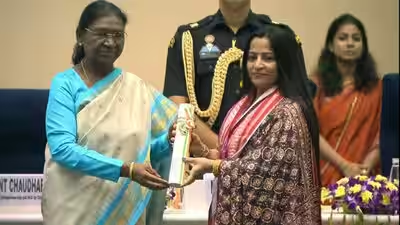
President Droupadi Murmu presented the award at Vigyan Bhawan in New Delhi on Teachers’ Day, September 5, 2026 — a ceremony that recognised Mahajan’s broader record of innovative teaching, school leadership and environmental initiative, not the grass-craft classes alone. But those classes are arguably the most tellable part of the story: proof that a rural government school, working with no special budget beyond imagination, can turn a fading local tradition into a national talking point about what sustainability education can look like outside the metros.
Why This Story Matters Beyond Hamirpur
Government schools in hill states rarely make education headlines for reasons other than infrastructure gaps. Bhaleth and Sujanpur Tihra’s back-to-back recognitions flip that script — they suggest that environmental literacy, taught through hands-on, locally rooted practice rather than textbook theory, can be a genuine differentiator for public education, even in resource-constrained settings.
For a state whose economy and identity are closely tied to its ecology, a principal who turned waste segregation, water conservation and a nearly-lost grass craft into award-winning classroom practice offers a small but instructive model — one that other government schools, in Himachal and beyond, may find easier to copy than a big-budget green initiative.


No responses yet