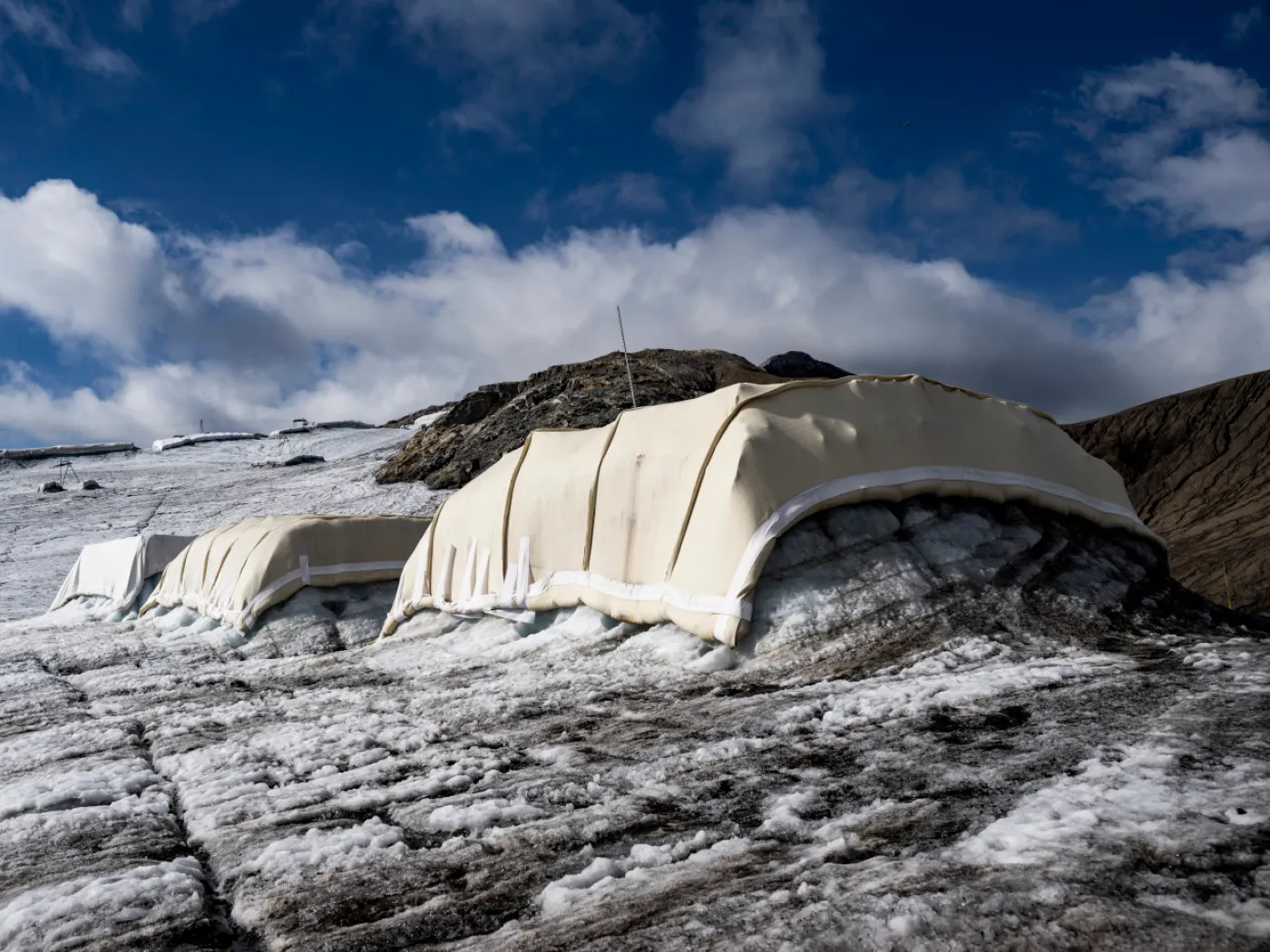
As Switzerland’s glaciers continue to shrink under record summer heat, scientists in the Alps have turned to an unlikely ally in the fight to slow the melt: sheep’s wool.
The experiment, called “Keep It Wool,” is being run on the Tsanfleuron Glacier at Glacier 3000 near Les Diablerets in western Switzerland. It’s led by the environmental group Summit Foundation together with the University of Lausanne, and its results were presented at a press conference on September 2, 2026.
Why Wool, and Why Now
For years, glacier conservation teams have used synthetic tarpaulins — large geotextile sheets — to cover sections of ice and snow through the summer. The idea is simple: white or reflective covers bounce sunlight away from the ice, reducing the heat it absorbs and slowing how fast it melts. It’s a technique already used in “snow farming,” where ski resorts protect snow stockpiles for the following season.
The problem is what those tarpaulins are made of. Being plastic-based, they shed microfibres into the surrounding environment over time — a form of pollution scientists are increasingly trying to avoid, especially in fragile alpine ecosystems.
That’s where sheep wool comes in. Switzerland produces a significant amount of wool each year that never enters the commercial market — researchers involved in the project say that roughly 40–70% of Swiss wool goes unused annually, much of it composted or simply incinerated. The “Keep It Wool” team saw an opportunity to test whether this discarded natural fibre could do the same job as plastic sheeting, without the pollution problem.
How the Test Went
Wool coverings, woven into blankets by local craftspeople, were laid across sections of the Tsanfleuron Glacier alongside traditional synthetic covers, so researchers could directly compare how each performed over the season.
The early results have reportedly exceeded expectations: the wool covers limited ice melt about as effectively as the synthetic geotextiles they were tested against. Elliot Gaffiot, a student involved in the project, said the team hadn’t been sure what to expect going in, but the outcome was one they could see and physically touch — and it worked far better than anticipated.
Not a Fix for Climate Change
Even so, the researchers behind the project are careful not to oversell it. Protective covers of any kind — wool or synthetic — currently shield only about 0.02% of Switzerland’s total glacier surface, a fraction too small to meaningfully slow the country’s overall ice loss. Scientists involved stress that cutting greenhouse gas emissions remains the only real long-term solution to glacier retreat; wool covers are, at best, a localized and more sustainable stopgap for specific sites.
The stakes behind the research are real. This year’s record heat melted snow on Swiss glaciers weeks earlier than usual, accelerating the kind of ice loss that has been linked to increased rockslide risk in the Alps — including the landslide that devastated the village of Blatten in 2025 — as well as glacial flood risks seen elsewhere in mountain regions such as the Himalayas.
What Comes Next
If wool continues to hold up as a viable, biodegradable alternative to plastic geotextiles, it could open a small but meaningful path for using a genuinely local, low-impact material in alpine conservation — while also giving Swiss wool, most of which currently goes to waste, a second life protecting the very landscape its sheep graze on.


No responses yet