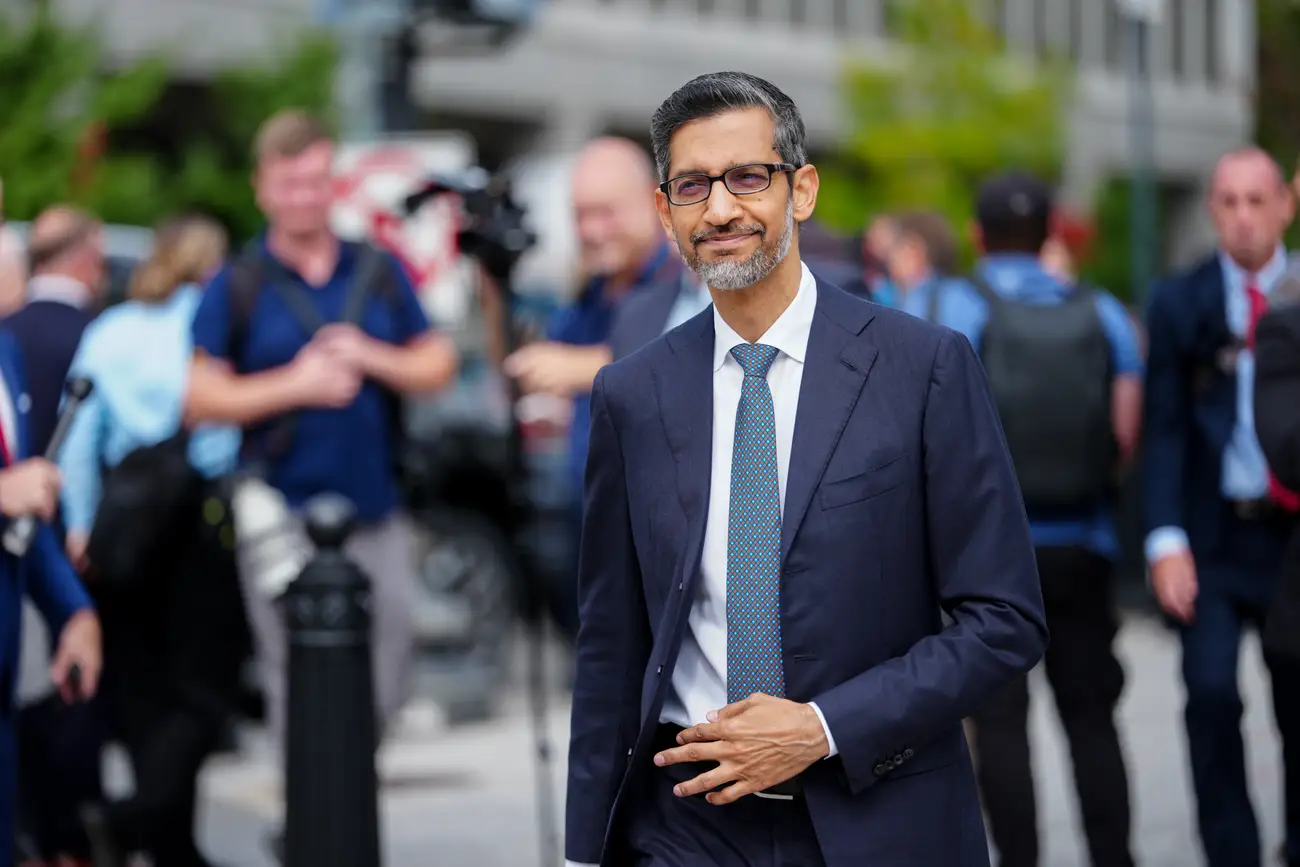
Alphabet lost just over $500 billion (£374 billion) of market value in a single session after admitting that its own AI answers are earning less advertising money than traditional search. The fall, which came as Amazon and Microsoft also reported huge AI spending, has sharpened a question that now hangs over the whole technology industry: who will actually be paid for AI?
Alphabet shares fell by more than 12% on Thursday to a six-month low, a day after the Google owner published its September-quarter results. Its total stock market value dropped to $3.46 trillion from $3.97 trillion the day before, according to the BBC. Bloomberg called it Alphabet’s largest one-day market value loss on record. According to a separate market report, it is also the second-largest one-day loss in Wall Street history, behind Nvidia’s $593 billion fall in January 2025.
What Google said
Total revenue grew 25% to $127.6 billion, but missed analysts’ forecasts, particularly in advertising. Search and other revenue rose 12% to $63.4 billion, down from 19% growth in the first quarter and 17% in the second, and short of the $64.9 billion analysts expected, according to The Next Web and Implicator.
The explanation came from Philipp Schindler, Google’s chief business officer. “The strong growth in AI Mode queries had an impact because of the lower monetization we were seeing in AI Mode,” he said, according to The Next Web. AI Mode is Google’s conversational search, where users get written answers instead of a page of links with ads beside them. Schindler also said he felt “very good about our trajectory”. Google says click-through rates for sponsored and organic product listings in AI Mode are already similar, and that queries in AI Mode are about three times longer than traditional searches. Executives also pointed to exchange rates as the biggest drag on search growth.
Kim Scott, who formerly led Google’s advertising business, told the BBC’s Today programme that the company would “rather eat its own lunch than allow someone else to eat their lunch”. She said Google was founded on long-term bets on technology, even when they hurt it in the short term.
The bill for AI
Behind the share price is spending. Google’s free cash flow was negative $9.1 billion in the quarter, only the second negative quarter since its 2004 listing, according to Implicator. That figure includes a $5.2 billion payment to settle a 2018 European fine. Capital spending was $51.3 billion in the quarter, up from $44.9 billion, and the chief financial officer reiterated 2026 capex of up to $205 billion.
Google Cloud was the bright spot, with revenue up 103% to $30.7 billion, above analysts’ $29.2 billion estimate. Implicator reports that over a third of that growth comes from a joint venture Alphabet partly owns, which complicates the picture.
Amazon and Microsoft
Amazon’s shares fell 6% in after-hours trading on Thursday. Quarterly sales grew 11% to $201 billion, but the company reported a cash flow figure of negative $42 billion, the BBC said, with spending up six-fold over three months. Chief executive Andy Jassy said Amazon had a chance at two businesses that could each bring in $1 trillion: its cloud services and its retail stores. He also pointed to the company’s own chips and its Bedrock AI platform. “People always assume whatever is in the lead early on will be the only thing that people use – it’s never true,” he said. Asked repeatedly about the spending, he admitted it “would be more convenient” if it were spread over 25 years: “That’s not the world we live in.”
Microsoft fell by less than 1%. Revenue grew 19% to $92.3 billion, and its cloud business grew 30% to $63 billion. Chief executive Satya Nadella said Copilot’s automated tasks have “nearly double[d] since July” and daily users have grown 500% from a year ago. The BBC reported the company spent around $5 billion less on AI-dedicated investments, but Implicator reports its capital spending rose to $45.2 billion. The two accounts appear to measure different things, and the difference is not explained in either report.
What it means
For investors, the market is weighing growth against cash burn. Forrester analyst Tracy Woo said Alphabet’s search results highlight “the challenge of funding massive AI investments while maintaining the strength of established businesses”. JonesTrading’s Mike O’Rourke put it as “one of the companies most aggressively investing in AI to protect its core businesses showed vulnerability to AI”. Others urge caution. D.A. Davidson’s Gil Luria said investors may fear “AI has finally come for Google” but would not draw conclusions from one quarter, and Rosenblatt’s Scott Devitt called it “not a sea change”.
For advertisers and publishers in India, the timing matters. Google said ads in AI Mode now reach ten more countries, India among them, with Brazil, Mexico and the UK following in the fourth quarter. Brands buying search ads in India will see more of their budgets pass through AI answers. Whether those ads convert as well as the old ones is the same question that just cost Alphabet half a trillion dollars in value. Publishers and sites that depend on search traffic, including independent outlets, face the related risk that conversational answers reduce clicks, though Google says search queries grew at their fastest rate in five years.
For the AI economy, the three updates show that spending is outrunning proven returns, at least in the short run. Microsoft shows demand is real, Google shows the cost of cannibalising a profitable product, and Amazon shows that even a booming cloud business does not fully cover the build-out. Woo said Wall Street is trying to look further into the future to see where AI value will ultimately be captured. NewStreet Research estimates it could take until the first half of 2027 for Alphabet to restore faith in search fundamentals and AI monetisation.
What to watch
Alphabet will need to show that AI Mode ads close the monetisation gap, and that its capex produces cloud revenue faster than it consumes cash. Currency effects are expected to be a larger drag in the fourth quarter. For smaller companies, including those in India that rely on cloud and search, the question is whether the cost of AI infrastructure is eventually passed on through higher prices.


No responses yet