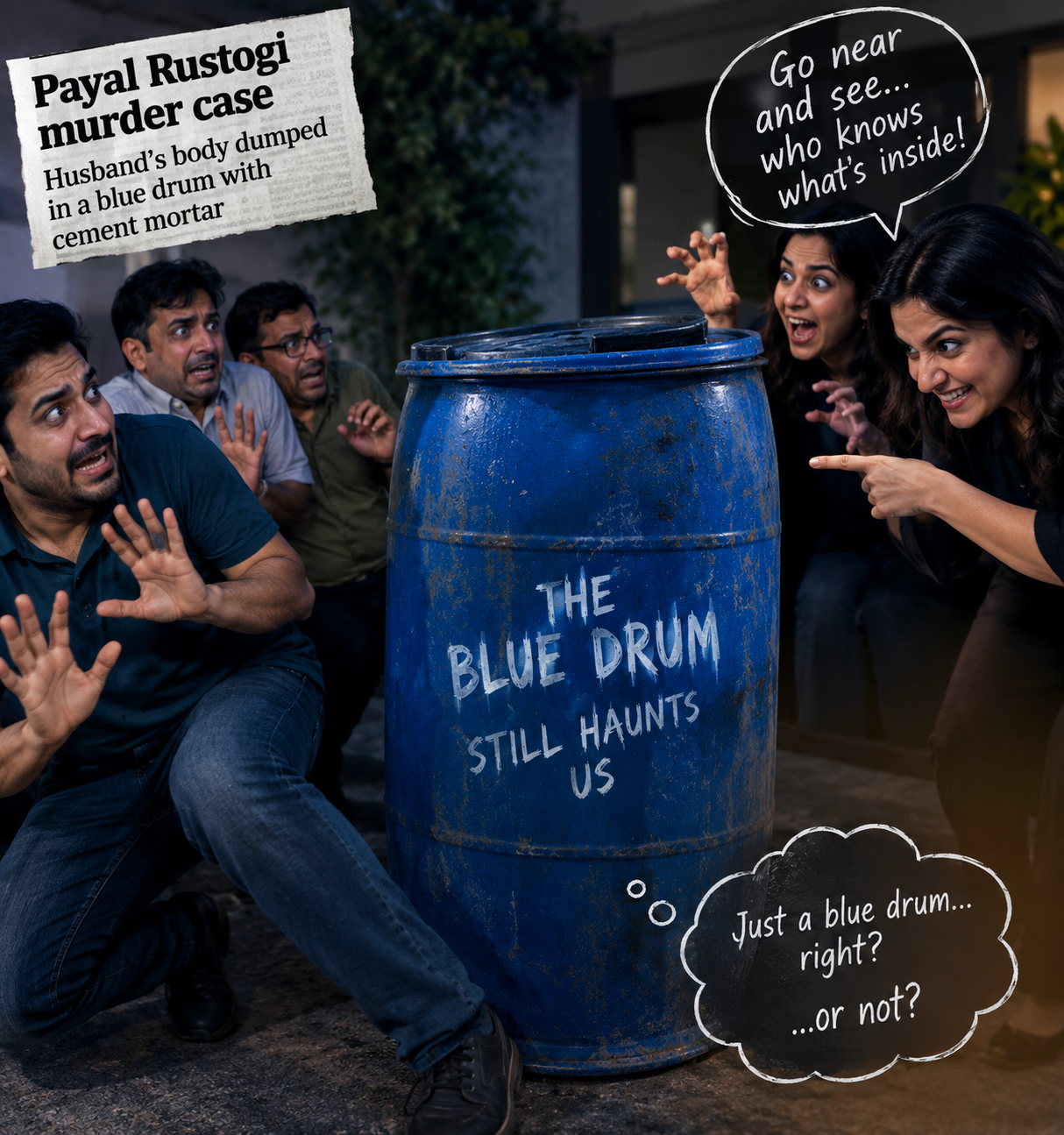
It holds water, grain, sometimes cement. In March 2025 it also became a punchline.

When the Meerut police cut open a blue drum and found the remains of merchant navy officer Saurabh Rajput, they ended one murder investigation and began something larger. Within days the drum was a meme template. Men posted reels in which they bolted from the sight of a wife carrying one. On X, one user wrote, “When you see A woman carrying Blue Drum!! RUN.” Business Standard reported that drum sellers in Meerut saw sales fall sharply, because buyers now associated the colour with the crime. The Quint found newly married couples being gifted blue drums by friends, as a joke.
Now, with Muskan Rastogi and Sahil Shukla sentenced to death on October 14 for the killing, the drum is back in the conversation. The more interesting question is what it came to stand for.
The joke that was never only a joke
Humour was the first reaction, and it was not harmless to everyone. Prarthana Mitra of the non-profit Point of View told The Quint that viral templates used “to malign a particular group of people (in the blue drum case, to villainise married women) can generate detrimental patriarchal narratives at a large scale.” Critics argued that the same internet that joked about a murdered husband had laughed less at the many women killed by partners. X user Deepika Narayan Bhardwaj wrote that if the genders were reversed, the reaction would be called “Blatant display of Society’s Misogyny.”
Both points can be true at once. A crime that was in no way a joke was turned into one, and the joke carried a message: marriage is risky for men.
A second case sharpened the fear
Three months later, the Meghalaya honeymoon murder gave the anxiety a second face. Raja Raghuvanshi, 29, went missing with his wife Sonam on May 23, 2025. His body was found on June 2. Meghalaya Police arrested Sonam on June 9 and alleged that she had hired contract killers. Her family has disputed the police account and sought a CBI probe, and the case is still being investigated, so every claim about it remains an allegation.
Together, the Meerut and Meghalaya cases changed the tone of many online conversations. Spiritual leader Dhirendra Shastri, as reported by Business Standard, said he was relieved not to be married. What had been rare headlines was now read as a trend.
What the numbers say, and what they don’t
Here the debate needs care, because the data cuts in several directions.
- Violence against women remains far larger in recorded cases. NCRB data for 2023 shows 4,48,211 crimes against women, including 1,33,676 cases of cruelty by husband or relatives (Section 498A) and 6,156 dowry deaths.
- Men’s distress is real and under-discussed. A 2023 petition before the Supreme Court cited NCRB 2021 figures: of 1,64,033 suicides, 81,063 were married men and 28,680 were married women. The petition said 33.2 per cent of men who died by suicide cited family problems, and 4.8 per cent cited marriage-related issues. These figures come from the petition and the report does not independently verify them, and a suicide figure does not by itself show harassment by a spouse.
- The court did not accept that leap. On July 3, 2023, Justices Surya Kant and Dipankar Datta indicated they would not entertain the plea for a “National Commission for Men,” and it was withdrawn. The bench said “the law takes care of this, there are adequate provisions,” and asked for data on young women dying within a few years of marriage.
India has no reliable national count of men killed or abused by wives, and the two murder cases above, however shocking, cannot be read as a statistical trend.
The false-case anxiety
A second strand of the men’s safety debate is about the law itself. The Supreme Court has repeatedly cautioned against mechanical use of Section 498A. In Archin Gupta v. State of Haryana (2025) it said that “many times, the parents, including the close relatives of the wife, make a mountain out of a mole.” In Kahkashan Kausar v. State of Bihar (2022) it noted that “a criminal trial leading to an eventual acquittal also inflicts severe scars upon the accused.” In Geddam Jhansi v. State of Telangana (2025) it warned against “criminalising domestic disputes without specific allegations and credible materials.” In Janshruti v. Union of India (2025), the same court upheld Section 498A’s constitutionality and said “the harsh truth is that dowry continues to persist as a deeply entrenched social evil.”
That is the state of the argument: courts recognise that the provision is sometimes misused, and that it is also still needed. The 2024 death of Bengaluru techie Atul Subhash, who had faced a long legal battle with his wife and in-laws, brought the first half of that sentence into public view. His family’s allegations and the legal proceedings are matters for the courts, and no verdict on them was found in the reports reviewed.
What the drum really measures
Seen soberly, the blue drum shows how quickly a single crime can become a stereotype. Rajput’s murder was a case of alleged betrayal and violence inside a marriage, proved to the satisfaction of a trial court. It did not show that wives are dangerous, any more than murders of wives show that husbands are. What it did show is that India has few places where a man in a failing marriage can speak openly, and that the same internet that laughs at him is quick to treat his fear as either a joke or a political cause.
The more useful lessons are quieter ones: fast investigation of every complaint regardless of gender, evidence-based use of 498A, counselling and helplines that do not assume who the victim is, and journalism that resists turning a killing into a meme.


No responses yet