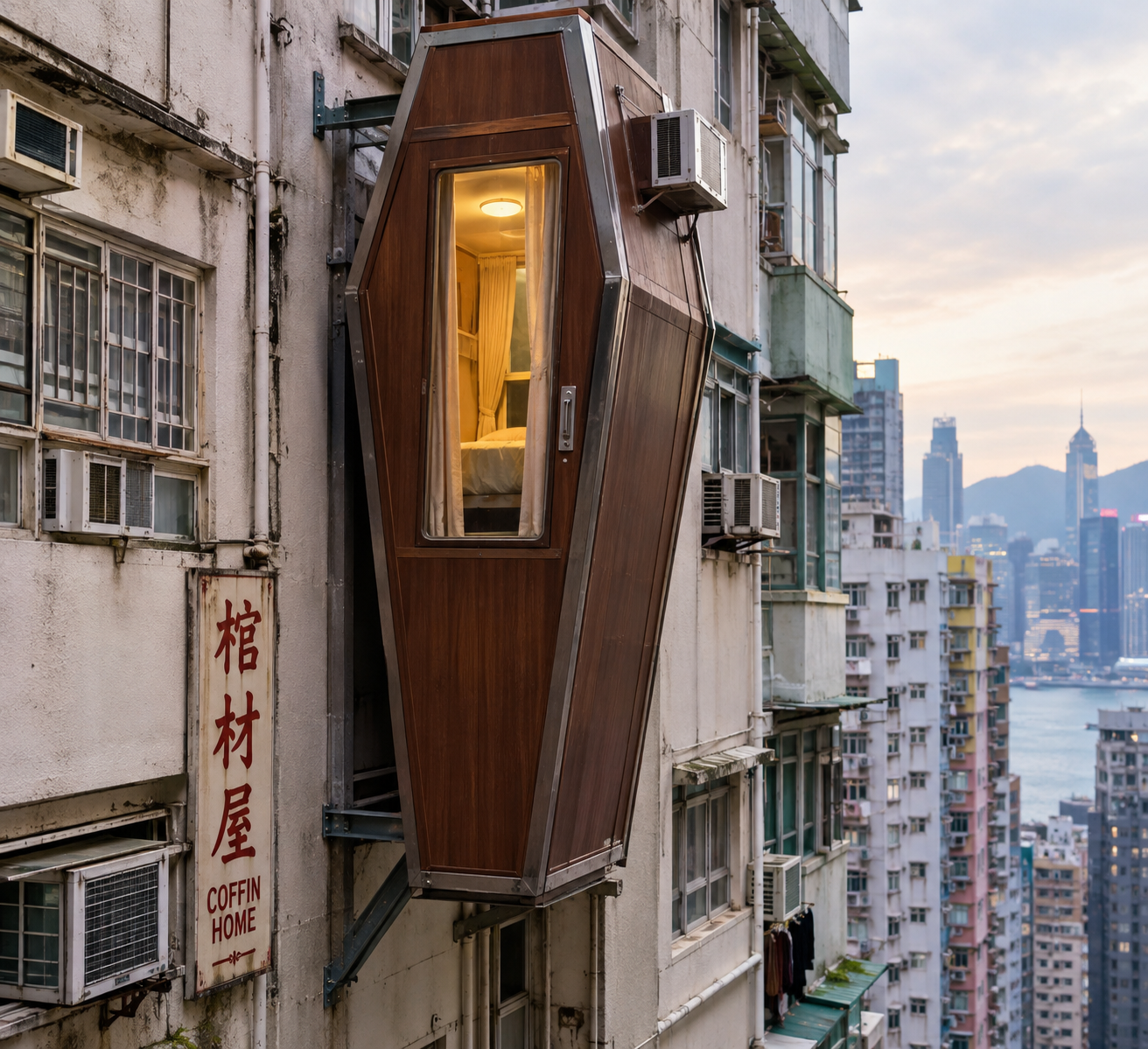
In one of Hong Kong’s subdivided flats, a homemaker named Jimmy Au sleeps in a bunk bed with her husband and their son. Her flat is one of four units carved out of a single apartment, and only a curtain separates the bathroom from the kitchen. The family pays about $460 a month, roughly half of her husband’s income from irregular renovation work. She has never measured the room. “I’m taking it day by day,” she told the Associated Press. “It’d be worse if I think about it so much I develop mental problems.”
Her story, as reported by the AP in February 2025, is one of many in a city that is among the world’s richest and most expensive. It is also not a Hong Kong story alone. From Seoul to Tokyo, people who work, or once worked, are ending up in homes that are small enough to be compared to a coffin.
The cubicle and the city that built it
Hong Kong packs about 7.5 million people into a city where only 7 per cent of the land is residential. About 220,000 people live in subdivided flats, according to the AP: migrants, labourers, students and young professionals. The median monthly rent for such a unit is HK$5,000, about US$640. The wait for a public rental flat averaged 5.5 years as of September 2024, according to the same report.
The extreme end of this system is what the city calls “cage homes” and what the world calls “coffin homes.” Reporting by Yahoo Finance, drawing on Vice and the South China Morning Post, says a 400 sq ft flat can be illegally split into nearly 20 sealed bunk spaces, each about 6 by 2.5 feet. Kitchens and toilets are shared, and rats and cockroaches are common, according to the SCMP. Tenants told the newspaper they felt ashamed and depressed.
“Bed spaces”, where a single room is divided into bunk sleeping areas, are the bottom rung. Law Chung Yu, who cannot work because of a health problem and lives on government subsidies, rents one layer of a bunk bed in a bed space in Sham Shui Po for about $280 a month, roughly 30 per cent of his subsidy. He shares a bathroom with neighbours in an apartment he describes as lice-infested.
Work does not guarantee a way out
Poverty here is not always unemployment. Fafa Ching is a security guard. She has lived in several subdivided flats for over a decade, pays about $490 a month and has no sink in her bathroom, so she washes her face with water collected from the showerhead in a basin. She has waited eight years for a public flat.
Children are in these homes too. The Yahoo Finance report says about 40,000 of the roughly 220,000 people in such conditions are children, and cites a 2023 study that found higher risks of food insecurity and nutritional deficiencies among children in subdivided flats.
A fix that frightens the people it is meant to help
In September 2025, Hong Kong lawmakers passed a law setting a minimum size of 8 square metres (86 sq ft) for subdivided units, along with an openable window, fire detectors and an enclosed toilet. About a quarter of the city’s 110,000 subdivided homes are below that size, and about 33,000 need major renovations, according to the AP. Landlords face fines of up to HK$300,000 and up to three years in prison. Beijing wants such homes phased out by 2049, and the city plans about 189,000 public flats over five years.
But for tenants, the law brings its own fear. “I’m afraid the rent will get so high we can’t afford it,” Au said. Sze Lai-shan of the Society for Community Organization said some residents had already been asked to move out as landlords anticipated the rules. Chan Siu-ming, a professor at City University of Hong Kong, warned that some single people could be pushed into even smaller bed spaces, which the law does not cover. Housing Secretary Winnie Ho has said she expects rents will not rise significantly and that transitional apartments will be available.
Seoul: the “coffin with windows”
South Korea has its own version. The gosiwon, once a cramped study room for students preparing for exams, is typically about 6.6 square metres. A 2020 survey of 2,010 gosiwon households found that 76.6 per cent of residents were men, 67.5 per cent were unmarried and 55.3 per cent were over 40. JoongAng Ilbo editor Jang Joo-young wrote in January 2022 that they had become places for socially disadvantaged groups as students moved to studios, and called the rooms “coffins with windows.”
The cost of that was shown on November 9, 2018, when a fire in a gosiwon in Jongno-gu, central Seoul, killed seven people and injured eleven. Most victims were day labourers in their 40s to 60s. The building had no sprinklers, and many of the rooms had no windows. Police traced the fire to an electric heater. Seoul later revised its codes to require a window in each room.
Tokyo: the poor you cannot see
In Tokyo, the “coffin” is a booth in an internet or manga café. Some charge about 1,500 yen (roughly $10) a night for a private cubicle, shower and laundry, Cronkite News reported in April 2026. A 2007 health ministry study estimated 5,400 people nationwide were effectively living in such places, mostly young people with irregular work who had lost housing after losing jobs. They became known as “net café refugees.” A 2017 Tokyo Metropolitan Government survey estimated 4,000 people were sleeping in Tokyo’s internet cafés on a given night.
Official counts miss them. Japan’s January 2025 national survey found 2,591 homeless people, but it is a daytime visual patrol in winter that counts only people visible on the street. People in cafés, cars or friends’ homes are not counted. Ayumi Kato, director of the Moyai Support Center, believes the café number is an undercount and rising, and says young people have “no home but are not sleeping outside”. She also says wages have lagged behind prices and that some welfare offices have illegally turned applicants away.
What the stories have in common
These places differ in language and law, yet the pattern is the same. Housing costs rise faster than the lowest wages, public housing has long queues, and a small, hidden market fills the gap with spaces that are cheap per person but costly in dignity, health and safety. Official statistics, as in Tokyo, can then make the problem look smaller than it is. And when governments do act, as in Hong Kong and Seoul, the first fear among residents is losing the only roof they can afford.


No responses yet