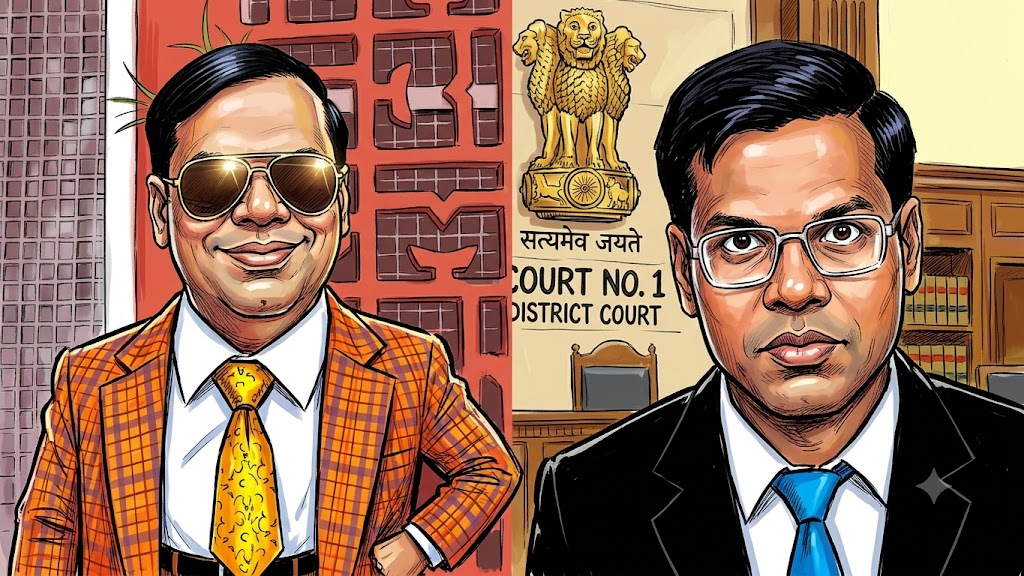
A Muzaffarnagar judge handed down 23 death sentences in about five months. Then he publicly challenged his own district judge and was moved to the family court. The record does not support a simple story about either him or the system.
Additional District and Sessions Judge Ravi Kumar Diwakar, who presided over a fast-track court in Muzaffarnagar, Uttar Pradesh, has been transferred under an Allahabad High Court order to the town’s family court as Additional Principal Judge. Officials confirmed the move on October 25, according to PTI. Shiv Kumari takes over his fast-track court.
No official reason for the transfer has been given, and no source I found links it to his death sentences or to his criticism of the recall of cases. Deccan Herald reported that the move came “days after” he questioned the shifting of 97 murder case files. His judgment is dated September 17 and the transfer was reported on October 25, roughly five weeks apart. Whether the two are connected is not established.
According to PTI, Diwakar awarded 23 death sentences in 11 cases between April and September 2026. LiveLaw counted 22 sentences in 10 cases up to August, with the 23rd on September 7. LawBeat, which listed cases up to mid-August, said the murders involved were committed between 1999 and 2019. They include the 2014 shooting of Pawan Kumar in Shamli, the 1999 kidnap-murder of wood trader Saleem, and the 2011 killing of a woman and her six-year-old son.
For scale, Project 39A’s annual statistics, as reported by Newslaundry, show sessions courts across India imposed 139 death sentences in 2024, 34 of them in Uttar Pradesh. One judge’s 23 in about five months therefore equals roughly two-thirds of the state’s 2024 total and about a sixth of the national one. The years differ, so this is a yardstick, not a like-for-like comparison.
None of these sentences is final. Every death sentence from a sessions court must be confirmed by the High Court before it can be carried out.
“Obsessed with death sentences” is a framing, not a finding, and the record can’t back it. We do not know how many cases the court decided, how many ended in acquittal or life terms, or how many murder trials were simply old and ready for judgment. A fast-track court that clears old murder cases may reach a verdict in many of them in one stretch. A high count of death sentences fits two stories: a judge who reaches for the maximum penalty readily, or one who inherited a run of especially brutal cases. Without conviction and sentencing data for his whole docket, the first cannot be separated from the second.
The legal test is clear. In Bachan Singh and Machhi Singh, the Supreme Court reserved death for the “rarest of rare”. LiveLaw’s explainer argues his frequency sits uneasily with that standard. Project 39A has separately found that in at least 90.5% of death sentences in 2024, trial courts across India sought or relied on no information about the accused’s life, a finding about trial courts generally and not about Diwakar. Whether Diwakar’s judgments met that bar is a question for the High Court, which will read the full records.
What his own words reveal
A judge’s psyche can’t be read from outside, and no one should pretend to. What can be read is how he wrote.
In his September 7 judgment sentencing Nadeem to death for burning his wife Shahzadi alive, he turned to Adam and Eve, Laila-Majnu and Shirin-Farhad to argue that love does not involve taking a life. In a December 2024 case in Bareilly, he reportedly drew on the Ramayana. In March 2024, he praised Chief Minister Yogi Adityanath as an example of the “religious person” power needs, invoking Plato’s philosopher king, and the Allahabad High Court expunged the remarks as personal views.
Taken together, these suggest a judge who sees the bench as a moral office as much as a legal one, and who writes for a public beyond the parties. That reading is an interpretation of his writing, not a diagnosis. It also explains why admirers and critics each find confirmation in the same judgments.
His September 17 judgment shows a second side. He called the recall of 97 part-heard cases “without jurisdiction”, argued that a sessions judge can recall a case only before hearing begins, and wrote: “a judge’s work is to do justice and if injustice is done to the same judge, then where will he go?” He also said a message reached him through a western UP “mafia” figure warning that his court could be changed through “contacts at higher levels”, and that he would “rather die than be called a coward judge”. These are his statements, as reported, and no one has publicly confirmed or answered them. The orders, dated August 18, came from the then district judge, who has not been named in the reports or quoted.
Two readings, neither proven
One reading is that a conscientious trial judge was moved after an uncomfortable protest about administrative power. The other is that a judge with a record of intense moral rhetoric and unusually harsh sentencing was shifted through ordinary administrative channels. Judicial transfers are routine and rarely explained.
Both readings can be tested. The High Court will review each death sentence on the evidence. The recall question, whether part-heard cases can be withdrawn by administrative order, is a legal one with a clear answer in the statute. Until those answers arrive, the more useful question is not what drives one judge, but what checks exist when a trial court imposes the ultimate penalty at this pace.


No responses yet