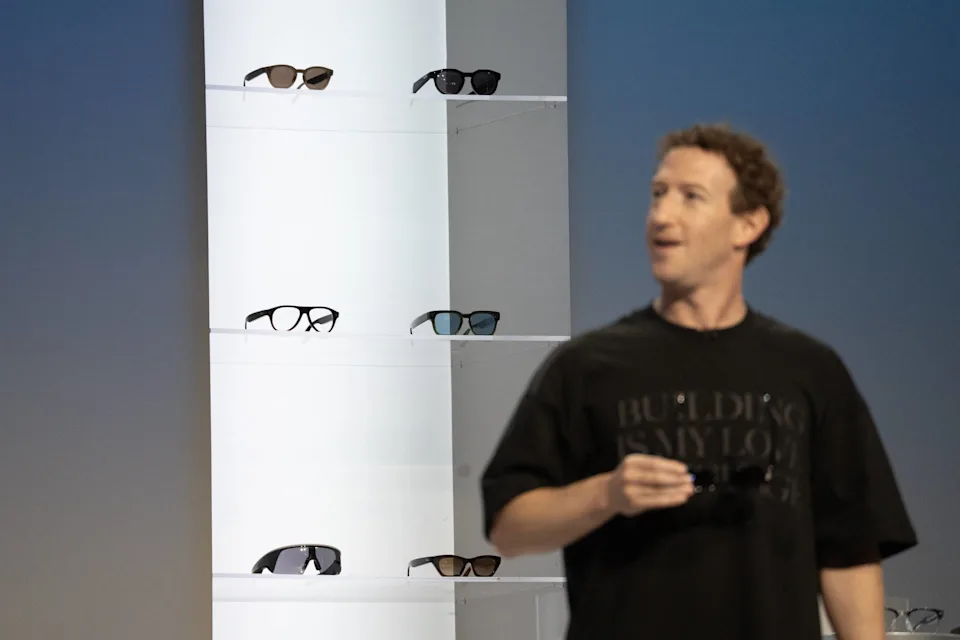
Meta used its Connect event on September 23 to make its most direct move yet against Apple’s Vision Pro: a pair of VR glasses priced at $1,299, weighing about 100 grams, and built around a 5K full-color passthrough display — a fraction of the weight and roughly a third of the price of Apple’s headset. They won’t actually reach buyers until spring 2027, but the pitch is unmistakable, and CEO Mark Zuckerberg said as much himself on stage, calling the new glasses “much lighter than Vision Pro.”
What’s actually inside Meta’s new glasses
The specs, as laid out at Connect, are modest in one sense and ambitious in another. The 5K display runs at up to three hours of continuous playback, with the actual computing offloaded to a separate puck that tethers to the glasses and houses a Snapdragon Reality Elite chipset — meaning the 100-gram weight figure covers only the headset itself, not the puck a wearer also has to carry. Field of view comes in at 70 degrees, well short of the Vision Pro’s 100 degrees. The glasses are IMAX Enhanced certified, work with Xbox Cloud Gaming, and will launch with roughly 75 games, according to Engadget’s coverage of the event.
Meta paired the launch with a broader glasses lineup spanning multiple price points: the camera-free Ray-Ban Meta Audio at $349 (shipping October 13), the entry-level Meta Adventurer at $249 (shipping October 23), the camera-equipped Ray-Ban Meta Gen 3 at $449, and the display-equipped Meta Ray-Ban Display at $799 — with the $1,299 VR glasses sitting at the top of that ladder as the only model still a year and a half away from shipping.
The Vision Pro comparison, and where it breaks down
Apple’s Vision Pro, priced at roughly $3,499 to $3,700 depending on configuration, has struggled commercially in large part because of its weight — between 1.3 and 1.7 pounds — and its price tag, a point Fortune’s coverage of Meta’s launch made explicitly. Meta’s glasses undercut that on both fronts by a wide margin. But the trade-off is real: a narrower field of view, a shorter battery life, and — crucially — a separate compute puck that Apple’s more self-contained (if heavier) headset doesn’t require. Whether “lighter and cheaper” beats “wider and sharper” is likely to depend on what buyers actually plan to use the device for; a three-hour battery comfortably covers a movie, but not a full workday inside a virtual desktop.
Snap’s very different bet — and a much higher price
Meta and Apple aren’t the only players shaping this market. Snap unveiled its own consumer AR glasses, called SPECS, at the Augmented World Expo in June — and priced them well above both Meta and Apple’s offerings, at $2,195 with a refundable $200 deposit, shipping this fall in the US, UK and France.
Snap’s approach is architecturally distinct from Meta’s: SPECS are fully standalone, with no separate puck or tether of any kind, built into a Swiss TR90 polymer frame weighing 132 grams (47mm size) or 136 grams (52mm size). They use liquid-crystal-on-silicon projectors and a stereo waveguide display offering a 51-degree field of view, dual Snapdragon processors — one dedicated to computer vision, the other to running Snap’s Lens applications — and 7-millisecond motion-to-photon latency. Battery life is rated at four hours of mixed use, extended to roughly 20 hours total via the included charging case.
Lined up together, the emerging AR/VR glasses field looks less like a single race and more like three different bets on what trade-off buyers will accept:
| Device | Price | Weight | Field of view | Battery | Tethered? |
|---|---|---|---|---|---|
| Meta VR glasses | $1,299 | ~100g (glasses only) | 70° | ~3 hrs | Yes — separate compute puck |
| Apple Vision Pro | ~$3,499–3,700 | 1.3–1.7 lbs | 100° | Not disclosed here | Yes — external battery pack |
| Snap SPECS | $2,195 | 132–136g | 51° | 4 hrs (~20 hrs with case) | No — fully standalone |
Snap’s bet is that untethered, phone-free operation is worth a higher price and a narrower field of view than Meta’s. Meta is betting the opposite: that a lower price and lighter headset frame will win out even if it means carrying a separate compute puck. Apple, for now, is anchored at the high end on both price and immersion, with neither of its two closest challengers matching its field of view.
The bigger context: glasses, not headsets, are winning
None of these launches is happening in a vacuum. According to International Data Corporation (IDC) data reported by Mixed, Meta shipped 68.7% of all smart glasses in the second quarter of 2026, with RayNeo a distant second at 3.6% and Alibaba at 2.6%. More tellingly, glasses now account for 84.6% of the entire extended reality market, up from 72.9% a year earlier, while traditional VR/AR headsets have fallen to a 15.4% share from 27.1%. Glasses with no display at all — the category Ray-Ban Meta Audio sits in — made up 70.3% of shipments on their own.
That data point helps explain why Meta is simultaneously pushing a premium VR headset-in-glasses-form and a stripped-down, camera-free audio-only pair at $349: the bulk of the market’s current growth is happening at the lighter, cheaper, display-free end, even as Meta, Apple and Snap all continue to chase the higher-immersion segment at very different price points.
The market’s initial reaction
Meta’s stock closed at $744.10 on September 23, up 1.02% for the day, before the Connect keynote aired after market close; shares slipped roughly 0.4% in after-hours trading. Analyst reaction was mixed: Evercore ISI’s Mark Mahaney said Meta’s shift in emphasis toward its Muse AI agent, and away from pure metaverse hardware, was “a good thing” for Meta investors, while Deepwater Asset Management’s Gene Munster expected the stock to trade flat to down given the lack of disclosed data on how well Meta’s Muse AI agent is actually being adopted. Meta did not disclose unit sales figures for any of its new glasses at the event.


No responses yet