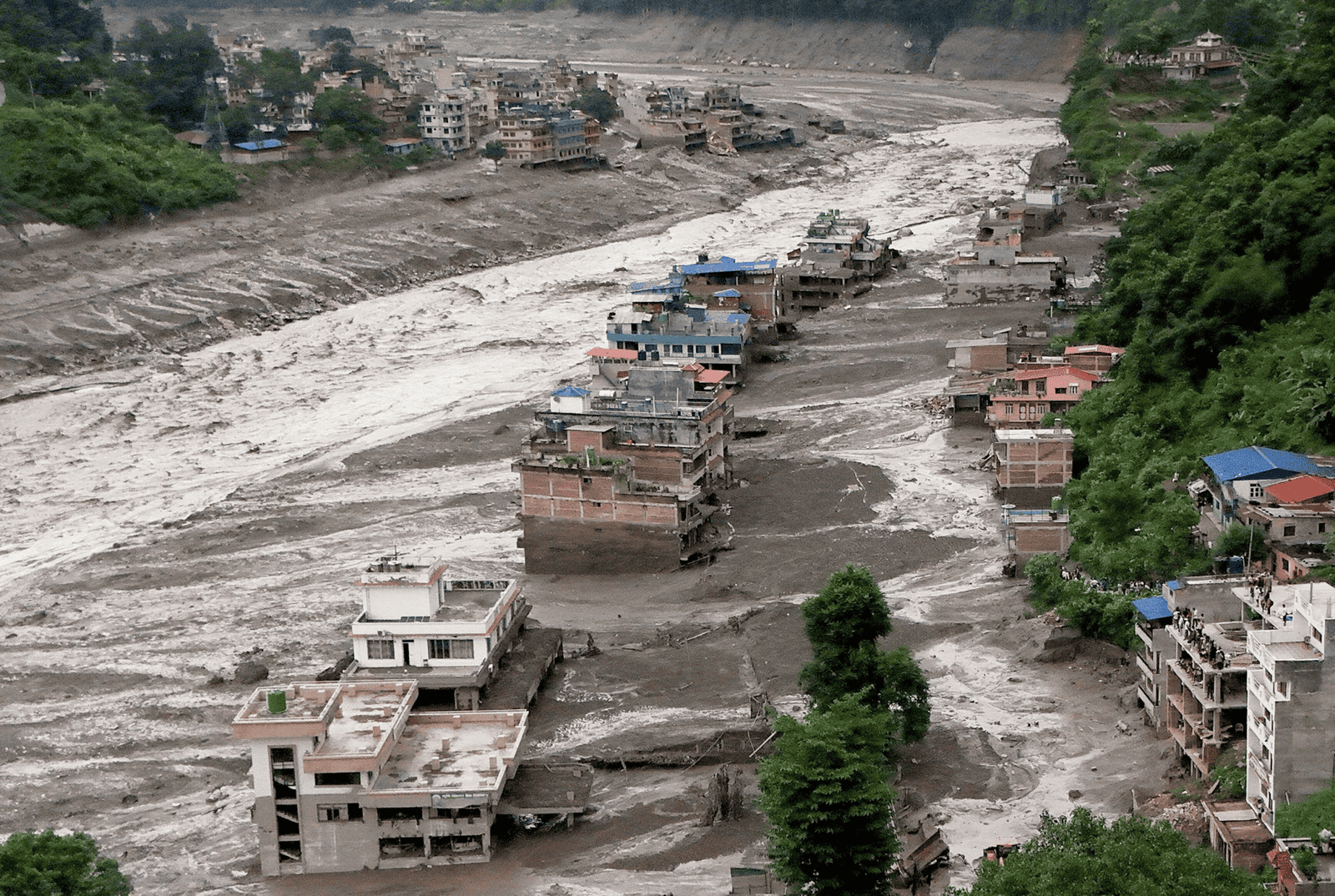
A glacier collapse near the Nepal-China border has killed hundreds and left nearly 1,500 people missing. The disaster is being called a geophysical event — but it sits at the end of a long, well-documented chain of climate and sustainability failures that scientists and Nepal’s own disaster agencies have been flagging for over a decade.
What Happened
On the morning of August 26, 2026, a massive section of glacier broke away high in the Himalayas near the Nepal-China border, roughly 55 kilometres northwest of Kodari. According to CNN’s analysis of satellite imagery, the collapsed section was around 2,000 feet wide, with a similarly sized section of rock breaking away alongside it, leaving a gash roughly 3,000 feet wide in the mountainside. The mass plunged nearly 7,000 vertical feet before crashing into the Lhende river in Tibet, which feeds into Nepal’s Trishuli river system.

What followed was less a flood than a demolition. Jeffrey Kargel, a senior scientist at the Planetary Science Institute, told CNN that the resulting flood wave — a mixture of water, pulverized ice and rock — descended the first 22 kilometres at an average speed of 193 kilometres per hour, hitting villages “like liquid cement.” The wall of debris tore through a 72-kilometre stretch of the Trishuli river valley, devastating Nepal’s Rasuwa and Nuwakot districts before crossing into China’s Gyirong county.
The human toll has climbed steadily in the days since. By August 27–28, Al Jazeera reported more than 390 confirmed deaths and over 1,500 people missing across Nepal and Tibet combined — 389 dead and roughly 910 missing in Nepal alone, alongside 3 dead and 558 missing across the border in Gyirong county, where a large share of the missing are foreign nationals. Nepal Police said the toll is expected to rise further as rescue teams reach terrain that remains largely inaccessible. At least 19 bridges and around 40 kilometres of road have been destroyed, according to Al Jazeera, badly hampering search and rescue operations that now involve more than 5,000 Nepali army and police personnel. Compounding the crisis, Nepal’s disaster authorities have identified a new lake forming at the site of the original collapse, which is reportedly rising and raising fears of a second, secondary flood.
Initial confusion around the cause has largely settled. The U.S. Geological Survey first registered the event as a magnitude 4.4 earthquake, later describing it as an energy release from a landslide equivalent to a magnitude 5.2 quake, detected on seismometers as far away as the United States and Germany. Göran Ekström, a geophysicist at Columbia University’s Lamont-Doherty Earth Observatory, told ABC News that the sheer scale of falling rock and ice generated enough friction-driven heat to melt glacial ice, which may explain the immense volume of water that surged into the valley below.
The Climate Science Underneath the Geology
Scientists have been careful about direct attribution. Wikipedia’s running account of the disaster notes that researchers have not yet directly linked this specific collapse to climate change, pointing instead to more proximate geological triggers — but it also records the broader scientific consensus that climate change contributes to the thawing of mountain permafrost, which in turn increases the likelihood of glacier and slope collapses of exactly this kind. A Bangladesh-based geologist quoted in that same account went further, describing such disasters as the “new normal” for the region, warning that the pattern will worsen over time.
That caution around single-event attribution should not obscure the trend line underneath it. The Hindu Kush Himalaya — often called the world’s “Third Pole” for holding the largest volume of ice and snow outside the polar regions — is losing that ice at an accelerating pace. A landmark ICIMOD report released in March 2026 found that glacier ice-loss rates across the region have doubled since the year 2000, with a cumulative loss of up to 27 metres of ice thickness since 1975. ICIMOD’s Qianggong Zhang, head of climate and environmental risks at the organisation, has noted that the Hindu Kush Himalaya is especially sensitive to these shifts, with accelerated melting driving sudden, destructive events such as glacial lake outburst floods — and that melt is only part of the picture, since reduced snow cover and permafrost thaw compound the uncertainty communities downstream now face.

An earlier, comprehensive 2023 ICIMOD assessment — the HI-WISE report, produced with contributions from over 350 researchers across the region — described the changes underway in the region’s glaciers, snow and permafrost as “unprecedented and largely irreversible.” That report projected that at 3°C of warming, which is roughly where current global climate policy trajectories point, glaciers in the Eastern Himalaya — the stretch that includes Nepal and Bhutan — could lose up to 75% of their ice by 2100. Even under the Paris Agreement’s most ambitious 1.5°C target, the region would still lose roughly a third of its glacier volume. The mechanism connecting warming to events like the one that just struck Rasuwa is precisely permafrost thaw: as the frozen ground that binds steep Himalayan slopes together loses its grip, rockfaces and the ice sitting on them become progressively less stable, raising the odds of exactly this kind of catastrophic collapse.
A Disaster Nepal’s Own Agencies Saw Coming
What makes this catastrophe particularly hard to categorise as a pure “natural” disaster is how well-documented the underlying risk already was. Nepal has 3,252 glaciers and 2,323 glacial lakes, and ICIMOD has recorded 26 glacial lake outburst flood (GLOF) events in the country since 1977, eleven of which had transboundary impact — meaning they crossed, as this one did, between Nepal and its neighbours. A 2020 joint assessment by ICIMOD and the UNDP identified 47 potentially dangerous glacial lakes across the wider region, including 21 inside Nepal.
This is not the first time this particular valley has been hit. A Kathmandu Post editorial published on the eve of this disaster noted that the Rasuwagadhi area — struck again this week — suffered a flash flood in the Lende river last year that killed at least 11 people and swept away the bridge connecting Nepal and China at that crossing. In 2024, a glacial lake outburst flood inundated the Thame river, destroying 20 houses and a school. The editorial called this the third consecutive disaster to hit the same broader region in three years, and argued explicitly for stronger early-warning systems and better cross-border information sharing with China, given how often these events originate on the Tibetan side of the border and arrive in Nepal with little advance notice.

The early-warning infrastructure that does exist has proven fragile. PreventionWeb reported that Nepali authorities installed sensors and automated sirens at Imja Lake, a fast-growing and closely watched glacial lake, back in 2016 — but that this system has since fallen into disrepair. For communities located closest to the source of this week’s collapse, any warning that did go out simply arrived too late to matter, according to experts cited in that report. Nepal’s disaster risk reduction authority also reported that a significant share of the missing — 476 people, according to ABC News — are foreign tourists, underscoring how a warning system built primarily around resident communities may be poorly matched to the transient, high-altitude tourist traffic that now moves through these valleys.
Nepal has not been without adaptation investment. A UNDP-backed project, financed with $36 million from the Green Climate Fund, is currently working to lower water levels in four of the country’s highest-risk glacial lakes — Thulagi, Lower Barun, Lumding Tsho and Hongu 2 — while building out early-warning systems and eco-engineering protections. But that project’s own framing, that GLOF frequency and intensity are projected to keep rising under future climate scenarios, is itself an acknowledgment that current defences are running to catch up with a moving target, not ahead of it.
The Economics of a Country That Barely Caused the Problem
The sustainability dimension of this disaster extends well beyond glaciology into Nepal’s economic structure. Nepal contributes less than 0.1% of global carbon dioxide emissions and has been ranked among the most climate-vulnerable countries in the world — one widely cited estimate puts its share of global greenhouse gas emissions at just 0.027%. Yet the country’s economy is built on precisely the sectors most exposed to the kind of disaster now unfolding: hydropower, agriculture and tourism.
Reporting from Outlook Business this week cited UNDP estimates that a single glacial lake outburst flood can cause more than $100 million in economic losses, and referenced research finding that Nepal loses an average of 647 lives annually to climate disasters, with projected losses rising to 2.2% of GDP by 2050 and 9.9% by 2100 without stronger mitigation. Between 2018 and 2024 alone, disasters cost Nepal roughly NPR 23.6 billion, with floods and landslides the largest contributors. With the country’s GDP growth already projected at a modest 2.3% for the current fiscal year, this disaster adds fresh strain to an economy still recovering from last year’s political unrest and a string of earlier aviation and tourism setbacks, as the Kathmandu Post noted in its coverage of the flood’s impact on the tourism sector.
Rajendra Singh, an expert cited in that Kathmandu Post report, framed the disaster in terms that get to the heart of the sustainability challenge: events of this scale generate the kind of hard evidence needed to make the case for international climate finance directed at high-risk mountain communities — finance that could, in his words, help make Nepal’s tourism sector sustainable rather than repeatedly rebuilding after catastrophe. Without it, he warned, the cycle simply repeats, and people keep dying.
Why This Is a Sustainability Story, Not Just a Disaster Story
Three threads run through the material now available on this flood, and together they describe less a single freak event than a system under sustained strain.
The first is a scientific thread: the Hindu Kush Himalaya’s cryosphere is degrading at a pace that has doubled since 2000, driven by global warming to which Nepal has contributed almost nothing, and permafrost thaw is making the region’s slopes and glaciers measurably less stable.
The second is an institutional thread: Nepal’s own scientific agencies and international partners have spent over a decade mapping exactly which glacial lakes and valleys carry the highest risk, building early-warning systems in some of them — but funding, maintenance and cross-border coordination with China have not kept pace with the scale of the threat, leaving systems like the one at Imja Lake to fall into disrepair even as the underlying hazard grows.
The third is an economic and justice thread: a country that produces a negligible fraction of global emissions is absorbing a disproportionate share of the consequences, through infrastructure destroyed, hydropower capacity offline, tourism revenue lost, and lives cut short — costs that current international climate finance mechanisms have only begun to address at the scale the region needs.
Taken together, these threads point toward the same conclusion reached by Nepal’s own disaster researchers and the editorial voices now writing in its wake: what happened in Rasuwa and Nuwakot this week was geologically triggered, but it was not unforeseeable. It was the latest, deadliest expression of a cryosphere-to-community risk chain that scientists have been documenting since at least the early 2000s — and one that will keep producing disasters of this magnitude until early-warning infrastructure, cross-border data sharing and climate adaptation financing are scaled to match the pace at which the Himalayas are now changing.
Sources
- CNN, “August 26-27, 2026 — Deadly flash flood hits Nepal-China border region,” cnn.com
- Al Jazeera, “Satellite images show destruction from Nepal-Tibet floods,” aljazeera.com, August 27, 2026
- Al Jazeera, “Nepal-Tibet floods: What happened, what caused them and who is missing?” aljazeera.com, August 27, 2026
- ABC News, “What caused Nepal flood? Scientist says it was enormous landslide, glacier fall,” abcnews.com
- EarthSky, “Nepal flash flood nightmare: What caused it?” earthsky.org
- Wikipedia, “2026 Nepal floods,” en.wikipedia.org
- ICIMOD, “Hindu Kush Himalaya glaciers losing ice at double the rate since 2000,” icimod.org, March 2026
- ICIMOD, “Landmark report on impacts of disappearing snow and ice in the Hindu Kush Himalaya” (HI-WISE), icimod.org, June 2023
- ICIMOD/UNDP, “Protecting Livelihoods and Assets at Risk from Glacial Lake Outburst Floods (GLOFs),” UNDP Climate Change Adaptation portal
- The Kathmandu Post, “Strengthen early-warning systems, fix cross-border information sharing,” kathmandupost.com, August 26, 2026
- The Kathmandu Post, “Nepal tourism faces another setback as Rasuwa disaster exposes mountain risks,” kathmandupost.com, August 28, 2026
- Outlook Business, “Nepal Floods Put Economy Under Strain: From Hydropower To Trade And Tourism,” outlookbusiness.com
- PreventionWeb, “Nepal: Emergency warnings weren’t enough to save flood-ravaged villages,” preventionweb.net
- weADAPT, “Community-Based Flood and Glacial Lake Outburst Risk Reduction in Nepal,” weadapt.org


No responses yet