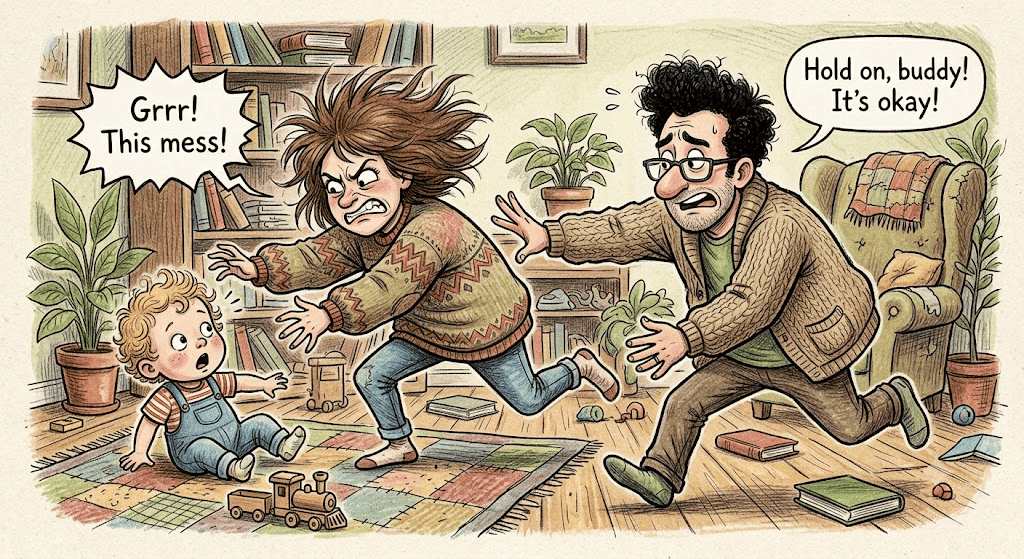
A two-year-old boy in Faridabad survived a brutal attack by his own mother, saved because his father intervened and rushed him to hospital. The case is not an isolated horror. It belongs to a recurring, under-discussed pattern of attempted and completed filicide in India — one that experts say has far less to do with “monstrous” individuals and far more to do with untreated postpartum illness, domestic isolation, and a mental healthcare system that is nowhere near equipped to catch women before they reach a breaking point.
The Faridabad Case, and Why It Isn’t Isolated
According to reporting on the case, a mother in Faridabad, Haryana, allegedly used a blade to injure her two-year-old son’s neck. The child was badly hurt but survived — his father, on learning what had happened, raised the alarm and rushed him to hospital, where he was treated and saved. The mother was subsequently taken into custody. Details of motive and her mental state are still emerging through police investigation. But strip away the location and the specific case, and the pattern — a parent, often a mother, attacking a very young child in circumstances suggesting a psychiatric break rather than premeditated cruelty — is disturbingly familiar in India’s crime reporting, even when, as here, the child survives.
In May 2024, police in Balrampur, Uttar Pradesh, reported that a 30-year-old woman named Nadia allegedly slit the throat of her 15-month-old daughter before attempting to take her own life. Police described her as mentally unstable and undergoing treatment at the time, and she was admitted to a trauma centre in critical condition.
In December 2020, a 25-year-old woman named Pratima in Uttar Pradesh’s Tikonia area allegedly hanged her two-year-old son before hanging herself; police suspected a family feud but could not conclusively establish the motive. In an earlier and widely reported Kerala case, a woman named Shahida in Palakkad district slit the throat of her six-year-old son in what she told police was a “sacrifice to God” — a case that, according to Gulf News’s report at the time, occurred while she was pregnant with her fourth child, raising immediate questions among mental health professionals about untreated psychiatric illness tied to pregnancy and childbirth.
These are not fringe, once-in-a-decade events. They form a recognisable category that criminologists and psychiatrists call filicide — the killing of a child by a parent — and a narrower, medico-legally distinct subset called infanticide, defined as the killing of a child under 12 months by a mother who has not fully recovered from the physical and psychological effects of pregnancy, childbirth and lactation.
The Psychiatric Evidence Nobody Talks About
What makes these cases genuinely difficult to process as simple “crime” is what clinical research consistently finds underneath them. A landmark Indian study by Chandra and colleagues, examining postpartum women with severe mental illness, found that 43% reported infanticidal ideation — thoughts of harming their infant — and 36% had gone as far as exhibiting infanticidal behaviour. The study found this was associated with the infant being female, difficulty coping with separation from the child, and the presence of psychotic thinking centred on the baby.
This is not an Indian anomaly; it mirrors global clinical findings. A widely cited UK study covering nearly 300 filicide cases and 45 filicide-suicides between 1997 and 2006, published through the National Confidential Inquiry into Suicide and Homicide by People with Mental Illness, found that mothers who killed their children were far more likely than fathers to have a documented history of mental disorder — 66% versus 27% — and far more likely to be symptomatic at the time of the offence. Seventeen percent of the mothers in that study had schizophrenia or another delusional disorder. Yet the same research found that the majority of these women had never actually been in contact with mental health services before the tragedy, and only a small fraction had received any treatment — meaning the illness was very often present, but invisible to the system, right up until it wasn’t.
A more recent case-control study of 90 mothers, published in Archives of Women’s Mental Health, similarly found that among women who committed filicide, nearly all displayed depressive symptoms at the time, a majority had a prior psychiatric history, and factors like severe insomnia, psychotic symptoms and a family history of violent death were strongly associated with elevated risk. The study’s authors concluded plainly that the lack of adequate postpartum psychiatric care was a critical factor across many of these cases — not a peripheral one.
India’s Specific, Compounding Vulnerability
If postpartum psychiatric illness is a global risk factor, India’s capacity to detect and treat it is unusually thin. A systematic review and meta-analysis of Indian studies conducted between 2020 and 2024 found a pooled postpartum depression prevalence of 19% among Indian mothers — meaning roughly one in five new mothers in the country is estimated to experience clinically significant postpartum depression, with the risk highest in southern states and in urban community settings. An earlier meta-analysis put the figure even higher, at 22%, and specifically flagged financial difficulty, domestic violence, marital conflict, lack of spousal support and the birth of a female child as recurring risk factors — a list that reads less like a clinical footnote and more like a summary of everyday domestic stress for a large share of Indian women.
Against that backdrop of high prevalence sits an acute shortage of people equipped to catch it. India’s psychiatrist density is estimated at around 0.75 per 100,000 population — against a World Health Organization-recommended benchmark of at least 1.7, and a widely cited “desirable minimum” of 3 per 100,000. A 2023 Parliamentary Standing Committee report found India had only around 9,000 practising psychiatrists for a population of roughly 1.4 billion, implying a shortfall of well over 25,000 specialists against basic need. India’s overall mental health treatment gap — the share of people who need care but never receive it — is estimated to exceed 80%, and mental health receives roughly 2% of the national health budget. For a new mother in a small town or rural district showing early signs of postpartum psychosis or severe depression, the honest picture is that there is often nobody nearby trained to recognise it, let alone treat it before it escalates.
The Social and Economic Layers Underneath the Clinical Picture
Mental illness alone rarely explains these tragedies in isolation; it interacts with a set of very concrete social and economic pressures that Indian households are navigating in changing ways.
The retreat of the joint family. For generations, new mothers in India relied on an extended household — a mother-in-law, sisters-in-law, aunts — for both practical childcare support and informal monitoring of a new mother’s emotional state. As urban migration and nuclear family structures have become the norm, especially in fast-growing satellite cities like Faridabad and Gurugram, many young mothers now navigate the exhausting first years of parenthood largely alone, often far from their birth families, with a husband working long hours. The informal safety net that once caught early warning signs of postpartum distress — a mother-in-law noticing a daughter-in-law not eating, not sleeping, talking strangely about the baby — has weakened considerably even as clinical services have not scaled up to replace it.
Financial precarity. Research on postpartum depression in India repeatedly identifies financial difficulty as one of the strongest and most consistent risk factors. Rising costs of urban living, insecure gig and informal employment, and the economic strain of childcare in dual-income households where formal support systems (affordable daycare, paid maternity support) remain limited, compound psychological vulnerability at precisely the life stage — the first year after childbirth — when women are already at elevated psychiatric risk.
Gender preference and marital conflict. The Chandra et al. finding that infanticidal ideation was associated with the child being female is a difficult but important data point in the Indian context, where son preference remains a documented social pattern in parts of the country. Similarly, the broader postpartum depression literature consistently identifies domestic violence and marital conflict as major risk factors — meaning that for a meaningful share of these cases, the psychiatric crisis does not exist in a vacuum but is entangled with an unsafe or unsupported domestic environment that predates the pregnancy itself.
Stigma as a barrier, not just a consequence. Even where mental health services technically exist, the stigma attached to psychiatric illness — and specifically to a mother admitting she is having frightening thoughts about her own child — remains a powerful deterrent to seeking help. Clinical literature on postnatal depression in India has repeatedly noted that more than half of cases go undetected by healthcare providers even when women do interact with the health system, because screening for maternal mental health is not routinely built into postnatal care visits the way physical health checks are.
What This Pattern Tells Us About Changing Indian Society
Taken together, these cases and the research around them point to something more specific than a vague claim that India is becoming “more violent” or that mothers are “losing values.” The pattern instead describes a mismatch: Indian family structures are changing faster than Indian institutions are adapting to support them.
The extended family that once absorbed the shock of a difficult postpartum period is disappearing for a growing share of urban and semi-urban Indians, particularly in the migrant, nuclear-family-heavy townships that ring cities like Delhi, where Faridabad sits. In its place, formal healthcare has not yet stepped in at scale — postnatal mental health screening is not routine, psychiatric workforce density remains a fraction of what public health guidelines call for, and stigma continues to discourage women from naming what they’re experiencing even when help is nominally accessible.
Meanwhile, the pressures bearing down on new mothers — financial insecurity, marital and domestic strain, in some cases gendered disappointment over a child’s sex — have not eased even as the traditional buffers against them have thinned. The result, in the small number of cases that end in tragedy, is not usually a story about a woman without love for her child, but about an untreated, unrecognised psychiatric crisis unfolding in near-total isolation until it reaches a point of no return.
What Would Actually Help
The clinical and public health literature converges on a set of interventions that are neither exotic nor especially expensive relative to their potential impact: routine postpartum depression screening as a standard part of postnatal check-ups rather than an optional add-on; task-sharing models that train community health workers and ASHA-style peer counsellors to deliver basic psychological support in areas with no psychiatrist for miles, an approach India has already piloted with programmes like the Thinking Healthy Programme delivered by trained peer mothers; wider public awareness that postpartum psychiatric illness is a medical condition rather than a moral failing, so that families are more likely to recognise warning signs and seek help rather than conceal them; and continued expansion of low-barrier services like the Tele-MANAS helpline, which exists precisely to reach people who have no nearby psychiatrist and no immediate way to ask for help.
None of this excuses or minimises the loss of a child’s life. But treating each new case purely as an isolated act of individual cruelty, rather than as the visible tip of a much larger and well-documented public health gap, all but guarantees that the pattern continues.
Sources
- Deccan Herald, “UP: Mentally unstable mother slits toddler’s throat, tries to kill self,” May 21, 2024
- Deccan Herald, “Woman hangs son to death before killing self in Uttar Pradesh,” December 25, 2020
- Gulf News, “In twin grisly crimes in Kerala, mother ‘sacrifices’ son, man kills mum”
- Chandra, P.S. et al., cited in “Child Murder by Mothers: A Critical Analysis of the Current State of Knowledge and a Research Agenda,” American Journal of Psychiatry, psychiatryonline.org
- “Filicide: Mental Illness in Those Who Kill Their Children,” National Confidential Inquiry data, PMC/NCBI (ncbi.nlm.nih.gov/pmc/articles/PMC3617183)
- “A case–control study of filicide/infanticide in 90 mothers,” Archives of Women’s Mental Health, Springer Nature Link
- “Barriers to mental health in post-partum women in India: A systematic review and meta-analysis,” ScienceDirect
- “Postpartum depression in India: a systematic review and meta-analysis,” PMC/NCBI (ncbi.nlm.nih.gov/pmc/articles/PMC5689195)
- Business Standard, “India’s mental health crisis: 197 million need care, few get it,” October 2025
- “Training and National deficit of psychiatrists in India – A critical analysis,” PMC/NCBI (ncbi.nlm.nih.gov/pmc/articles/PMC3146235)
- Mentis, “Mental Health Statistics India 2026: Key Facts, Data & Crisis Scale”


No responses yet