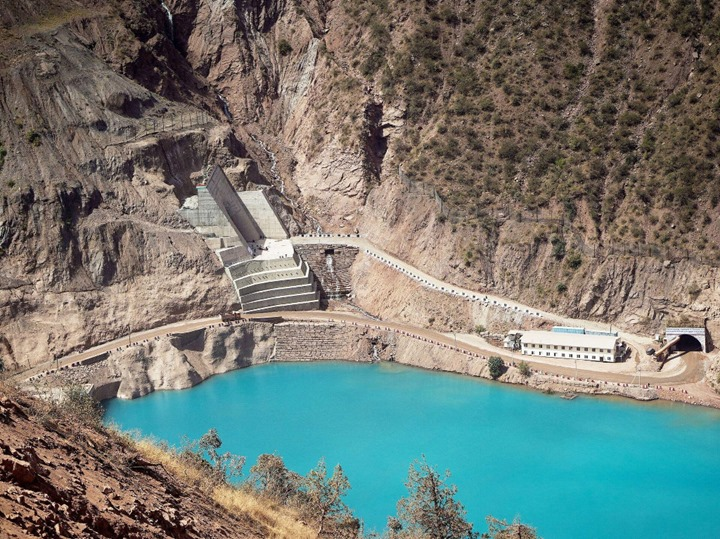
Fifty thousand people are expected to be displaced by the reservoir of Tajikistan’s Rogun Dam, and the Amu Darya River basin — already under significant water stress — will need to have large volumes of water diverted from it for years just to fill the reservoir. Those are the costs environmental groups say are being pushed further into the background as the World Bank moves forward with fresh funding for a project now rising toward the title of world’s tallest dam.
Safeguards loosened to release the money, critics say
The central environmental concern isn’t simply that the dam is being built — it’s how the latest round of financing was approved. Eugene Simonov, a coordinator at the environmental NGO Rivers without Boundaries, which opposes the project, said the World Bank’s newest tranche of finance came with a significant reduction in the financial conditions tied to completing environmental and social safeguards. His concern is specific and pointed: once the second tranche of funding is released, he said, the Bank will have “no real strings to pull to control the borrower.”
Simonov also told Eurasianet that despite a World Bank pledge in February to address civil society groups’ concerns during the latest round of consultations, a lack of transparency and meaningful follow-through has eroded those groups’ confidence in the process. The World Bank’s own Board of Executive Directors, in its chair’s summary of the meeting that approved the funding, acknowledged that the Rogun program “remains a high-risk, high-reward undertaking, which requires robust monitoring and oversight systems” — language that, environmental groups argue, sits uneasily next to a decision to ease the very financial conditions meant to enforce that oversight.
The World Bank, for its part, told Eurasianet on September 23 that it had not paused its involvement: “There was no temporary suspension or freeze of the Bank’s participation in the project.” The Bank says the funds simply could not be disbursed until agreed conditions were completed, which it says happened on December 22, 2025.
What’s actually being built, and what it displaces
The Tajik government has been constructing the Rogun Dam in the Vakhsh River Valley since 2016 and has already spent more than $3 billion on it. If completed to its full planned height of 335 meters, Rogun would become the tallest dam in the world. WeBuild Group, the Italian infrastructure conglomerate building the dam, announced in August that it had begun work on the project’s $2.3 billion “Lot 2” phase and had raised the structure to 1,155 meters above sea level — a height that will let operators raise the reservoir’s water level by 49 meters and expand output from the two turbines (of a planned six) already installed.
The completed plant is projected to generate up to 14,400 gigawatt-hours of electricity annually — equivalent to roughly 60% of Tajikistan’s current total power production. Tajik Finance Minister Faiziddin Qahhorzoda told reporters in Dushanbe in July that he was “fully confident” the country would reach energy independence by 2027. The project is widely seen as a centerpiece of 73-year-old President Emomali Rahmon’s legacy, with the government hoping Rogun will also generate electricity export revenue and support industrial growth, including a nascent AI sector.
The money behind the dam
The World Bank’s Board of Executive Directors approved a $300 million grant for Rogun in June, its second round of funding after an earlier $350 million grant in December 2024. Smaller financiers have followed the Bank’s lead: the Abu Dhabi Fund for Development signed a $100 million loan agreement in February, and Italy’s state investment arm, Cassa Depositi e Prestiti, committed $150 million through the World Bank’s financing consortium in late July. Simonov described this pattern as “gang finance” — smaller institutions joining in on what he calls “questionable” projects because they trust the World Bank has already done the necessary due diligence.
Tajikistan’s finance minister says the country has secured $1.5 billion in international commitments toward the project so far. But in a mid-August note, ratings agency S&P Global estimated the government still needs roughly $5.8 billion more to finish the dam, which is presently targeted for completion in 2035. Two larger, still-undecided funding decisions loom over the project: a long-discussed $500 million investment from the European Investment Bank, with negotiations reportedly in their final stage, and a potential $500 million in low-interest loans and grants from the Asian Development Bank. Tajikistan itself continues to fund the project directly from its own budget, spending $400 million in government revenue on Rogun in the first half of the year, with another $300 million planned for the second half.
A project caught between energy ambition and ecological cost
Rogun sits at the center of a familiar and difficult tension in large-scale hydropower: a country seeking genuine energy independence and clean electricity generation, built on a project that environmental groups say is advancing with weakening — not strengthening — safeguards for the people and river system it most directly affects. The dam’s backers point to real numbers: a 60%-of-national-supply generation capacity, a path toward 2027 energy independence, and growing international financial confidence reflected in $1.5 billion already committed. Its critics point to equally real numbers on the other side: 50,000 people facing displacement, a already-stressed river basin facing years of major water diversion, and a World Bank oversight process that, by the account of groups directly engaged with it, has grown weaker rather than stronger even as the funding has grown larger.
Whichever side of that tension proves more consequential may not be clear until the reservoir actually begins filling — a stage the project is now, after years of delay and renewed financing, visibly closer to reaching.


No responses yet