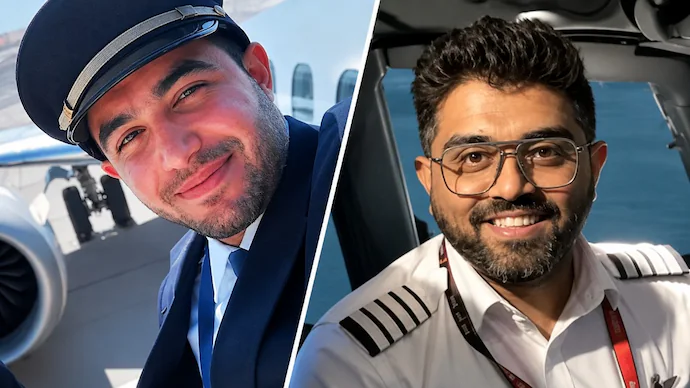
When a flydubai co-pilot allegedly attacked his captain with a crash axe in mid-air on September 30, the world asked the obvious question first: how did a pilot reportedly flagged for extremist views end up on a flight deck? That question has dominated coverage, and the answers so far point to a breakdown in information-sharing between Oman, the UAE and others.
But reporting from Israeli outlets has surfaced a second question that has received far less attention, and that may matter more to the hundreds of thousands of people who fly this route: on the Israeli side, who was supposed to be checking the crews of foreign airlines bound for Tel Aviv, and was anyone actually doing it?
What happened
Flight FZ1073, a Boeing 737 MAX 8 carrying 174 passengers from Dubai to Tel Aviv, was diverted to Tabuk in Saudi Arabia after the co-pilot, identified by multiple outlets as Omani national Hamam al-Hammami, allegedly struck Indian captain Smit Machchhar with a crash axe and tried to take control of the aircraft. UAE Prosecutor General Hamad Saif Al Shamsi said on October 3 that the co-pilot attempted “a terrorist act”. Flight-tracking data cited by Deccan Herald showed the jet losing about 16,625 feet in just over 30 seconds; Reuters, citing Israeli officials, put the plunge at nearly 14,000 feet in under 30 seconds.
The wounded captain managed to open the cockpit door, and passengers and crew overpowered the co-pilot. Reuters reports that a second pair of flydubai pilots aboard then landed the aircraft. The co-pilot was arrested by Saudi authorities and later transferred to the UAE, which is leading the investigation. His motive has not been established, and investigators have not concluded their inquiry. A Gulf diplomat told AP the probe had so far found no links to militant groups, which suggested he acted alone.
The question everyone is asking: how was he cleared to fly?
Several outlets have reported that Oman barred him from flying over concerns about extremist views. CNN reported he was removed from training at Oman Air and given another role, and that his LinkedIn profile showed seven years at Oman Air, then Royal Air Maroc from June 2025 to January 2026. Royal Air Maroc told AP he trained with the airline for three months as part of pre-employment but was not selected; the reasons have not been made public, and Airways Magazine cautions that the airline’s decision should not be read as evidence of a security concern. An Israeli official told CNN he had worked for flydubai for only about eight months.
The vetting trail is thin. A Gulf diplomat told AP that the checks flydubai ran focused on whether he had been convicted of criminal charges. CBS News sources said flydubai hired him without vetting him with the Omani government. The Wall Street Journal, as relayed by VINnews, reported it remains unclear whether Oman told other authorities about the concerns. Oman’s government, AP notes, has said nothing publicly.
The question fewer are asking: who was checking at the Israeli end?
Here the reporting turns up something unusual. Israel’s own rules, Prime Minister Benjamin Netanyahu told Fox News, bar pilots from countries without diplomatic relations with Israel from flying to it. Oman has no such relations. Yet he conceded: “Clearly there was a loophole here, and we are dealing with it.”
According to Channel 12, as reported by The Telegraph via Yahoo, dozens of Omani pilots employed by flydubai had flown the Dubai–Tel Aviv route in recent years. The Shin Bet, the same report said, had not run background checks on flydubai pilots, though it had instructed the airline not to assign crew from countries without relations with Israel. Nothing in the reporting alleges wrongdoing by any of those other pilots. The point is narrower and more troubling: the rule existed as an instruction to a foreign airline, and, on this account, nobody verified that it was being followed.
Ynet’s analysis explains why. Shin Bet’s security remit covers Israeli airlines. Foreign carriers entering Israel fall under a different mix of oversight: the Civil Aviation Authority of Israel, which grants operating permits, and the Transportation Ministry’s Aviation Security Operations Center, working within the 2020 UAE–Israel air services agreement. Licensing mechanisms exist for foreign crews, Ynet notes, but that does not mean each foreign pilot undergoes an Israeli security background check before every flight. Officials told the outlet that security arrangements on foreign airlines may be even more limited than on Israeli ones, and that a stricter framework would, with high probability, have prevented this kind of incident.
The gap was not unforeseen in general terms. In May 2024, Israel’s State Comptroller published an audit of international aviation security that recommended the government clarify which agencies are responsible for what, including for foreign aviation entering Israel, and noted that some governing decisions dated to the 1970s. The public portion did not address UAE flights specifically.
How the corridor outgrew its oversight
The numbers explain why the gap matters. flydubai began flying to Tel Aviv on November 26, 2020, with two daily flights, according to Ynet; during parts of 2026 it ran as many as ten flights a day in each direction. Reuters reports that the UAE accounted for 1.5 million passengers, or 8.3 percent of Ben Gurion’s traffic, in 2025.
Then came the war. Israeli security authorities, Reuters reports, halted Israeli airlines’ flights to the UAE at the outset of the war with Iran in late February. Israelis kept travelling anyway: 837,000 passengers, 7.5 percent of Ben Gurion’s total, flew to the UAE in the first eight months of 2026, and half of them flew on flydubai. JTA puts flydubai’s 2026 total at more than 420,000 passengers to or from Ben Gurion, making it the airport’s third-largest international carrier by volume.
This is analysis rather than something any official has said, but the arithmetic is hard to miss. Shin Bet grounded the carriers it directly supervises. Demand for the route did not disappear; it moved to carriers outside that direct remit. Most passengers on FZ1073 were Israeli. The security decision and the passenger flow pointed in opposite directions, and the screening of foreign crews rested on an instruction nobody was verifying.
Four screens, four different questions
The reporting so far suggests that every checkpoint this pilot passed asked a different question.
| Checkpoint | What it reportedly asked | What it missed |
|---|---|---|
| Oman Air / Omani authorities | Is this trainee showing concerning views? Reportedly removed from training and reassigned | The finding apparently did not travel; unclear whether Oman told anyone |
| Royal Air Maroc | Pre-employment training; not selected | Reason undisclosed; not evidence of a security concern |
| UAE / flydubai hiring | Reportedly checked for criminal convictions | A non-criminal administrative flag leaves no conviction to find |
| Israel (route rules) | Is the crew member from a country without relations with Israel? | Instruction to the airline, reportedly never verified |
No single screen was designed to look for the thing that mattered. The Israeli rule asks where a pilot’s passport comes from, the Omani action reflected what he was reportedly doing, and the UAE check asked whether he had been convicted. Nobody, on this reporting, asked all three.
Vetting is possible when the state decides to do it
One detail deserves attention. Netanyahu noted that background checks were carried out on the crews sent to Saudi Arabia to fly the stranded Israeli passengers home. In other words, Israel can vet crews rapidly when it chooses to; routine foreign-carrier crews on a commercial route were simply not subject to the same scrutiny. The gap was a policy choice, or an omission, rather than a technical limit.
The last safety net wasn’t designed
A 737 flight deck is built around two pilots. When one was wounded and the other was the alleged attacker, the aircraft’s recovery depended on other qualified pilots being on board. Reports differ on who they were: flydubai said on-duty crew travelling on the flight secured and landed the aircraft, while Israeli media described off-duty or reserve pilots among the passengers. Either way, none of the reporting reviewed for this article suggests their presence was required by any rule. The cockpit-door and two-person debates that followed the 2015 Germanwings crash, as Tech Times notes, have not produced a binding global rule, and a two-person rule would not have stopped this incident anyway.
What to watch
- Whether the fix is verification or just another instruction. Netanyahu says Israel is working to close the loophole and wants advance pilot screening. The test is whether crew lists are actually checked.
- The shape of the route’s recovery. El Al cancelled its flights and flydubai suspended its Israel route after the incident. Israeli airlines El Al, Israir and Arkia have asked for permission to resume Dubai flights, and the Transportation Ministry has asked Etihad to add Abu Dhabi–Tel Aviv flights. Restoring capacity without strengthening checks on foreign crews would leave the same exposure in place.
- The UAE-led investigation. What flydubai knew, whether Oman shared its concerns, and what the motive was remain unanswered.
- Attribution. U.S. President Donald Trump said that if Iran were linked to the co-pilot it would be struck “very hard.” An Israeli official and a regional official have said no Iran link has been found so far. Conclusions should follow evidence.
A caution on what the “warning signs” were
The only first-hand account from inside the cockpit is the captain’s. Reports of his testimony say the co-pilot rose to pray, that he found it unremarkable, and that out of respect he deliberately did not look behind him. Some outlets have quoted a colleague describing the co-pilot’s religious observance as extremism. That is an unverified characterization, and it should not be mistaken for a screening standard. The flags reportedly at issue were specific and documented: a training removal, reported monitoring of online activity, and an administrative reassignment. Religious practice is not a security control; records that follow a pilot from one employer to the next could be.
The bottom line
Captain Smit Machchhar, who lives in Dubai and hails from a suburb of Mumbai, has been called a hero by the Israeli prime minister, and the Gujarat government has announced it will honour him. His survival and the safe landing owe a great deal to individual courage and to the presence of other pilots. The systems around him had a different story. A flag raised in Oman, a hiring check in Dubai and a rule written in Israel each looked at a different part of the same person, and none of them looked at the whole.


No responses yet