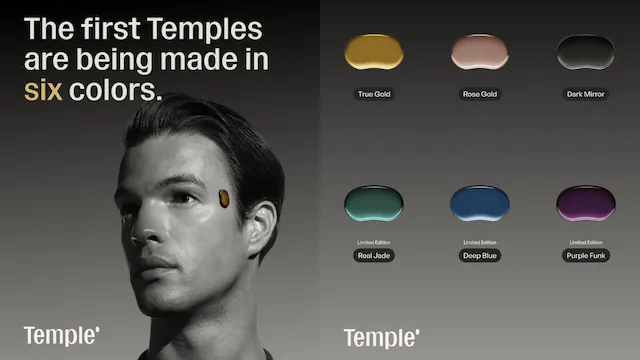
The wearable market has spent a decade measuring the same handful of things on the wrist and, more recently, the finger: heart rate, sleep, steps, skin temperature. Temple, the device backed by Zomato and Eternal founder Deepinder Goyal, is betting that the next category sits somewhere else entirely, on the side of your head, and measures something no mainstream wearable claims to track: blood flow to the brain.
On October 1, Goyal revealed six colours for the launch edition and said pre-orders could open as early as next week. Whether that makes Temple a market-changer or a high-profile experiment depends on questions the launch has not yet answered.
What launched this week
Goyal showed the launch edition in True Gold, Rose Gold, Black Mirror, Real Jade, Deep Blue and Purple Funk. Until now, Temple had mostly been shown in a gold finish. He described the six as colours for the “launch edition,” which leaves open whether the palette will continue afterwards, according to WION.
Several details remain undisclosed. Storyboard18 reports that early-access waitlist members will be prioritised when bookings open, while the final price and a confirmed pre-order date have not been announced. Goyal has said launch units will ship before the end of 2026. According to CIOL, Goyal said Temple received more than 100,000 applications for its first 100 devices, and that the latest hardware is less than half the size of versions shown publicly earlier.
What Temple actually is
Temple is neither a watch nor a ring. It sits on the temple, between the forehead and the ear, and uses optical sensing to capture signals from tissue and blood vessels in that area. Its system, called BrainFlow, is described by Goyal as the first continuous, wearable measurement of blood flow to the brain, according to NewsBytes.
The pitch rests on a physiological point: the brain accounts for roughly 20 percent of the body’s blood supply, and flow can change with ageing. Conventional hospital methods typically take readings at single points in time rather than continuously, per Justo Global. Temple is aimed, as Goyal said in February, at building “the ultimate wearable for elite performance athletes”, according to TechCrunch, which also reported that the company raised $54 million at a post-money valuation of about $190 million, led by Goyal with Steadview Capital following.
The evidence so far, and its limits
The science behind Temple is where the claims need the closest reading.
- Validation study. Temple’s most recent study compared BrainFlow against time-domain near-infrared spectroscopy (TD-NIRS), one of the few technologies that can separate brain blood-volume changes from scalp changes. Readings correlated with brain blood volume at up to 0.91 and were much less influenced by scalp changes, NewsBytes reports. The work was guided by Prof. David Boas of Boston University’s Neurophotonics Center, who is also a scientific adviser to Temple.
- The headline number is reported inconsistently. Several outlets describe a study of 60 participants. A separate NewsBytes report says it involved 60 sessions with 44 healthy young men. Readers should treat the sample as small and narrow until the paper is public.
- It is not peer-reviewed. The research is a preprint that has yet to go through peer review.
- Blood volume is not blood flow. The comparison was against brain blood volume. NewsBytes notes the device does not directly measure blood flow just yet. An earlier claim from Goyal, reported by CIOL, is that Temple tracked Middle Cerebral Artery velocity with a within-subject temporal correlation of around 0.8.
- Usefulness is unproven. A retail-industry analysis by Retail Intel argues that validation in a small group does not establish clinical accuracy, performance across diverse users, or that tracking these signals improves health outcomes. TechCrunch likewise called differentiation an open question.
Goyal says Temple is currently the only wearable validated against brain blood volume rather than just scalp blood volume. That is the company’s claim, and it was not independently verified for this article.
Why it could matter for the market
The case for Temple being different is straightforward. According to Sahha’s market analysis, smartwatches and smart rings carry a familiar stack: heart rate, HRV, sleep staging, skin temperature and, on some models, SpO2, ECG and blood-pressure estimates. Temple is not trying to be a better version of that stack. It is trying to add a signal none of them offers.
The backdrop is a market looking for new growth. IDC reports global wearable shipments of 145.7 million units in Q1 2026, up 4.3 percent, with smart rings forecast at 4.9 million units in 2026, up 12.8 percent, and wristbands forecast to decline 6.8 percent. In India, IDC data shows the market fell 4.0 percent in 2025 to 114.2 million units, its second consecutive annual decline, with smartwatches down 17.6 percent. Even the category leader in smart rings, Oura, sold 3.6 million rings in the twelve months to June 2026, which a HackerNoon analysis put at only about 2 percent of global wearable shipments.
Read together, those figures suggest that premium, health-focused devices are where the growth and the differentiation are. A device that opens a new measurement category rather than competing on the crowded wrist fits that pattern, at least in theory.
The hurdles
Several things stand between Temple and market impact, and none is resolved yet.
- Price. Not disclosed. Whether Temple is a niche performance tool or a mainstream product depends heavily on it.
- Scale. Demand for 100 early devices is not evidence of demand for tens of thousands. The wearables market has been consolidating around a small number of platforms.
- Meaning of the data. Even a perfectly accurate brain-blood-flow reading needs a clear answer to the question “so what should I do?” Neither the validation studies nor the marketing have yet shown what users can act on. Temple has partnered with Art of Living to study meditation ahead of launch, per Retail Intel’s tracking, which suggests the company is working on that question.
- A new form factor. Wearing a sensor on the temple is a different proposition from a watch or ring. Whether users accept it daily is untested, and this point is an observation, not something reported.
What to watch
- Peer review. Publication of the BrainFlow studies in a reviewed journal would be the single biggest credibility step.
- The price and the first deliveries. Goyal’s end-of-2026 shipping target is the test of whether the launch edition arrives on time.
- Independent testing. Third-party validation, particularly on more diverse users than young healthy men, would show whether the early results hold.
- Use cases. Whether Temple finds a repeatable job to do for athletes, meditators or older users will decide if it becomes a category or a curiosity.
The bottom line
Temple is the most distinctive new wearable pitch to come out of India in some time, and Goyal has the capital and the profile to get it noticed. But “poised to change the wearable market” is, for now, a prediction rather than a finding. The device has no public price, the supporting science is early and unreviewed, and the measurement it highlights is still being established as useful. If the next few months deliver a published study, independent testing and a clear reason to wear it, Temple could open a new category. If not, it risks becoming a well-designed answer to a question most buyers are not yet asking.


No responses yet