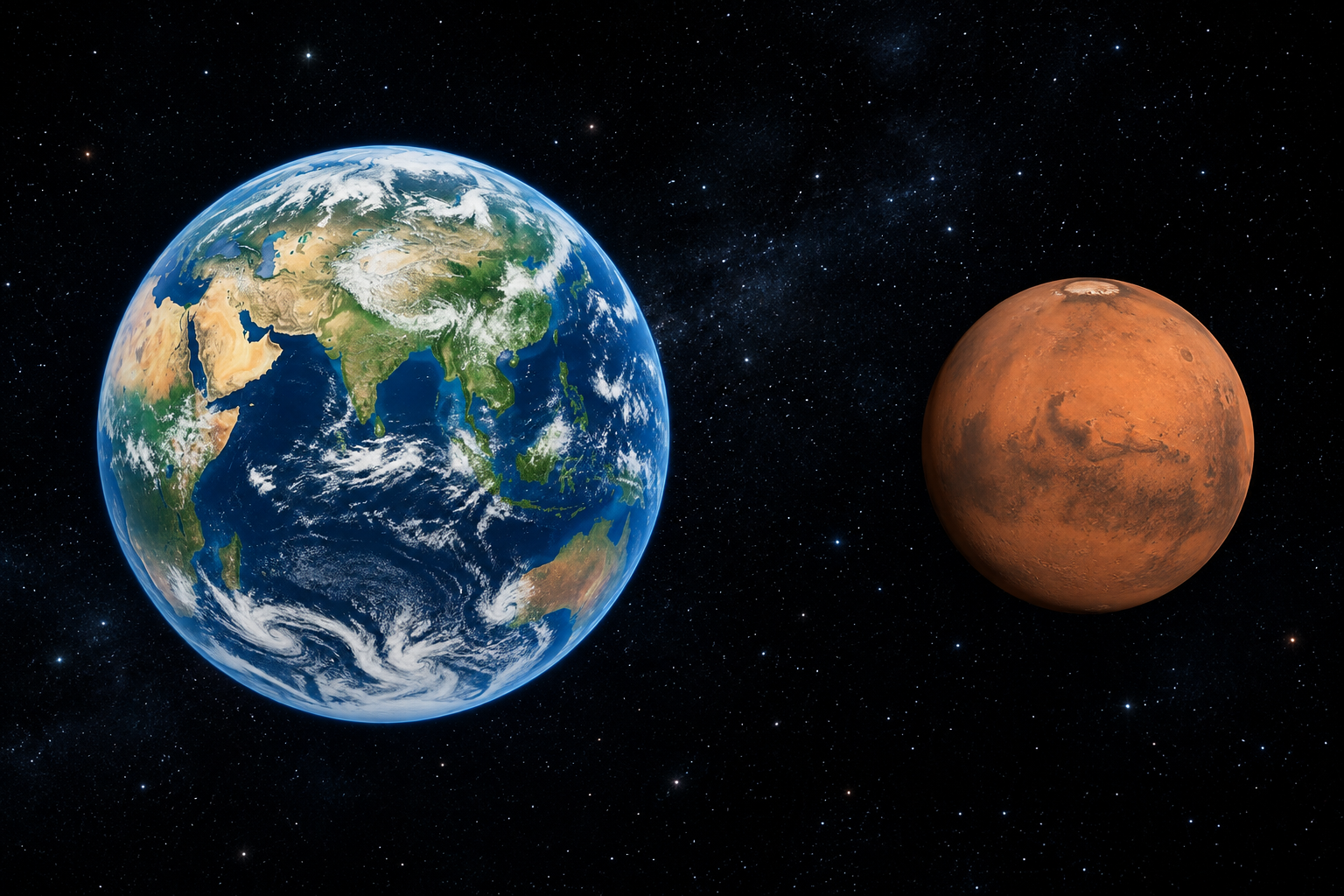
Earth and Mars formed 4.5 billion years ago in the same rotating cloud of gas and dust that became the solar system. A new study suggests the two neighbours were nonetheless assembled by very different routes, with Earth built mainly from large bodies that grew by sweeping up pebbles and Mars built mostly from collisions between rocky building blocks.
The work, published in Nature Astronomy, was led by researchers at the Globe Institute, University of Copenhagen. Its title is “Volatile depletion in rocky planets as a chemical fingerprint of hybrid accretion.”
What the researchers found
The study was co-led by Professor Anders Johansen and Assistant Professor Haiyang Wang. According to the university’s release, at least 75 percent of Earth’s mass appears to come from two young planets, known as protoplanets, that grew large by accreting pebbles, while planetesimals contributed up to 25 percent. For Mars, roughly three-quarters of its mass appears to come from planetesimals, with the remaining quarter from pebble accretion, Wang said. StudyFinds puts the Mars figures at about 73 percent and 27 percent.
| Earth | Mars | |
|---|---|---|
| Main building blocks | Two protoplanets that grew by accreting pebbles (at least 75% of mass) | Planetesimals (roughly 75% of mass) |
| Smaller contribution | Planetesimals (up to 25%) | Pebble accretion (roughly 25%) |
Johansen said the result was the most surprising one, since two planets formed side by side in the same solar system might be expected to share a similar formation history. Even so, he said, the exact percentages may vary somewhat, but the analyses consistently indicate that Earth and Mars formed in two different ways, as Phys.org reported.
The two ways to build a planet
Planetary scientists broadly agree that rocky planets grow in one of two ways, or through a mix of both. In one, solid kilometre-sized bodies called planetesimals, formed from cosmic dust, collide and merge. In the other, larger bodies, called protoplanets, which range from moon-sized to Mars-sized embryos, gather up small pebble-sized particles, a process called pebble accretion. Scientists have not settled which process, or which combination, best explains how Earth and Mars formed, PTI reported via The Tribune. The Copenhagen team says its findings support the hybrid model, with a different balance for each planet.
How they worked it out
The researchers analysed volatile elements, such as sodium, zinc and potassium, in the crust and mantle of the two planets. Volatile elements evaporate relatively easily at high temperatures, so how much of them a planet retains reflects how it grew. The mantles of both planets have stayed essentially unchanged for 4.5 billion years and, as Johansen put it, can be seen as “an imprint of the formation process”.
Using computer models, the team tested which formation scenarios best match the measured chemistry. Wang said the approach offers a more precise and direct way to understand planet formation than the more widely used isotope-based method, which can often be interpreted in more than one way, according to Mirage News.
What the study does not settle
The conclusions rest on modelling, and the models depend on assumptions. Two are named in the coverage: that the planetesimal building blocks of Earth and Mars were chemically similar to the asteroid Vesta, and that volatile elements are lost more efficiently during pebble accretion than during giant impacts. The researchers say the main conclusion holds even when those assumptions are adjusted. Scientists also do not know the exact chemical makeup of all the material that originally built the two planets, as Knowridge notes. Independent confirmation from other teams has not yet been reported.
Why it matters
The finding bears on a question that reaches beyond our own solar system. Johansen said that understanding how planets lose volatile elements while forming could help scientists predict how much water and other life-supporting substances a planet ends up keeping. With several future space missions aimed at finding and studying Earth-like planets, that kind of link between formation history and a planet’s chemistry could become a practical tool.
For now, the result is a reminder that two planets born from the same cloud, a short distance apart, can follow quite different paths, and that the chemistry still locked in their mantles carries a record of how they began.


No responses yet