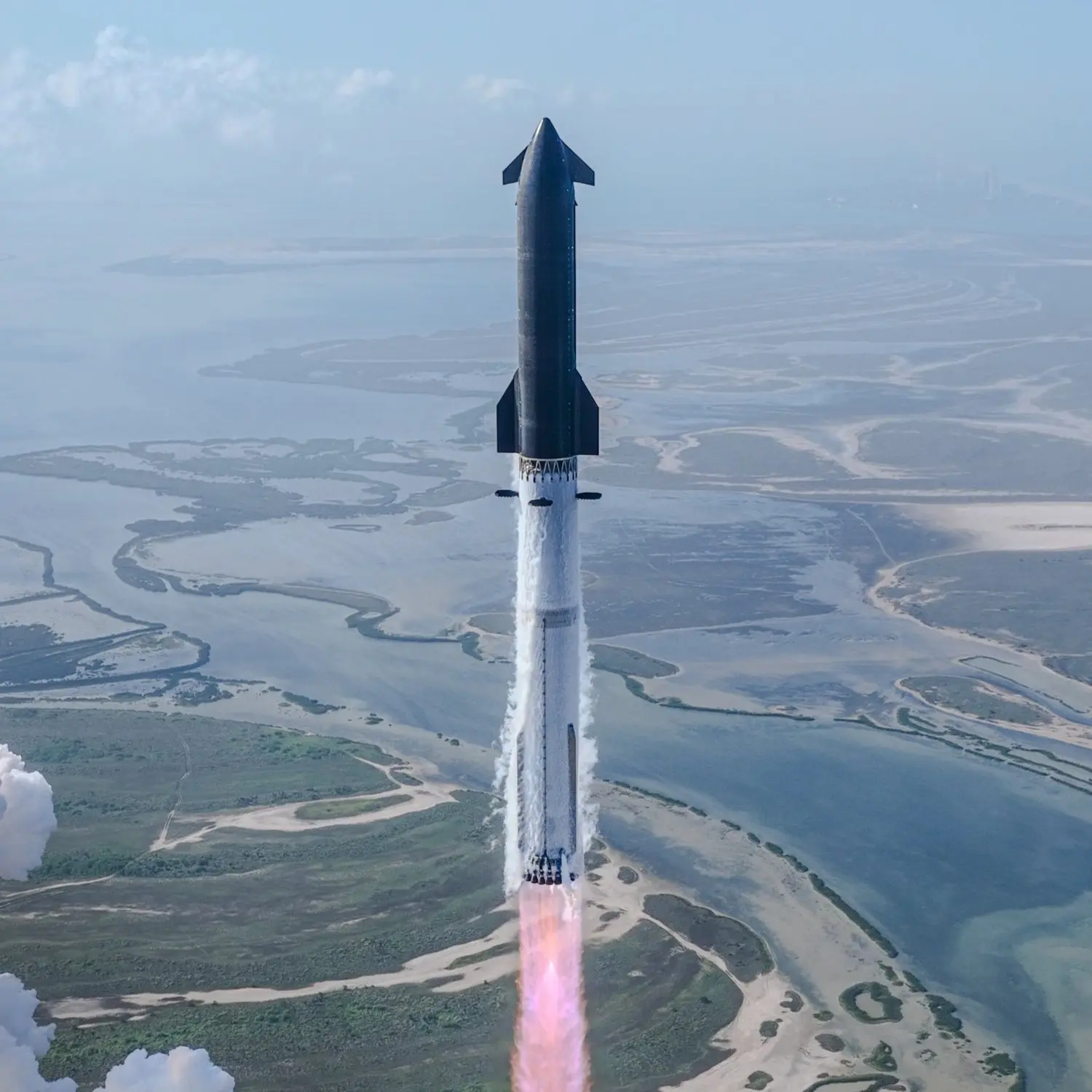
SpaceX’s Starship reached orbit for the first time on September 28, deploying 26 upgraded Starlink V3 satellites before splashing down in the Pacific. It is the first time the world’s largest rocket has carried an operational payload to orbit, and it came a day after Elon Musk wrote that “Starship is 2 to 3 years away from hourly flights.”
The launch is a real engineering milestone. The hourly-flight claim is a separate matter, and the evidence for it has yet to be produced.
What happened on Flight 14
Starship lifted off from Starbase, Texas, at 7:49 a.m. local time. Earlier Starship tests deliberately flew suborbital paths, so this was the first time the ship went all the way to orbit. According to CNN’s live coverage, the vehicle relit an engine and reached an orbital trajectory, then deployed all 26 Starlink V3 satellites, the first time Starship has deployed operational satellites. SpaceX said it made contact with every one of them.
The mission did not run as long as planned. The original plan called for roughly six trips around Earth over nearly ten hours. SpaceX shortened it because of an engine issue during ascent. In a statement quoted by CNN, the company said that “out of an abundance of caution” its flight control team limited the time on orbit and deorbited the ship to a splashdown in the northern Pacific. ABC News put the total mission at about three hours from launch to splashdown and reported that SpaceX called the flight a success because it met both primary objectives: reaching orbit and adding Starlink satellites to the constellation. Space.com noted that, apart from the unflown extra orbits, the flight accomplished its goals. Three of the deployed V3 satellites were assigned to point cameras back at the ship to inspect heat-tile damage and gather data on sample tiles.
One caveat on timing: the Yahoo Finance and TheStreet report that prompted this piece was written on launch day, before the flight ended, and describes the full ten-hour plan. The shortened mission is based on later coverage.
Why the V3 satellites matter
Each Starlink V3 satellite is designed for one terabit per second of downlink capacity and 160 gigabits per second of uplink, according to Starlink’s own figures cited by TheStreet. Across 26 satellites, that implies about 26 terabits per second of designed downlink capacity. TheStreet is careful to note this is network capacity, not the speed an individual subscriber will see. SpaceX spokesperson Dan Huot said the flight was “like 20 Falcon 9 flights in terms of bandwidth.”
ABC described Flight 14 as the first Starship mission to make money for SpaceX, since it placed a revenue-generating payload into the network that is the company’s main source of income.
The money behind the milestone
TheStreet’s financial reading rests on SpaceX’s second-quarter 2026 results, which show why cheaper capacity is valuable:
- Connectivity revenue rose 66 percent to $4.29 billion, roughly 55 percent of total sales.
- Segment operating income rose 79 percent to $1.66 billion.
- Starlink subscribers doubled to 12 million.
- Consumer revenue reached $2.49 billion, up 44 percent, but monthly revenue per subscriber fell to $66 from $85 a year earlier.
Bernstein analyst Douglas Harned, in a September 28 note reported by dpa-AFX, identified $64 billion of potential annual revenue by 2031 from Starlink’s residential broadband business alone. TheStreet also cites Seeking Alpha data showing SpaceX stock trading at about 2,260 times forward GAAP earnings, far above the sector median. That is one data provider’s figure and is included for context, not as a recommendation. Nothing here is investment advice.
The hourly-flight claim
Musk’s claim deserves a careful reading. TheStreet points out that a launch every hour would equal 8,760 flights a year, and stresses that this is illustrative arithmetic, not company guidance. Reaching that pace would take reliable vehicles, rapid turnaround and enough launch infrastructure. Flight 14 strengthens the technical foundation, but the commercial hurdles are untouched.
TheStreet draws a useful distinction between three milestones that each prove something different: reaching orbit, recovering hardware, and flying recovered hardware again. Flight 14 achieved the first. Whether the economics work depends on the third, because frequent reuse is what spreads costs across many missions.
Why it matters beyond Starlink
Launch cost is the variable many ambitious space projects depend on. GyanMuse’s earlier reporting on orbital data centres found that companies from Google to Starcloud are betting that Starship-style reusability will bring launch costs down sharply. A working orbital Starship is a necessary step for that bet, though not a sufficient one, since reuse and cost per kilogram have not yet been demonstrated.
What to watch
- Whether the engine issue is resolved. SpaceX curtailed the mission because of it, so the next flight’s results will show how serious it was.
- Booster and ship reuse. Orbit is one milestone; flying recovered hardware again is the one that changes costs.
- Satellite performance. Musk has said all 26 V3 satellites are operating nominally; sustained service will be the real test.
- Subscriber economics. Revenue per subscriber fell even as the base doubled, so growth has to outrun price declines.
The bottom line
On September 28, Starship did something it had not done before: it reached orbit, delivered a working payload and came back. That is a genuine milestone, and the financial case for it is clear. What it does not yet show is that SpaceX can fly the vehicle often, cheaply and reliably enough to justify Musk’s hourly-flight timeline. Those answers will come from the flights that follow, not from this one.


No responses yet