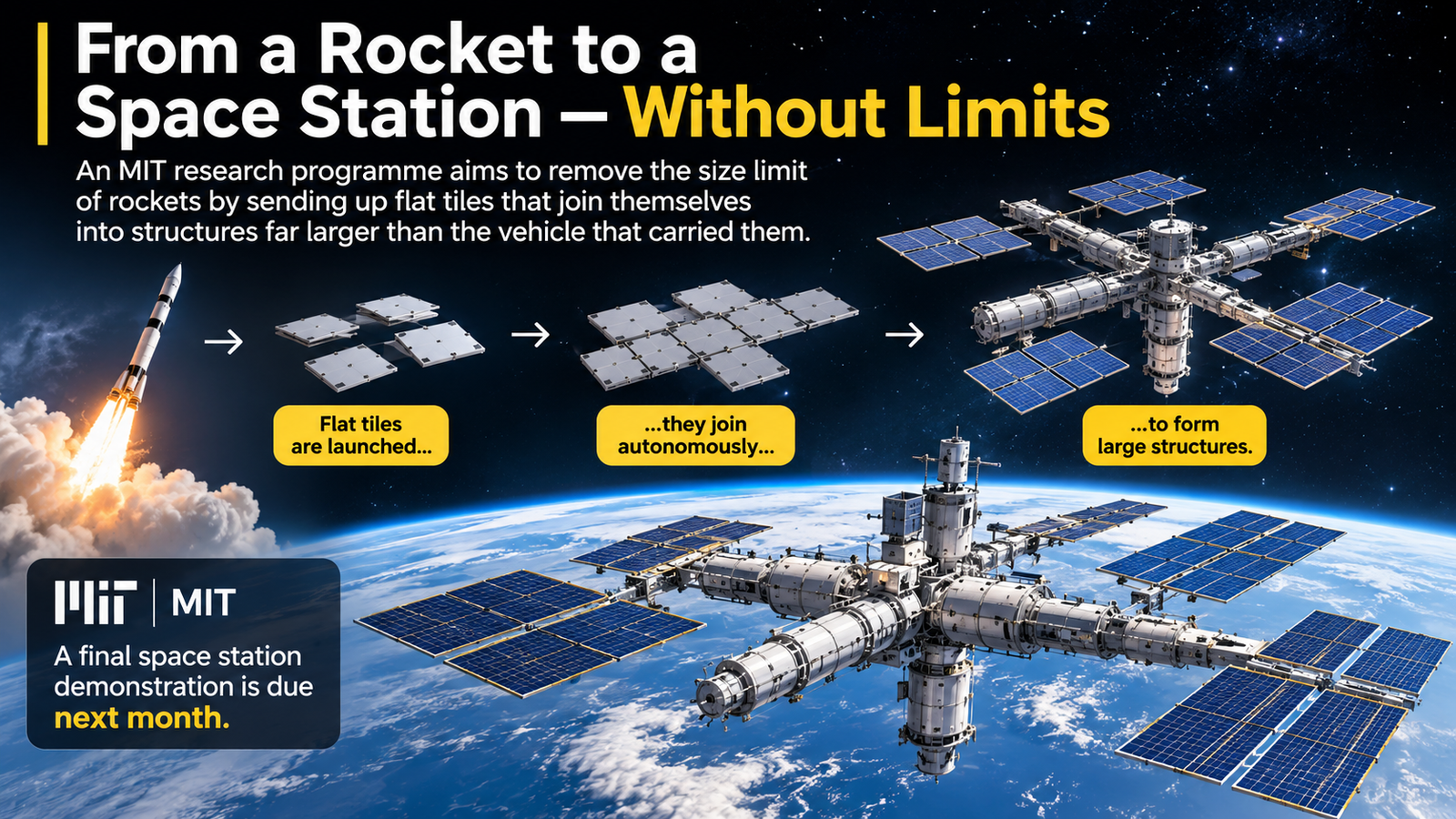
Every spacecraft ever launched has had to fit inside a rocket. A research programme that began at MIT wants to remove that limit by sending up flat tiles that join themselves into structures far larger than the vehicle that carried them. A final space station demonstration is due next month.
The idea is called TESSERAE, short for Tessellated Electromagnetic Space Structures for the Exploration of Reconfigurable, Adaptive Environments. It was designed by Ariel Ekblaw, who earned a master’s degree in 2017 and a doctorate in 2020 at MIT and founded the Space Exploration Initiative at the MIT Media Lab. CNN’s Amy Gunia, whose report was published on October 30, describes the tiles as stackable inside a rocket, released in orbit, and able to join together on their own. “They can self-assemble into something way bigger than the size of the rocket that they came up in,” Ekblaw told CNN.
How it works
According to MIT, the tiles use custom electro-permanent magnets that hold without power and release when current is applied. Sensors and software let each tile detect its neighbours and decide whether to stay joined or separate. In CNN’s account, cameras and artificial intelligence help the tiles form a predetermined shape. The first structure planned was based on a buckyball geometry, a shape made of linked hexagons and pentagons.
What has been tested
The concept has been tried at small scale several times, MIT reported in 2022. It went through several parabolic flights, a suborbital launch with Blue Origin, and a 30-day mission on the International Space Station in which the tiles were confined to a small box. In April 2022, tiles flew to the station on Axiom Space’s AX-1 mission and were tested in a larger contained area before astronauts released them to float freely and assemble. The tests showed good bonding, separation of a poor bond, quick assembly of small groups and a stable dome formation.
From lab to company
The technology has since moved into a startup. Rendezvous Robotics, co-founded by Ekblaw and led by chief executive Joe Landon, announced a $20 million seed round on October 28, according to SatelliteToday and Interesting Engineering. MaC Venture Capital and Toyota Ventures led the round, with participation from the University of Michigan Endowment, Astera and existing investors.
The company’s tiles are hexagons about three feet (roughly one metre) across. Electromagnets move the tiles and latch them together, creating power and data connections. Rendezvous is building the magnets and core assembly systems in-house, and partners can add payloads and propulsion.
Notably, the company is putting habitats second. It originally pitched in-space assembly of large antennas, solar panels, manufacturing sites and habitats, and now prioritises nearer-term missions such as remote sensing and communications. Landon said large habitats and space stations are “all still very much in our vision for the company.” On the commercial logic, he said “having to fit every satellite into a rocket is a ridiculous constraint that we cannot tolerate going forward,” and on repairs: “just send one tile up and replace the one part that needs to be fixed.”
The timeline
- November 2026: A parabolic flight campaign to test electromagnetic actuation and mobility in microgravity.
- December 2026: A final TESSERAE research demonstration on the space station, in which 32 fifth-generation tiles are to assemble autonomously into a three-dimensional structure. It is expected to conclude the existing research programme.
- No earlier than April 2028: A full spacecraft mission on a booked rideshare, in which seven independent tiles join into one spacecraft, separate and reassemble into a new configuration.
What remains unproven
The December test has not happened, and the reports describe planned tests rather than results from the larger tile design. Nothing flown so far has approached habitat scale: the station tests involved small groups of tiles, and the 2028 mission uses seven. The articles name no customers for Rendezvous Robotics and give no cost or mass comparison with conventional spacecraft. Ekblaw’s own stated aim, in MIT’s 2022 profile, is long-term: “to scale humanity’s presence in orbit,” with the hope that “self-assembling space structures in orbit that humans can actually live in” will be achievable within her lifetime.
Whether tiles that bond reliably in a box can bond reliably in the thousands is the question the next two years will start to answer.


No responses yet