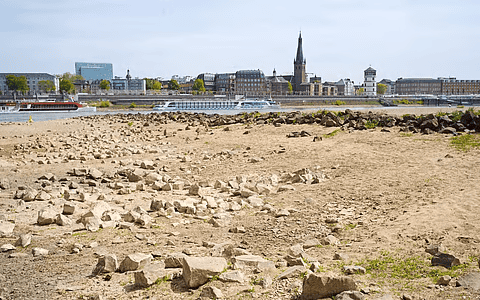
On August 31, 2026, Reuters reported that the Rhine in Germany had “risen sharply” after recent rainfall, with the country’s inland navigation agency confirming that vessels could load more cargo — but cautioning that “shipping difficulties were not yet over.” The navigable water gauge at Kaub, the river’s critical choke point near Koblenz, stood at about 72 cm on Monday, up from 60 cm the previous Friday. That is still barely half of the roughly 150 cm depth needed for barges to sail fully loaded (Reuters, via KFGO; Reuters, via Yahoo Finance).
The rise offers only partial relief. Earlier in August, the Rhine’s level at Kaub had fallen below 10 cm — breaching the previous record low of 25 cm set in 2018 — after Germany and much of Europe endured successive heatwaves and scant rainfall through the summer (Reuters, via KFGO). This is not simply a story about one dry summer. It is the latest, most severe chapter in a longer-running story about what happens when the glaciers that feed one of Europe’s most important rivers begin to disappear.

A river that carries a continent
The Rhine begins as a trickle of glacial meltwater from a small lake called Tomasee, at roughly 2,345 metres in the Swiss canton of Graubünden, before travelling about 1,233 km through Switzerland, Liechtenstein, Austria, France, Germany and the Netherlands to the North Sea at Rotterdam (OurRhine.eu). Along the way it becomes the drinking-water source for an estimated 20–30 million people, and its wider catchment area is home to around 60 million people across nine countries (EBSCO Research Starters; BASF, “Lebensader Rhein”; OurRhine.eu).
Economically, the Rhine is often described as the backbone of the European industrial economy. It links the North Sea ports of Rotterdam and Antwerp to some of the continent’s largest steel, automotive, textile and chemical hubs, and roughly one-fifth of the world’s chemical industry is clustered along its banks (Britannica; Society of Chemical Industry). BASF’s Ludwigshafen complex — the largest contiguous chemical site on Earth — draws around 5 million cubic metres of Rhine water a day for cooling (OurRhine.eu). Around 80% of the roughly 223 million tonnes of cargo moved on German waterways each year touches the Rhine at some point in its journey, carrying grain, coal, minerals, ores and refined oil products (The Chemical Company; Reuters, via KFGO).

The 2026 crisis: how low, how fast, how costly
This year’s drought unfolded in stages. Reports from mid-July already showed barges reduced to sailing 20–30% full through the Kaub chokepoint, with barge transport costs from Rotterdam to Karlsruhe jumping from around €45 a tonne in late June to €125–130 a tonne by mid-July (Baird Maritime). By early August, Bloomberg reported that levels at Kaub had fallen to the lowest since records began in 1880, with forecasters warning it could take weeks of sustained rain to bring the river back toward normal — pushing the crisis potentially into October (gCaptain, citing Bloomberg). German companies reported higher transport costs, logistics bottlenecks and curbed production; some regional governments, including Schleswig-Holstein, temporarily lifted Sunday and holiday trucking bans to help move freight off the river and onto roads.
The chemical industry was hit especially hard. Chemicals account for roughly 11% of commodity traffic on the Rhine, and low water halted large chemical barges, which need at least 40 cm of depth to operate (C&EN/ACS). BASF declared force majeure on various surfactants produced at its European sites due to a shortage of raw materials, though CEO Markus Kamieth told investors the company was “much better prepared” than during the disruptive 2018 low-water episode, having since deployed specialised low-water vessels and shifted more volume to rail and road. For Covestro, more than 30% of finished materials and 75% of raw materials in Europe move via the Rhine — a single barge with 1,500-tonne capacity replaces around 60 trucks — and the company has said it is “up to policymakers to find long-term solutions” to keep the river reliable “even under the conditions of climate change”.
The macroeconomic toll is being tracked closely. Stefan Kooths, an economist at the Kiel Institute for the World Economy, estimated that low Rhine water levels could shave up to 0.2% off German GDP in the third quarter of 2026 (Congress.net, citing Kiel Institute). That echoes the 2018 low-water episode, during which BASF alone lost an estimated €250 million as barges could not deliver raw materials, while the wider disruption was estimated to have cut German GDP by around 0.4% during the worst month of that crisis (OurRhine.eu, citing BASF and IfW Kiel).
Energy, too, is on the line
Low water on the Rhine and its neighbouring rivers is not only a shipping problem — it is an energy problem. Nuclear plants rely on river water for cooling, and hydropower plants rely on river flow to turn turbines. Switzerland’s Leibstadt nuclear plant, with a capacity of over 1,285 MW, draws its cooling water directly from the Rhine (Wikipedia, citing plant operator data). Across Europe more broadly, the same summer heat and low-flow conditions that hit the Rhine forced reactors offline or onto reduced output elsewhere: CNBC reported that nuclear plants in Hungary, Romania and France, and hydropower facilities in Serbia, all had to cut electricity generation in 2026 because there wasn’t enough water for cooling or for driving turbines — raising the risk of blackouts and forcing more expensive electricity imports, according to Liz Saccoccia, water security lead at the World Resources Institute (CNBC). Nuclear Engineering International separately reported that, across Europe, six reactors were closed and 17 more faced output restrictions in June–July 2026 because of heatwaves and critically low river levels, with France — where EDF is legally required to curb output if discharged cooling water would push river temperatures past environmental limits — accounting for the majority of the disruptions (Nuclear Engineering International).
The root cause: the Alps are running out of ice
Why is this happening, and why does it keep getting worse? The proximate trigger each summer is a familiar combination of heatwaves and scarce rainfall. But the deeper, structural cause lies roughly 1,000 metres above the Rhine’s Swiss headwaters, in the shrinking glaciers of the Alps.
Meltwater from Alpine glaciers and snowfields is a critical summer input to the Rhine’s flow, precisely at the time of year — during hot, dry spells — when the river needs it most (HESS/Copernicus). Research cited by Swiss public broadcaster SWI found that more than 25% of the water reaching the Mediterranean via the Rhône in August originates in Alpine glaciers, with similar though somewhat lower shares for the Rhine, Danube and Po — meaning that as glacier ice runs out, these rivers become progressively less reliable in the very months when shipping, agriculture, energy and drinking-water demand all peak (SWI swissinfo.ch).
The glaciers themselves are vanishing at an accelerating pace. Switzerland’s glaciers — the most extensive in the Alps — have lost roughly 38% of their volume between 2000 and 2024, and about 1,000 to 1,200 small glaciers have already disappeared entirely, according to the Swiss Glacier Monitoring Network GLAMOS and the Swiss Academy of Sciences (Brit Brief, citing GLAMOS; CBC). The worst single-year losses on record occurred in 2022, when Switzerland’s glaciers lost about 6% of their remaining volume — nearly double the previous record set in the hot summer of 2003 — followed by a further roughly 4% loss in 2023, meaning the country lost 10% of its glacier ice in just two years, “as much ice being lost in only two years as was the case between 1960 and 1990,” according to the Swiss Academy of Sciences (Al Jazeera, citing GLAMOS; Inquirer/Reuters). 2025 added a further roughly 3% volume loss — the fourth-worst year on record after 2022, 2023 and 2003 — as a snow-poor winter was followed by a hot June that saw snow reserves depleted by mid-July, before cooler July weather offered some relief (ScienceDaily, citing the Swiss Commission for Cryosphere Observation).
By mid-2026, the pattern was repeating with renewed intensity. Matthias Huss, the glaciologist who heads GLAMOS, told broadcaster RTE that a June 2026 heatwave was proving “surprisingly similar” to the record-breaking 2022 season, driven by a combination of low winter snowfall, Saharan dust settling on the ice in March — which darkens the surface and accelerates melting by absorbing more sunlight — and sustained high temperatures. Huss described returning to the Rhône Glacier after a ten-day gap to find that a full metre of ice had melted vertically in that short window alone, calling it “very impressive to see” and directly attributable to the heatwave. He also warned that if current warming trends continue, only “some little remnants of ice” would remain in the Alps by 2100.
“Peak water” — why more melting now means less water later
Counter-intuitively, a melting glacier does not immediately mean less water downstream — for a time, it can mean more. Climate scientists describe this using the concept of “peak water”: as a glacier shrinks, it initially releases extra meltwater on top of normal seasonal snowmelt and rainfall, sometimes boosting annual runoff by 50% or more above pre-warming levels. But this is a one-off dividend. Once the glacier becomes too small to sustain that elevated melt, runoff passes a “turning point” and begins a long-term decline — even as summers keep getting hotter — because there simply isn’t enough ice left to melt (IPCC Special Report on the Ocean and Cryosphere; IPCC SROCC FAQ 2.1).
For the Alps, this turning point has already arrived or is arriving for most small and medium glaciers, which dominate the range — unlike the far larger ice fields of High Mountain Asia or Alaska, where peak water is still some years or decades away in many basins (AntarcticGlaciers.org). A long-term modelling study of the Rhine’s glacierised headwaters, using the HBV-light hydrological model under a high-emissions scenario, confirmed that Alpine glacier contributions to Rhine streamflow have already begun shifting from an increasing to a decreasing trend across many of the river’s 65 modelled sub-catchments, with glaciers projected to have “largely disappeared” from the Alps by the end of this century. Detailed 2022-drought research further found that while melt intensity that year exceeded even 2003, the glaciers themselves were already about 21% smaller in area than in 2003 — meaning many catchments actually produced less glacial meltwater than in 2003 despite the more extreme heat, a direct sign of the declining phase of peak water setting in. Put simply: the Alps are now delivering less of a buffer each time a heatwave strikes, precisely when that buffer is needed most.
What this means for the millions who live along the Rhine
The near-term costs are already visible in freight surcharges, factory slowdowns, and GDP estimates — but the longer-run stakes are broader:
- Industry and trade. Chemical, steel and automotive plants along the Rhine depend on barge deliveries of raw materials and on shipping out finished goods; repeated low-water summers are pushing companies like BASF and Covestro to permanently diversify toward rail, road and specialised shallow-draft vessels, raising structural costs.
- Energy security. With nuclear and hydropower generation across the wider Rhine–Danube basin already vulnerable to low flows and high water temperatures, recurring droughts raise the risk of both electricity shortfalls and higher-cost imports during the hottest, highest-demand periods.
- Drinking water and agriculture. Millions who rely on the Rhine and its tributaries for drinking water and irrigation face a river whose natural summer “insurance” — glacial meltwater — is running out, even as demand for water during heatwaves rises.
- A river already ecologically stressed. The Rhine has recovered substantially since the catastrophic 1986 Sandoz chemical spill near Basel, which killed most life along a 180 km stretch and prompted an €80 billion, multi-decade investment in wastewater treatment across the catchment; 71 fish species, including returning Atlantic salmon, now live in the river again. Recurring low-water, high-temperature summers put that ecological recovery under renewed strain.
The conversation beyond the headlines
The 2026 Rhine crisis has drawn attention well beyond shipping-industry trade press. On Foreign Policy’s economics podcast Ones and Tooze, hosts Adam Tooze (a Columbia University history professor and FP economics columnist) and Cameron Abadi discussed the Rhine’s record-low reading at Kaub — noting the river had fallen to just 21 cm at that gauge, the lowest since records began there in 1880 — and examined why the story resonates so widely: economically, because the Rhine sits at the heart of Germany’s chemical and heavy-industrial base at a moment when German GDP growth is already fragile; culturally, because the river has long been central to German national identity; and institutionally, because the Rhine is managed by one of the world’s oldest international river-governance bodies (the International Commission for the Protection of the Rhine, ICPR) (Foreign Policy, “Germany’s Rhine Is Drying Up”; Ones and Tooze via Podbean).
A river adjusting to a new climate
The rain that lifted Kaub’s gauge from 60 cm to 72 cm by August 31, 2026 was welcome, but it was weather, not a fix. The Rhine’s underlying vulnerability — a shrinking Alpine ice reserve that once reliably topped up the river through every hot, dry summer — is a multi-decade structural shift, not a single bad season. As GLAMOS, the IPCC’s cryosphere assessments, and glaciologists like Matthias Huss have all documented, the Alps have already lost a large share of their ice since 2000, lost it faster in 2022, 2023 and 2025 than almost any point in over a century of records, and are on a trajectory — absent a sharp change in global emissions — toward losing most of what remains by the end of the century. Each such summer, the river the drops the same warning: the meltwater buffer that has quietly underwritten Europe’s industry, energy, drinking water and trade along the Rhine for generations is running out, and what happens next will depend far more on climate trends in the high Alps than on any single season’s rainfall.


No responses yet