This past Monday, Relay — the AI-powered workflow automation startup once positioned as a serious challenger to Zapier — officially shut its doors for paying customers, following free-tier users who had already lost access weeks earlier. Founder Jacob Bank is now heading back to Google as VP of Product for Chrome, taking part of his team with him. Relay had raised over $8 million from investors including Khosla Ventures and a16z, and it built its pitch around a genuinely useful idea: wrapping human approval steps around automated ones, so workflows stayed both fast and trustworthy.
So what happened? The honest answer is that Relay got caught in a squeeze that’s becoming familiar across the AI industry. As OpenAI, Google, and Anthropic have pushed workflow and task automation directly into their core AI products — agents that can trigger actions, connect tools, and complete multi-step tasks without a separate orchestration layer — the case for a standalone automation app got harder to make. Why bolt on a third-party workflow tool when the assistant you’re already using can increasingly just do it?
Relay’s shutdown isn’t an isolated story. It’s the latest entry in a growing list of AI apps, features, and hardware bets that launched with real ambition and real funding, only to be discontinued, rolled back, or quietly folded into something bigger. Here’s a look at some of the most notable names that no longer exist — or exist in a very different form than they launched in.
OpenAI’s “Super App” Redesign

In July, OpenAI attempted to turn ChatGPT into a broader super app, splitting the experience into separate “Chat,” “Codex,” and “Work” modes while rebranding the familiar version “ChatGPT Classic.” The redesign drew immediate criticism for being confusing and cluttered, and OpenAI rolled it back within weeks, restoring the interface users were used to. The company has had more success folding standalone products directly into ChatGPT instead — shutting down its AI browser, Atlas, less than a year after launch, discontinuing the Operator web agent, and steadily shrinking DALL-E’s role as image generation moved natively into the chat experience.
Lesson: Consolidation only works if it doesn’t sacrifice simplicity.
Apple’s Siri AI

Apple unveiled an overhauled, context-aware Siri as a headline feature of Apple Intelligence back in 2024. The release was delayed repeatedly, citing engineering issues, and the delay eventually contributed to a $250 million settlement over how Apple marketed the iPhone 16’s AI capabilities. The redesigned Siri finally arrived in the iOS 27 beta this past July, rolling out to English-language users this month.
Lesson: Overpromising a flagship AI feature you can’t ship on time carries real financial and reputational costs.
Microsoft’s Recall

Pitched as a “photographic memory” for Windows PCs, Recall periodically screenshotted user activity so it could be searched later. The announcement triggered an immediate privacy and security backlash, forcing Microsoft to delay the feature for nearly a year. Even after a redesign, a security researcher recently built a tool that could extract Recall’s captured data, reviving questions about whether the underlying problem was ever fully fixed.
Lesson: A useful idea can still fail if privacy and security aren’t solved before launch, not after public backlash forces a rethink.
Notion Mail

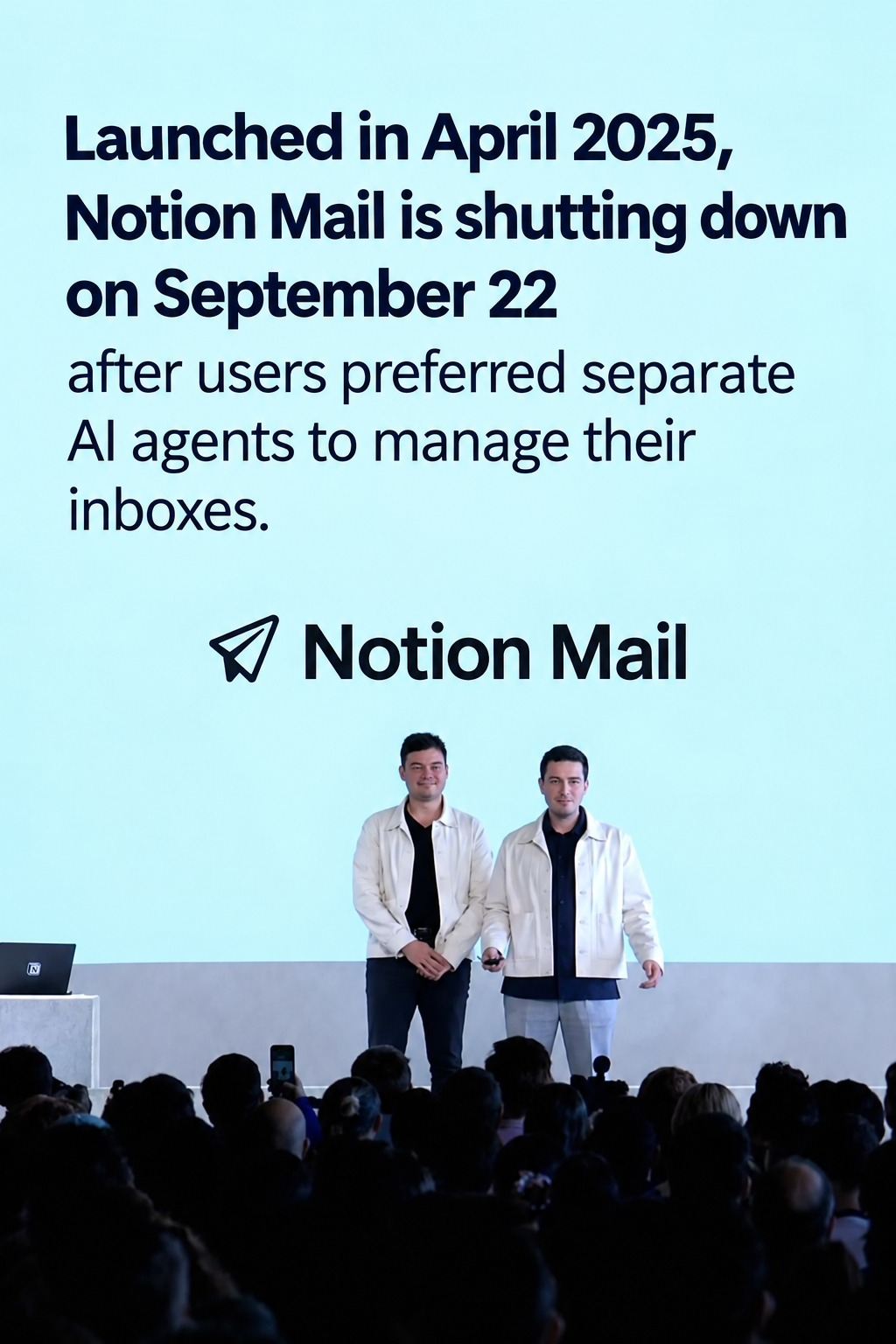
Launched in April 2025 as an AI-driven email inbox designed to organize and automate messages, Notion Mail is scheduled to shut down on September 22. Notion found that users preferred running separate AI agents to manage their inboxes rather than relying on a dedicated AI mail client.
Lesson: Sometimes the market moves in a direction the product wasn’t built for.
Humane AI Pin

One of AI hardware’s most well-known failures, the Humane AI Pin promised to deliver AI features through a wearable device instead of a smartphone. Humane raised $230 million and generated enormous buzz, but the product struggled with performance, and the company was later forced to warn customers to stop using its charging case over battery fire risks. Humane shut down its AI Pin business in February 2025, with most of its assets acquired by HP for $116 million.
Lesson: Hardware is unforgiving — funding and hype can’t compensate for a device that doesn’t reliably do its job.
Rabbit R1

Unveiled at CES in January 2024, the Rabbit R1 was designed as an AI companion device capable of performing tasks on a user’s behalf, and the company said it sold 100,000 units shortly after launch. Early reviews described the device as unfinished, with unreliable performance and few useful integrations. Rabbit has continued updating the R1, repositioning it as a computer-controlling agentic device, and recently announced a new hardware project called “Project Cyberdeck” aimed at vibe-coding.
Lesson: Strong pre-orders don’t guarantee product-market fit if the experience ships half-baked.
Huxe

Built by former developers of Google’s NotebookLM, Huxe turned written information into conversational, podcast-style audio. The company shut down in May 2026, partly because larger platforms with existing audiences — like Spotify, which has been expanding its own AI-powered audio tools — began offering similar experiences natively.
Lesson: Standalone AI apps are especially vulnerable to being absorbed by platforms that already have the audience.
Yupp

Yupp was a free playground letting users compare responses from more than 800 AI models side by side, including models from OpenAI, Google, and Anthropic, while earning cryptocurrency for voting on responses. Despite the novelty, its founders said the platform never achieved strong enough product-market fit to survive, and it shut down in March 2026.
Lesson: Interesting mechanics don’t automatically translate into durable engagement.
Figgs AI

Figgs AI let users create and interact with customizable AI characters for role-play and storytelling, drawing more than a million users between 2023 and 2024. Its developers ultimately shut the platform down, saying it had become too expensive to keep the service free.
Lesson: Popularity without a sustainable monetization path is a ticking clock, not a win.
The Bigger Picture
What connects Relay, Notion Mail, Huxe, and even OpenAI’s own rolled-back redesign is a pattern worth paying attention to: as foundation model companies keep absorbing more capability directly into their core products, the space for standalone AI tools built on top of them keeps shrinking. Some failures came down to safety and privacy issues. Some came down to hardware that simply didn’t work. But a growing number are coming down to timing — good products built on the wrong side of a platform shift.
For anyone building, investing in, or simply relying on AI tools day to day, the takeaway is the same one Relay’s own shutdown teaches: don’t assume any AI product, however well-funded or well-reviewed, is a permanent fixture. Export your data, document your workflows, and stay one step ahead of the next shutdown notice.


No responses yet