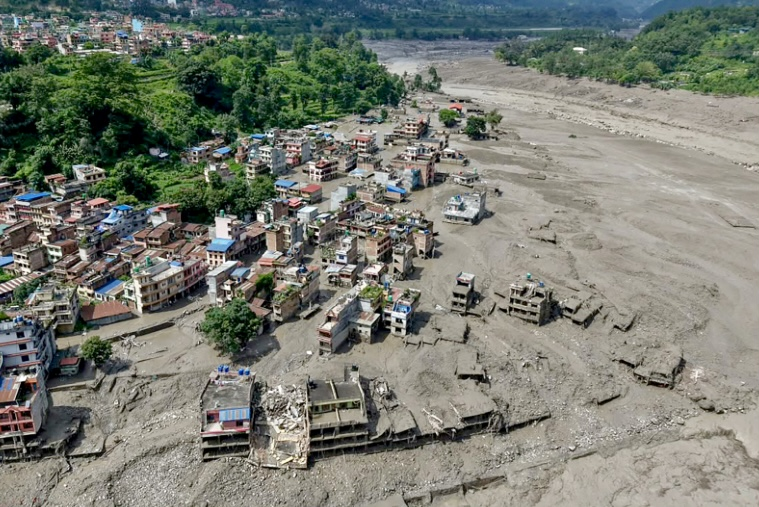
On the morning of August 26, 2026, a chunk of rock and glacier ice roughly 2,000 feet wide sheared off Langtang Lirung, a mountain on the Nepal-China border, and plunged about 7,000 feet into the valley below — releasing energy equivalent to a magnitude 5.2 earthquake. The impact melted the ice almost instantly, picked up sediment and buried ice as it went, and sent a flood wave thundering more than 20 miles downstream at devastating speed. By the time the water reached populated areas, it had destroyed towns, roads, bridges and hydropower infrastructure, killing at least 1,300 people and leaving more than 5,000 more missing, according to figures reported by CNN in mid-September.
Three weeks on, a team of 24 scientists from 14 institutions across nine countries — working with World Weather Attribution (WWA), the research network that specializes in rapidly analyzing the climate fingerprints behind extreme weather disasters — has published its analysis of what actually caused the collapse. Their answer isn’t a single culprit. It’s a “compound event,” in their words: a cascade of geological and climatic factors stacked on top of each other, several of which climate change measurably worsened.
The mountain was already weakened before this year
The WWA team traces part of the story back more than a decade. In April 2015, a magnitude 7.8 earthquake struck Nepal and triggered a major rock-and-ice avalanche on Langtang Lirung’s southern slope — the same mountain that collapsed again this August. That earlier event likely left structural cracks and weaknesses in the rock that never fully healed, creating what the researchers describe as a pre-existing geological predisposition to further collapse.
On top of that inherited fragility, the region experienced unusually heavy snowfall in October and November 2025, adding a large reservoir of meltwater that was sitting in the system well before this year’s summer heat arrived.
Then came the heat — and this is where climate change enters clearly
Using historical climate data and modeling, the WWA researchers found that July and August temperatures in the region were running around 1.5 degrees Celsius (2.7°F) warmer specifically because of human-caused climate change. Zooming out further, they found the region’s annual average temperatures have risen by about 2 degrees Celsius (3.6°F) — significantly above the global average warming trend. Separately, mean temperatures in the Himalayan region in August 2026 alone were running roughly 5°C above normal, with the researchers attributing about 1.5°C of that specific spike to the influence of climate change.
That sustained regional warming has had two compounding physical effects, according to the study:
- Glaciers have been thinning by roughly half a metre (1.6 feet) per year, weakening the ice structurally and widening existing fractures.
- The freezing line — the elevation above which precipitation falls as snow rather than rain — has risen by around 100 metres per decade, which gradually thaws the permafrost that had been holding fractured rock and ice together on steep slopes like Langtang Lirung’s.
As Imperial College London climatologist Dr. Friederike Otto, who co-authored the study, put it, there’s no doubt human-caused climate change played a role in preconditioning the disaster.
The chart below puts the region’s warming in context against the current global average.

What the study is careful NOT to claim
Good attribution science is defined as much by its caveats as its conclusions, and the WWA report is explicit about the limits of what it found. The researchers said they found less of a clear statistical link between global warming and increases in snow or rainfall in the immediate lead-up to the collapse — a gap they attribute partly to how genuinely difficult it is to measure and monitor precipitation and snowpack across the complex, remote, high-altitude terrain of the Himalayas. In other words: the study isn’t claiming climate change directly caused more rain or snow to fall in the days before the disaster. Its clearest, best-supported finding is about sustained regional heat weakening the mountain over years — not a discrete extreme-rainfall trigger on the day itself.
The researchers also stop short of saying climate change caused the disaster outright. Their framing, echoed by Dr. Otto, is that climate change acted as a destabilising factor layered onto a pre-existing geological predisposition — worsening the odds and the severity, rather than being the sole trigger. Mountain hydrologist Walter Immerzeel of Utrecht University, who was not formally part of the WWA team but has studied the region, separately described the event as an unprecedented disaster for the Himalayas.
Meteorology professor Liz Stephens of the University of Reading has pointed out a broader pattern relevant here: in high-mountain regions like Nepal and Tibet, flash floods are often assumed to be rainfall-driven, when in fact they frequently result from complex chains of hazards — landslides and avalanches among them — which makes early-warning systems considerably harder to design and trust than for simple rain-triggered floods.
Was there any warning?
Yes, in retrospect. Satellite imagery analysis found that between January 8 and August 18, 2026 — in the roughly seven months before the collapse — the glacier north of Langtang Lirung had already been moving, shifting by around 10 millimetres over that period. That’s a small, slow signal, but exactly the kind of subtle precursor that ongoing satellite monitoring is meant to catch. Since the disaster, cryosphere analyst Prashant Baral of the Nepali climate research group ICIMOD has warned that the danger isn’t necessarily over: the remaining glacier ice, fractured bedrock and recently disturbed slopes around the collapse site may still be unstable, and fresh avalanche deposits can shift unpredictably through further erosion, seepage or melting of buried ice. Mountain geographer Alton Byers of the University of Colorado Boulder has offered a more reassuring data point since then — a lake that had formed in the impact crater below the collapsed glacier appears to have mostly drained, easing fears of a second sudden release of water downstream.
The scale of what’s left behind
Beyond the human toll, the physical scale of the disaster has been staggering. The United Nations Development Programme’s preliminary estimate put the volume of debris generated by the flooding at more than 2.4 million tons. International recovery pledges had reached roughly $820 million by September 7, according to figures reported by the UN Fund for responding to Loss and Damage and the World Bank. Nepal’s government has said it intends to use the new WWA climate attribution findings as the scientific basis for a formal claim — reportedly in the range of $20 million — to the UN’s Loss and Damage Fund, which exists specifically to support countries disproportionately affected by climate change they did little to cause.
That reflects a point Nepal’s foreign minister, Shisir Khanal, has made publicly: that Nepal is bearing a disproportionate share of climate change’s consequences relative to its own historically minimal contribution to global emissions — a familiar and increasingly urgent argument from mountain and low-lying nations worldwide as climate-linked disasters accelerate.

Why this matters beyond Nepal
Perhaps the most consequential warning in this entire episode isn’t really about what already happened — it’s about what could happen again. Sara Netzer, regional director for the UN’s infrastructure and project-management agency UNOPS, told journalists in Geneva in mid-September that the kind of catastrophic flooding seen in Nepal could recur, in Nepal or elsewhere across the Himalayas, as long as the underlying climate trend continues. Given that the Himalayas host thousands of glaciers across multiple countries — many following the same thinning, permafrost-thawing pattern documented in this study — the Langtang Lirung disaster reads less like an isolated tragedy and more like a preview of a broader regional risk that current early-warning infrastructure, monitoring capacity and international disaster financing are still catching up to.


No responses yet